Miami Luxury Market Intelligence
Miami's $30 Million Home Market Is Breaking Records. What It Means for Luxury Buyers in 2026
Miami-Dade has built a trophy tier that did not exist six years ago. The transaction record is real — but it describes scarce waterfront land, not the whole of Miami, and the difference matters to anyone buying here.
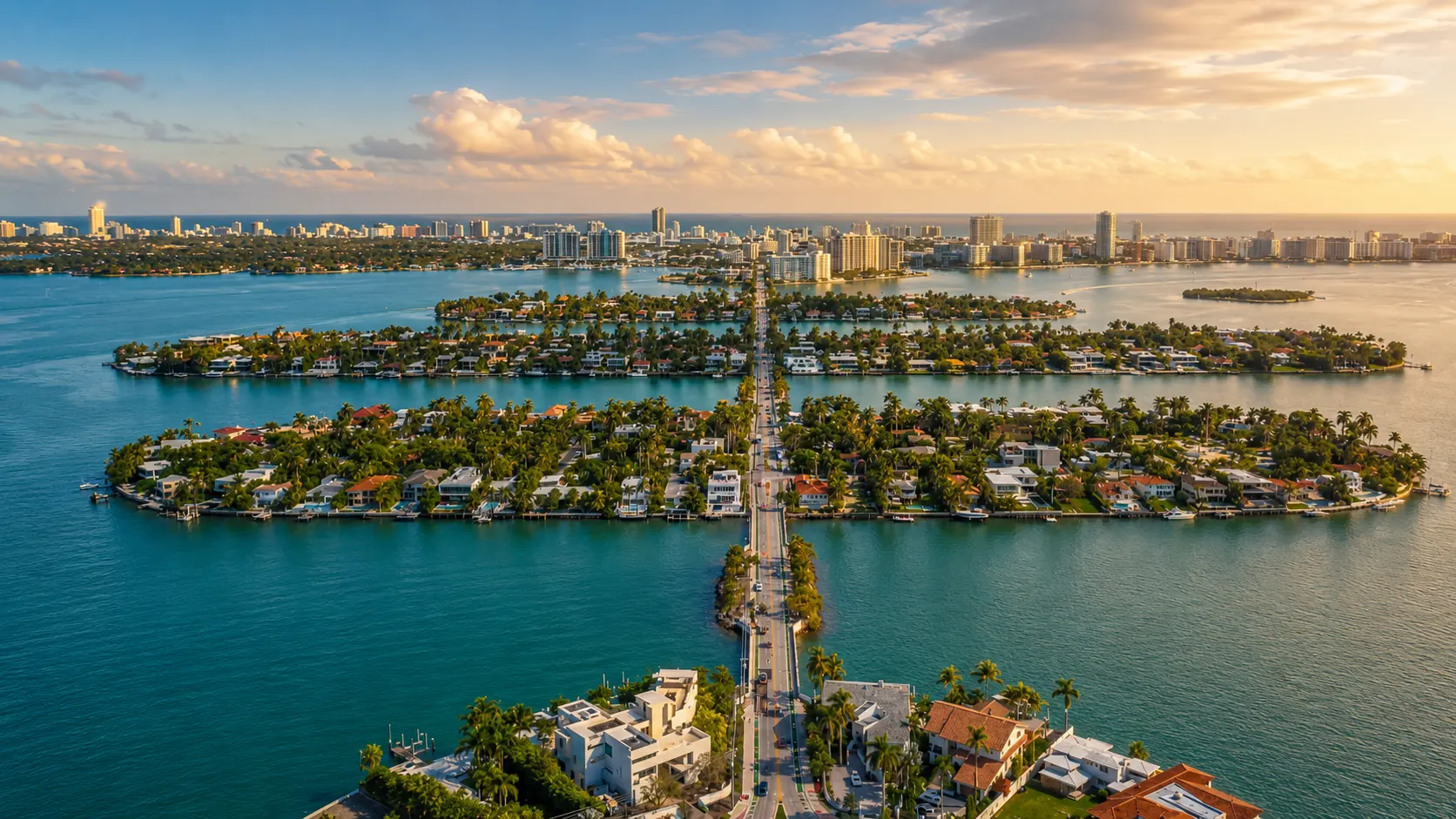
The headline number in Miami's luxury market this year is not a price. It is a count. Miami-Dade County closed 29 single-family sales at $30 million or above in 2025 — a level of activity that, six years ago, would have taken roughly a decade to accumulate.
That is the part of the story worth a buyer's attention. Individual nine-figure sales make news, and this year produced one of the largest in Florida history. But a single extraordinary trade can be an outlier. A sustained, repeated volume of transactions at a price point that barely existed before 2020 is something else: it is evidence that a distinct tier of the market has formed, with its own buyers, its own supply constraints and its own rules.
Below is what the data supports, what it does not, and what a buyer should actually do with it.
Key Takeaways
- Miami-Dade recorded 29 single-family sales at $30 million or more in 2025, against a pre-2020 baseline of no more than three in a full year.
- The county's residential price ceiling has moved three times in four years: approximately $106.9 million in 2022, $120 million in March 2025, and $170 million in March 2026.
- This is transaction-volume evidence. It shows demand met supply at these levels; it does not forecast appreciation for any property.
- Scarcity is the structural driver. Miami can approve more condominium towers. It cannot manufacture more prime waterfront land.
- Miami is not one market. In June 2026, single-family inventory sat at a 4.9-month supply while existing condominiums sat at 12.3 months — a seller's market and a buyer's market in the same county.
- At this level, comparable sales are thin and much of what changes hands is land and orientation rather than a finished house. Representation and diligence matter more than list price.
The progression
Miami-Dade single-family sales at $30 million and above
- Pre-2020 ≤3
- 2024 15
- 2025 29
- 2026 YTD 21
Single-family homes only. Miami-Dade County. Pre-2020 figure is an annual maximum, not an average. 2026 figure is year-to-date as of reporting in July 2026 and is not a full-year total. Source: Analytics Miami research, as reported by the Miami Herald.
Miami's $30 million market has changed
Analytics Miami, the research firm whose figures anchor most current reporting on this segment, counts 29 single-family closings at $30 million or above in Miami-Dade during 2025, up from 15 in 2024. Before 2020, the firm reports, no more than three such sales closed in any single year. Twenty-one had already closed in 2026 as of reporting in July.
Set those numbers side by side and the shape is clear: 2025 volume was close to ten times the pre-pandemic annual ceiling. That is not a price index rising a few percent. It is a price point that was previously exceptional becoming routine.
A second count, drawn from the same research firm and reported by Bloomberg in late July 2026, widens the net to include condominiums as well as houses. On that combined single-family-plus-condominium basis, 24 Miami-Dade homes and condominiums closed above $30 million in the first half of 2026 — roughly double the same period a year earlier — against a full-year 2025 total of 33 measured the same way. Bloomberg also noted that Miami-Dade recorded two such combined-basis sales above $30 million in all of 2019, and that Manhattan logged 17 sales at that level in the first half of 2026, fewer than Miami-Dade over the same stretch.
The two counts are not in conflict; they measure different universes. One tracks houses, the other tracks houses and condominiums together. We separate them here because the distinction turns out to be the whole argument: the constraint driving this market applies to land, and only single-family data isolates land.
Analytics Miami, first-half 2026, all Miami-Dade real estate. Dollar volume, not unit count.
What's driving the ultra-luxury surge?
Buyers arriving with different price anchors
The most cited explanation is wealth migration from higher-cost metropolitan areas — New York, the Bay Area, Los Angeles and elsewhere. Ana Bozovic of Analytics Miami has argued that buyers relocating from those markets are simply accustomed to paying more, and bring that reference point with them. Longtime Miami residents find current pricing shocking; an arriving buyer comparing against Manhattan or Atherton often does not.
This is a plausible and well-supported observation, but it should be held loosely. Migration correlates with the surge; it has not been isolated as its sole cause. Tax policy, interest-rate insensitivity among all-cash buyers, currency movements and the simple fact that Miami now has trophy product to sell all move in the same direction at once. Any single-cause explanation is doing more work than the evidence can carry.
Cash, and what it implies
At the top of this market, financing is largely beside the point. Bloomberg reported that most of the $30 million-plus closings (single-family and condominium combined) in the first half of 2026 were cash purchases. Countywide, MIAMI REALTORS® put cash at 38.1% of all June 2026 closings, well above the national figure of roughly a quarter.
For a buyer, the practical consequence is competitive, not academic: mortgage-rate movements that reshape the mid-market barely register at this level, and a financed offer competes against buyers who can close quickly and without a lender's conditions. That changes what makes an offer attractive, and it is one of the places where structuring matters more than price.
Why waterfront scarcity matters
Here is the distinction that most coverage of this market misses. Miami can build more condominiums. Zoning changes, towers rise, and a single site can deliver hundreds of units. What Miami cannot do is create more prime waterfront land.
The county's ultra-prime tier is concentrated in a handful of places: Indian Creek Village, the Venetian Islands, Star Island and the other Biscayne Bay islands, North Bay Road, Coconut Grove's bayfront, Fisher Island. Several of these are man-made or barrier-island geography with hard physical limits. Indian Creek Village, the roughly 300-acre island widely referred to as the "Billionaire Bunker," reports just 41 waterfront home sites in total. There is no version of the future in which it has 60.
Analytics Miami reports Miami-Dade single-family inventory running about 30% below pre-pandemic levels overall, with the shortage most acute in exactly these waterfront locations. When a fixed number of irreplaceable lots meets a growing pool of buyers who can pay cash, the mechanism producing these transactions is not mysterious.
Price discovery at the ceiling
The clearest way to see this is the county's residential record, which has moved three times in four years:
- 2022 — approximately $106.9 million. The Adrienne Arsht estate in Coconut Grove became the first Miami-Dade residential sale to clear $100 million.
- March 2025 — $120 million. 26 Star Island Drive, a 2.5-acre Miami Beach property, traded — widely reported as a likely teardown.
- March 2026 — $170 million. 7 Indian Creek Island Road, an under-construction estate on roughly two acres in Indian Creek Village, closed on March 2 and set the current county record. It had been listed at $200 million.
Two details in that sequence are more instructive than the prices. The Star Island trade was reported as a teardown candidate, and the Indian Creek property was still under construction at closing. At the very top of this market, buyers are frequently not purchasing a finished house at all. They are purchasing land, position and the right to build — which is precisely what the supply constraint predicts.
For scale: the Florida record stands at $225 million for a Naples compound, and the U.S. record at roughly $238 million for a New York apartment purchased in 2019. Miami-Dade is now competing in that conversation. It was not six years ago.
Miami is not one housing market
Everything above describes scarce trophy real estate. It would be a serious error to read it as a description of Miami generally — and this is where a buyer can lose real money by applying the wrong mental model.
In June 2026, according to MIAMI REALTORS®, Miami-Dade single-family homes carried a 4.9-month supply of inventory, which the association classifies as a seller's market. Existing condominiums in the same county, in the same month, carried a 12.3-month supply — which the same report classifies as a buyer's market. A balanced market sits between six and nine months.
Both conditions are true simultaneously. A buyer looking at bayfront land in Coconut Grove and a buyer looking at a resale condominium in Brickell are operating in markets with opposite dynamics, and advice that ignores this is worse than no advice.
The condominium picture also carries considerations that do not apply to houses at all: Florida's milestone inspection and structural integrity reserve study requirements have reshaped what older buildings must fund, and assessments, reserve adequacy and insurance history now belong in diligence from the first showing rather than the last week of a contract. We covered the supply side of that story separately in our analysis of Miami's improving housing supply and what it means for buyer leverage.
Two segments, opposite conditions, one county. Before you decide what a property is worth, it is worth knowing which market you are actually standing in.
Our buyer representative team works only for the buyer, and eligible buyers may also receive up to 50% of our buyer-agent commission back at closing.
What this means for a luxury buyer
If you are buying in Miami-Dade at the upper end, the market conditions described above translate into a fairly specific set of practical problems.
Comparable sales stop working
Standard valuation assumes a reasonable supply of similar recent trades. When a micro-market produces three or four sales a year and the properties are not alike, that assumption fails. Price per square foot in particular becomes close to meaningless when the improvement may be demolished. Valuation at this level rests on land: lot size and geometry, water frontage in linear feet, and what can legally be built.
Orientation and water access are not details
Two lots on the same street can differ substantially in value on facts that never appear in a listing summary: whether the frontage faces open bay or a narrow canal, which direction the main elevation looks, water depth at the dock, and whether a fixed bridge downstream limits the size of vessel that can reach the property. These are diligence items with real dollar consequences.
You may be buying a project, not a house
Given how often these transactions involve teardowns or unfinished construction, the relevant questions are frequently about entitlement and time: current zoning and setbacks, coastal construction control line implications, seawall condition and who is obliged to replace it, permitting history, and a realistic construction timeline. A property that cannot be built out for three years is a different asset than one that can.
Carrying costs deserve a real model
Property taxes reset on sale in Florida, and at these values the reset is substantial. Windstorm and flood coverage on waterfront property, elevation certificates, and — for island communities — municipal or association obligations all belong in the model before an offer, not after.
Much of the market is invisible
A significant share of Miami's largest trades are negotiated off-market or quietly, without public listing exposure. Reporting on several of the record sales described above noted exactly this. A buyer working only from public listings is, by definition, seeing an incomplete market.
Leverage varies by segment, not by sentiment
In a 4.9-month single-family market, the leverage a buyer has is usually about terms, timing, contingencies and diligence access rather than headline price. In a 12.3-month condominium market, price itself is genuinely negotiable. Knowing which conversation you are in prevents both overpaying and losing a property by negotiating a discount that was never available.
The Buyer Rebate perspective
Our role is straightforward: we represent the buyer independently, help evaluate the transaction, and negotiate where leverage genuinely exists rather than where a script says it should. Eligible buyers may also receive up to 50% of our buyer-agent commission back at closing.
Because the rebate is a share of the buyer-agent commission, it scales with the purchase price — which makes it most consequential in exactly the segment this article describes. Our buyer representative team also approaches transaction risk with a legal-informed perspective, and title and closing coordination may be available through an affiliated title resource where appropriate. Contract-specific legal questions should be directed to qualified Florida counsel.
One practical note for anyone considering new construction: registration timing matters. Where a project's sales gallery registers a buyer first, independent representation can become harder to arrange. It is worth understanding that sequence before visiting.
Sources & Methodology
- Analytics Miami research on Miami-Dade $30 million-plus single-family sales and first-half 2026 dollar volume, as reported by the Miami Herald, July 2026.
- Analytics Miami counts of $30 million-plus closings including condominiums, as reported by Bloomberg, July 24, 2026. Manhattan comparison attributed by Bloomberg to Olshan Realty.
- MIAMI REALTORS® + RWorld / MIAMI MLS, Miami-Dade County residential statistics for June 2026 (months' supply, cash share, median price).
- Miami-Dade residential record sequence: Adrienne Arsht estate, Coconut Grove, approximately $106.9 million, 2022; 26 Star Island Drive, Miami Beach, $120 million, March 2025; 7 Indian Creek Island Road, Indian Creek Village, $170 million, March 2026 — as reported by Bloomberg, The Real Deal, the Wall Street Journal and other outlets.
- Indian Creek Village home-site count as published by the village.
Methodology note. Figures above are third-party research and reporting, not proprietary TheBuyerRebate.com data. Two different $30 million-plus counts appear in current reporting because one series covers single-family homes only and the other includes condominiums; we label each rather than blending them. The 2026 figures are year-to-date at the time of reporting and are not full-year totals. Transaction counts describe completed sales and are not a forecast of future values.
Questions buyers are asking
Does a record $30 million market mean Miami home prices always go up?
No. The data described here measures how many transactions closed above $30 million, not what happens to values afterward. Transaction volume tells you that demand exists at a price level and that buyers were willing to meet it. It does not establish a forecast, and it says nothing about any individual property. Miami-Dade has also shown that different segments move differently at the same time.
Is the $30 million-plus market the same as the broader Miami housing market?
No, and treating them as one market is the most common mistake we see. In June 2026, Miami-Dade single-family homes carried a 4.9-month supply, which the Miami Association of Realtors classifies as a seller's market, while existing condominiums carried a 12.3-month supply, which the same report classifies as a buyer's market. A buyer can face scarcity in one segment and real negotiating room in another during the same week.
How does a buyer rebate work on a luxury purchase?
We represent the buyer, and where a buyer-agent commission is paid on the transaction, eligible buyers receive up to 50% of our buyer-agent commission back at closing, subject to transaction terms, lender/closing requirements, broker/project cooperation where applicable, and buyer eligibility. It is credited at closing rather than paid as a separate promotion. Because the rebate is a share of commission, the amount scales with the purchase price.
Why does independent buyer representation matter more at the top of the market?
At $30 million and above, comparable sales are thin, many trades are negotiated off-market, and a meaningful share of what buyers acquire is land, orientation and entitlement rather than a finished house. Those conditions reward advisers who work only for the buyer. Contract-specific and title questions should be directed to qualified Florida counsel.
Next step
Know which market you're buying in.
Whether you're evaluating waterfront land or a resale condominium, we represent the buyer only — and eligible buyers receive a share of our commission back at closing.
Check Your Rebate Schedule a Confidential Call
Eligible buyers receive up to 50% of our buyer-agent commission back at closing, subject to transaction terms, lender/closing requirements, broker/project cooperation where applicable, and buyer eligibility.