Pre-Construction Market Intelligence · Boca Raton, Florida Español Call (786) 550-6294
What happened Rebate calculator Why it matters Brand vs. developer How the structure works Construction financing Deposits Due diligence Representation What's next FAQ
HomePre-Construction › Market Intelligence

Pre-Construction Market Intelligence

Mandarin Oriental Residences Boca Raton Faces Foreclosure

A major foreclosure action involving the development provides an important case study in construction financing, developer risk and due diligence for luxury pre-construction buyers.

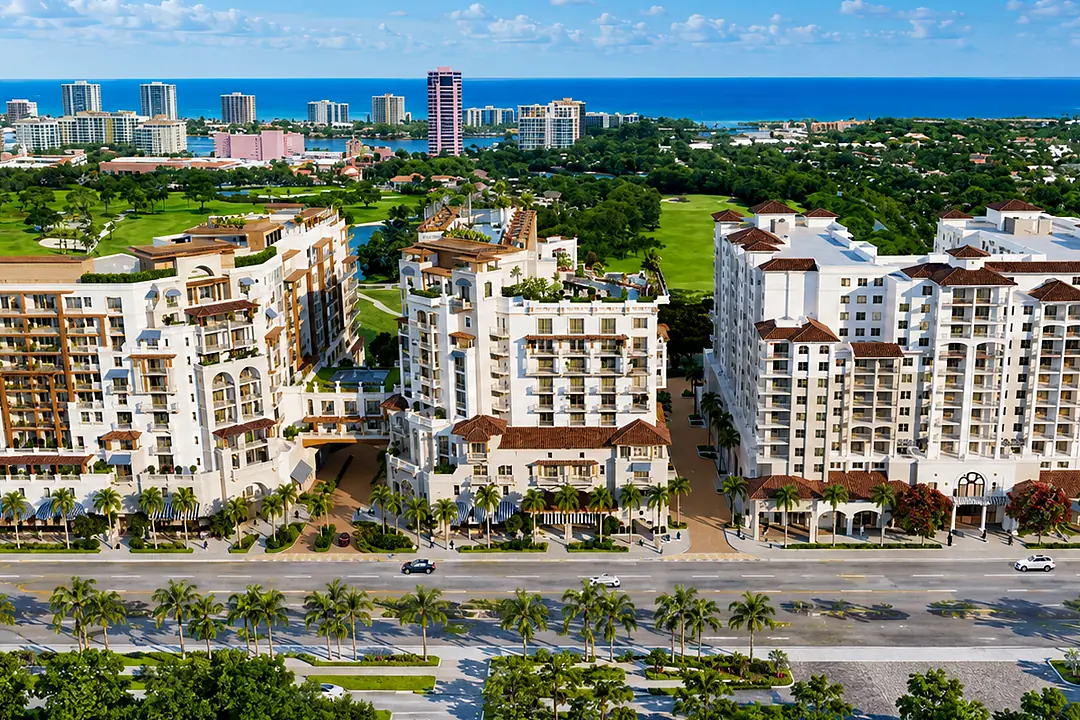
Aerial view of a Mediterranean-style luxury mixed-use development in downtown Boca Raton, Florida, with the Intracoastal Waterway and Atlantic Ocean in the distance
Downtown Boca Raton, where a $417.7 million foreclosure action filed in July 2026 targets the site of the long-delayed Mandarin Oriental Residences. Photograph provided for editorial context; it is not a depiction of the specific building or of construction conditions at the property.

Section 01

What happened

A lender group filed a $417.7 million mortgage foreclosure action on July 17, 2026 against the entity developing the Mandarin Oriental Residences at 105 East Camino Real in Boca Raton. The complaint contains allegations. It does not, by itself, determine who ends up owning the property or whether the building gets finished.

The plaintiff is Via Mizner Lender 1 LLC, which reporting identifies as representing a lender group that includes Athene Annuity and Life Company and Athora Lux Invest NL-CRE Direct Lending Fund, affiliated with Apollo Global Management. The defendant borrower is Via Mizner Owner III, LLC — an affiliate of Boca Raton-based Penn-Florida Companies, led by Mark A. Gensheimer. The action was first reported by the South Florida Business Journal on July 22, 2026 and by The Real Deal on July 23, 2026.

According to those reports, the lender group alleges that the borrower missed monthly interest payments beginning in June 2024 and continuing into 2025, failed to repay the loan when it matured in September 2025, missed a February 2025 completion deadline set by the loan documents, and permitted the hotel's management agreement to be terminated. The lender says the amount owed totals $417.7 million: a $270 million principal balance, roughly $24.6 million advanced to cover project expenses, plus accrued interest, fees and costs.

Every one of those items is an allegation in a complaint. None has been adjudicated. The borrower has the right to respond, contest the claims, negotiate, refinance, or pursue any other remedy available to it.

The complaint also names contractors that recorded construction liens against the project and condominium buyers who hold units under contract — including several buyers who had already sued the developer. Naming those parties is standard practice in a Florida mortgage foreclosure: a foreclosing lender joins parties whose recorded interests would otherwise survive the action. It is a procedural step, not an accusation against the buyers.

Key points

  • A lender group filed a $417.7 million foreclosure complaint on July 17, 2026 against Via Mizner Owner III, LLC, the entity developing the condominium at 105 East Camino Real.
  • The allegations include missed interest payments, failure to repay at the September 2025 maturity, a missed February 2025 completion deadline, and termination of the hotel management agreement.
  • The adjacent Mandarin Oriental hotel at 103 East Camino Real is owned by a different Penn-Florida affiliate that filed Chapter 11 in December 2025; a bankruptcy auction of that site was reported as scheduled for August 14, 2026.
  • Thirteen buyers have sued the condominium's development entity over missed delivery deadlines. One couple obtained a judgment of roughly $1.98 million; another reached a $2.1 million settlement.
  • The outcome of the foreclosure remains unresolved. A foreclosure filing does not itself determine the ultimate outcome of the development.
$417.7M
Claimed by the lender group, including $270M principal
Jul 17, 2026
Date the foreclosure complaint was filed
2015 → 2017
Year announced and the original target completion

Key facts

Project
The Residences at Mandarin Oriental, Boca Raton — the condominium component of the Via Mizner development
Location
105 East Camino Real, Boca Raton, Florida
Site
Approximately 1.49 acres
Residential units
85 condominium residences as described in July 2026 reporting; earlier coverage has cited 88. Buyers should treat unit counts as reported figures and confirm against the developer's offering documents.
Adjacent hotel
Approximately 163–164 keys at 103 East Camino Real, held by a separate ownership entity
Development entity (seller)
Via Mizner Owner III, LLC
Developer group
Penn-Florida Companies (Mark A. Gensheimer)
Luxury brand
Mandarin Oriental Hotel Group — brand licensor and hotel operator, not the developer or seller
Plaintiff lender
Via Mizner Lender 1 LLC, reported as representing a group including Athene Annuity and Life Company and Athora Lux Invest NL-CRE Direct Lending Fund, affiliated with Apollo Global Management
Amount claimed
$417.7 million — $270 million principal, approximately $24.6 million in advances, plus interest, fees and costs
Filing date
July 17, 2026 (Palm Beach County)
Status
Pending. Allegations are unadjudicated as of July 27, 2026.

Straight answers

Is the project in foreclosure? The development entity faces a foreclosure lawsuit. A lawsuit is a claim, not a completed foreclosure, and the lender does not own the property by virtue of filing it.

Does this mean the building will never be finished? No. A foreclosure lawsuit does not by itself establish that a development will fail or that construction will stop. Distressed projects are frequently completed under restructured debt, new capital, or new ownership.

Is Mandarin Oriental the developer? No. Mandarin Oriental Hotel Group is the hospitality brand. The seller and developer of the residences is Via Mizner Owner III, LLC.

What should pre-construction buyers take from this? Prestigious branding does not eliminate developer, financing or completion risk. Those are separate things, evaluated separately.

How we're treating this story. This is independent buyer-advisory analysis, not litigation reporting and not legal advice. We describe what has been filed and publicly reported, distinguish allegations from adjudicated facts, and use the situation to explain how pre-construction transactions are actually structured. Neither Jordan Real Estate nor TheBuyerRebate.com represents any party named here, and we do not market this development.
Buyer economics

Estimate your buyer rebate

See how buyer-agent compensation could translate into a potential closing credit on an eligible pre-construction purchase. This is a general South Florida luxury pre-construction estimator. It is not tied to any commission structure at Mandarin Oriental Residences, Boca Raton or to any other specific development.

Estimated buyer rebate Illustration only
$3,000,000
Example buyer-agent commission
$90,000
Your estimated rebate — up to
$45,000

Illustration only — not a quote, an offer, or a guarantee. Commission rates are set by developers and vary by project; not every project or transaction offers buyer-agent compensation. Your actual rebate, if any, depends on the compensation actually received, your buyer-representation agreement, lender approval of credits, and closing terms. We confirm your specific figure in writing before you commit.

Check your rebate

Section 02

Why this matters to pre-construction buyers

The larger lesson is not that branded residences are inherently risky. It is that branding and development risk are two different things.

A pre-construction purchase is a contract to buy something that does not exist yet, from an entity that must survive long enough to build it. The sales gallery is designed to make the first half of that sentence feel effortless. The second half is where a buyer's real exposure lives — and it is knowable in advance, through documents that buyers are entitled to review before they commit.

Five categories of risk are worth separating in your own analysis, because they can move independently of one another.

Risk 01

Developer risk

Can the development organization actually execute and complete the project? Track record is the most useful available proxy: prior deliveries, how far behind schedule they ran, how prior financings were resolved, and how the organization behaved with buyers when things went wrong.

Risk 02

Financing risk

How is construction funded, and what happens when the borrower and lender disagree? Construction loans carry covenants, draw conditions, completion deadlines and maturity dates. A dispute over any of them can escalate into default, acceleration and foreclosure — as the Boca Raton complaint alleges here.

Risk 03

Completion risk

What extension rights does the developer hold, and how far can delivery legally move? Marketing dates are estimates. The enforceable dates — and the buyer's rights when they pass — live in the purchase agreement and in Florida law, not in the brochure.

Risk 04

Entity risk

Which company is actually obligated to deliver your residence? In Florida pre-construction it is nearly always a single-purpose entity formed for that project — not the parent development company whose reputation was used to sell it, and not the hospitality brand on the door.

Risk 05

Contract risk

What rights and remedies does the purchase agreement actually give you? Deposit treatment, permitted modifications, cancellation triggers, assignment restrictions and dispute provisions vary considerably between developers — and they are negotiated, or at least understood, before signing rather than after.

The pattern

These risks compound

Delay increases carrying costs. Carrying costs pressure the loan. Loan pressure can trigger default. Default can trigger litigation, which further delays delivery. This is the sequence visible in the public record of many stalled projects — and it is why an early, unglamorous look at financing and contract terms matters more than a later look at finishes.

Section 03

The brand is not the developer

A luxury buyer who sees a name like Mandarin Oriental reasonably associates the project with a globally established hospitality company. In a branded residence, the brand is one component of a much larger transaction — and usually not the component that owes you a finished home.

In this instance, the distinction is not a matter of interpretation. It is stated in the project's own published offering language. Marketing materials for The Residences at Mandarin Oriental, Boca Raton identified Via Mizner Owner III, LLC as a newly formed entity and the sole offeror of the units, expressly noted that Penn-Florida Capital Corp. and the other Penn-Florida Companies are affiliated with the developer but are not the developer of the residences, and disclosed that the developer had obtained rights to use the Mandarin Oriental name and trademarks under non-exclusive license agreements that could be terminated.

That disclosure is not unusual or improper — variants of it appear in branded-residence offerings throughout South Florida. It is simply precise about something the marketing is not designed to emphasize: the brand licenses its name and, where a hotel is involved, may operate the hotel under a management agreement. The obligation to build and deliver your residence sits with the project entity.

The current foreclosure complaint makes that separation concrete. Among the alleged defaults is that the borrower permitted the hotel's management agreement to be terminated. Read carefully, that allegation says something about the borrower's compliance with its loan covenants. It is not an allegation against the hospitality company, and nothing in the public record suggests that Mandarin Oriental Hotel Group caused the project's financial distress or is itself in financial difficulty. We were not able to independently confirm the current brand status of the residences component, and buyers evaluating any branded project should verify current brand arrangements directly rather than assuming continuity.

A luxury name does not replace due diligence

A prestigious hospitality brand can add service standards, design identity, operating expertise and market recognition. It does not necessarily guarantee the developer's construction financing, completion obligations or financial performance.

Branded-residence structures vary considerably from project to project. Some involve a full hotel management agreement and shared amenities; others are a trademark license with defined service standards and little more. The only reliable way to know which one you are buying is to read the branding and disclosure provisions in the offering documents for that specific project.

The structure behind the rendering

How a branded pre-construction development works

Six parties typically stand between a rendering and a delivered residence. Buyers usually meet one of them — the sales gallery. Understanding the rest is what makes a purchase agreement readable.

Tier 01 · Brand
Luxury brand / hospitality operator
Licenses its marks and, where a hotel is involved, may operate it under a management agreement. Sets service and design standards. Typically does not own the land, fund construction, or sell you the residence.
Tier 02 · Sponsor
Developer / project sponsor
The organization whose track record markets the project. It assembles the capital, the team and the entitlements — and it is usually not the entity that signs your purchase agreement.
Capital
Construction lender
Funds construction through scheduled draws against covenants, budgets and completion deadlines. Holds a recorded mortgage and, on default, may pursue foreclosure.
Tier 03 · Your counterparty
Project-specific ownership entity
A single-purpose company formed for this one development. It owns the land, borrows the money, and is the seller named in your purchase agreement. Its obligations are generally limited to its own assets.
You
Buyer
Contracts with the project entity — not with the brand and not, usually, with the parent sponsor. Deposits are governed by the contract and by Florida condominium law.
Tier 04 · Build
General contractor & subcontractors
Build the project. When they are not paid, they can record construction liens against the property — which is why contractors frequently appear as defendants in a foreclosure action.
Tier 05 · After delivery
Condominium association
Takes over governance and operation from the developer at turnover, on the timetable set by Florida law and the condominium documents.

Project structures vary. This diagram is a simplified educational illustration, not a description of every branded development. In a specific transaction, the identity of each party — and which one owes you what — is established by the offering documents, the purchase agreement and the recorded condominium documents, reviewed with your own counsel.

Section 04

Construction financing, explained

Why should someone buying a $2 million to $10 million residence care how the developer borrowed money? Because the loan, not the brochure, sets the schedule the project has to keep.

A typical South Florida luxury development is financed in stages. The sponsor first acquires the site, often with land financing, and contributes equity. Before a construction lender funds, it usually requires that a defined share of equity be in place and that a defined level of presales be achieved — presale requirements are a lender's way of testing demand before advancing hundreds of millions of dollars against a hole in the ground.

The construction loan itself is not a lump sum. It funds through a draw schedule: the borrower requests money as work is completed, and the lender releases it after inspection against the approved budget. Around that mechanism sit covenants — promises about how the borrower will operate. Common covenants include hitting construction milestones, completing by an outside date, maintaining insurance, keeping the project lien-free, and preserving key agreements such as a hotel management contract.

Two dates then govern everything: the completion deadline and the maturity date. Missing a payment is one kind of default; missing a covenant is another; failing to repay or refinance at maturity is the one that most often forces the issue, because at maturity the entire balance comes due at once. If the project is not finished and the capital markets have moved — higher rates, tighter credit, higher construction and insurance costs — refinancing can become difficult precisely when it is most needed.

When a default is declared, a lender's remedies typically include accelerating the debt, charging default-rate interest, advancing funds to protect its collateral and adding them to the balance, seeking a receiver, and filing to foreclose the mortgage. The Boca Raton complaint reflects several of those elements, including approximately $24.6 million the lender says it advanced for project expenses.

A lender filing foreclosure does not automatically mean a project cannot ultimately be completed. Foreclosure is a legal process for enforcing a debt against collateral. It is often the beginning of a negotiation rather than the end of a project.

Possible paths from here — in general, not as a prediction

Depending on circumstances, distressed development loans have historically resolved in a number of ways:

  • Restructuring or loan modification — revised terms, extended maturity, new milestones.
  • Refinancing — a new lender replaces the existing debt.
  • New capital — preferred equity or a joint-venture partner recapitalizes the project.
  • Asset sale — the sponsor sells the project, in whole or in part, to a buyer who completes it.
  • Lender-controlled disposition — the lender takes title through foreclosure, a deed in lieu, or a credit bid at auction, then sells or completes the asset.
  • Litigation resolution — settlement, dismissal, or a negotiated outcome among lender, borrower and other claimants.
  • Continuation under new ownership — the project is completed by a different owner, potentially under different terms and sometimes under a different brand.

These are possibilities, not forecasts. We take no position on which, if any, applies to this matter.

Who gets paid first

If a foreclosure does proceed to a sale, the order of payment matters enormously and is frequently misunderstood. As The Real Deal noted in its reporting on this action, a mortgage lender is generally paid ahead of construction lienholders and most other creditors. Simplified, the ordinary priority looks like this:

1

Recorded first-mortgage lender

Principal, accrued interest, protective advances, fees and costs, to the extent proven and allowed.

2

Junior recorded interests, by priority date

Subordinate mortgages and other recorded encumbrances, generally in the order they were recorded.

3

Construction lienholders

Contractors and suppliers with recorded liens. Priority depends on Florida lien law and the timing of the notice of commencement relative to the mortgage.

4

Unsecured claims, including certain buyer claims

Claims not secured by the property. Deposits held in escrow are a different question — see below — but deposit amounts already released and spent are typically an unsecured claim against the entity.

Actual priority in any case is determined by the court on the specific record before it, including recording dates, lien law defenses and any subordination agreements. This ordering is educational.

Section 05

What happens to buyer deposits

This is the question every pre-construction buyer asks, and the honest answer is that it depends — on the contract, on how the deposits were handled, on the escrow arrangements, on Florida condominium law, and on the specific facts of the transaction.

We will not tell you that deposits are guaranteed. We will not tell you that buyers lose them. Both statements are wrong as general propositions, and neither can be responsibly applied to a matter that has not been decided.

What we can do is explain the framework, because it is public law and most buyers have never seen it.

The Florida framework, in plain English

Section 718.202 of the Florida Statutes governs deposits on condominium units that are not yet substantially complete. In broad outline:

  • The first 10% is escrowed. Payments up to 10% of the purchase price must be paid into an escrow account held by a qualified, independent escrow agent — not the developer.
  • Amounts above 10% go to a special escrow account and may not be used by the developer before closing, except as the statute allows.
  • That exception is the important one. If the purchase contract expressly permits it, the developer may withdraw the funds above 10% once construction of improvements has begun and use them for actual construction and development costs. The statute defines what qualifies — and specifically prohibits using those funds for sales commissions, marketing, loan fees, interest, attorney or accounting fees, or insurance.
  • A contract that permits this must say so, conspicuously. Florida requires a specific legend in boldface on the first page, immediately above the buyer's signature line.
“ANY PAYMENT IN EXCESS OF 10 PERCENT OF THE PURCHASE PRICE MADE TO DEVELOPER PRIOR TO CLOSING PURSUANT TO THIS CONTRACT MAY BE USED FOR CONSTRUCTION PURPOSES BY THE DEVELOPER.” Statutory legend required by Fla. Stat. § 718.202(3). If this appears on the contract you are signing, deposits above 10% can be spent on the building before you close.

The statute also provides that funds are released from escrow to the buyer, with interest, if the buyer properly terminates the contract under its terms or under the chapter; and that failure to comply with the section's escrow requirements renders the contract voidable by the buyer, with a refund of sums deposited plus statutory interest. Those provisions are why deposit disputes so often turn on precise questions of contract termination and escrow compliance rather than on the developer's financial condition.

Applied to the current situation, reporting on the Boca Raton action has noted that if the foreclosure moves forward, buyers would be expected to recover the portion of their deposits still held in escrow, while amounts already released to fund construction would be considerably more difficult to recover. That reporting describes a general expectation, not a court ruling, and individual outcomes will depend on individual contracts and on how each buyer's funds were handled.

Separately, the public record shows that buyers at this project have pursued their own remedies with mixed and case-specific results: thirteen buyers have sued the development entity over missed completion deadlines, one couple obtained a judgment of approximately $1.98 million, and another reached a $2.1 million settlement. Those outcomes reflect the terms of those particular contracts and the facts those buyers proved.

Never assume a deposit is protected simply because the project carries a famous brand

Before signing, a buyer should understand, in writing: where the deposit is held and who the escrow agent is; when and under what conditions funds may become available to the developer; what contractual protections exist beyond the statutory minimum; what events trigger refund rights; what happens if completion is materially delayed; what the developer is permitted to modify; and how long the developer may extend the completion date.

Buyers should have qualified Florida legal counsel review the condominium documents and purchase agreement for their specific transaction. Neither Jordan Real Estate nor TheBuyerRebate.com provides legal advice.

Section 06

What buyers should investigate before signing

This is the list we work through with clients on any pre-construction contract, at any price point. It takes a few hours and it is the highest-return work in the entire transaction.

Developer track record

Prior completed projects, how closely they delivered to the announced schedule, litigation history, and how prior financings were resolved. A developer's behavior in its last difficult cycle is the best available predictor of its behavior in the next one.

The development entity

Identify the actual seller named in the purchase agreement — usually a project-specific entity — and understand what stands behind its obligations. Ask whether any parent guarantee exists, and get the answer in writing.

Construction financing

Whether construction financing is in place, what is publicly recorded against the property, and what presale or equity conditions applied. Recorded mortgages, lis pendens filings and construction liens are matters of public record in the county where the property sits.

Deposit structure and escrow

The full deposit schedule, the identity of the escrow agent, which portions are held versus released, and whether the contract contains the statutory legend permitting use of funds above 10% for construction.

Completion provisions

The estimated completion date, the outside completion date, the developer's extension and force-majeure rights, and what remedies you have if those dates pass. Estimated dates and enforceable deadlines are not the same thing.

Material changes

What the developer may alter without your consent — unit layout, square footage tolerances, finishes, amenity program, unit mix, even the brand — and what triggers a right to rescind.

Cancellation rights

Statutory rescission rights, contractual termination triggers, notice requirements and deadlines. Rights that exist but are not exercised on time are frequently lost.

The brand agreement

What the branding actually delivers: a trademark license, a hotel management agreement, defined service standards, access to hotel amenities — and what happens to your residence, your fees and your rights if the brand relationship ends.

Resale and leasing restrictions

Assignment rights before closing, flip restrictions, developer consent requirements and transfer fees, plus minimum lease terms and rental frequency limits after closing. These provisions materially affect your exit.

Closing costs beyond the price

Developer closing costs are often substantial in South Florida new construction — typically including developer contribution or capital contribution fees, documentary stamps and title charges allocated to the buyer, resort or working-capital fees, and utility and reservation charges. Model them before you sign, not at the closing table.

Broker compensation and rebate treatment

Whether the developer offers buyer-agent compensation on your specific residence, what registration procedure protects it, and whether a rebate of that compensation can reduce your effective acquisition cost. This has to be established before you register anywhere.

Buyers working across several projects can start with our Miami pre-construction buyer representation guide, which covers this sequence in depth, or browse the Florida pre-construction rebate hub for project-level detail.

Section 07

Why buyer representation matters

The sales gallery is staffed by professionals who represent the developer. That is their job, and they are typically very good at it. Independent buyer representation puts someone with the same fluency on the other side of the table.

On a pre-construction purchase, that work looks less like finding a unit and more like underwriting a transaction:

  • Comparing projects across developers, delivery timelines and deposit structures rather than one project at a time
  • Understanding what incentives a developer is currently offering, and to whom
  • Assessing competing inventory — including resale alternatives that may deliver sooner at a lower effective cost
  • Negotiating the economic terms that are actually negotiable in new development, which are rarely the headline price
  • Analyzing the deposit schedule and how funds are held
  • Identifying closing-cost exposure beyond the contract price
  • Examining delivery timelines and the developer's extension rights
  • Reviewing publicly available project history — recorded mortgages, liens, litigation, prior deliveries
  • Coordinating with your attorney so the legal review has the commercial context it needs
  • Maintaining the relationship with the developer through reservation, hard contract and construction
  • Understanding how broker compensation is structured on your specific residence
Buyer representation is not legal representation. Legal review should be performed by qualified legal counsel. Buyer representation and legal representation serve different but complementary functions in a major pre-construction purchase. A broker does not replace an attorney, and we do not attempt to.

One sequencing rule matters more than any other, and it is the one buyers most often break: contact your own representative before you register with a developer, visit a sales gallery, or submit an online inquiry. Developers track who procured each buyer. Registering alone can permanently forfeit both independent representation and any associated rebate on that transaction.

Section 08

The buyer rebate

Eligible buyers receive up to 50% of our buyer-agent commission back at closing.

The economics are worth stating plainly, because the alternative is frequently misunderstood. When a developer is already offering buyer-agent compensation, working without buyer representation does not necessarily mean the buyer receives that amount as an equivalent reduction in purchase price. In many new-development transactions, that compensation simply remains on the developer's side of the ledger. Transaction structures vary, and compensation should always be confirmed for the specific residence and the specific project.

When Jordan Real Estate receives buyer-agent compensation on an eligible transaction, our rebate model can return up to 50% of that buyer-agent commission to the buyer at closing, subject to the transaction terms, lender approval of credits where financing is involved, and applicable requirements. The figure is confirmed in writing before you sign a contract.

Effective net acquisition cost

The rebate does not change the contractual purchase price. The price on the contract is the price on the contract, and the recorded transaction reflects it. What the rebate changes is your effective net acquisition cost — the total you are out of pocket once the closing credit or post-closing rebate is applied against the price and your closing costs.

On a $4 million residence with 3% buyer-agent compensation, the commission is $120,000; a rebate of up to half of it is up to $60,000 returned at closing. That is a meaningful shift in effective cost on a purchase where the developer will not move the price at all — which is precisely why, on pre-construction, the rebate is often the only real discount available.

Where financing is involved, credits are disclosed to and approved by the lender. Cross-border tax treatment varies for international buyers, so confirm specifics with your tax advisor.

Section 09

Does this mean buyers should avoid pre-construction?

No.

That answer deserves emphasis, because a single distressed project is a poor basis for a category-wide conclusion. South Florida has delivered a great many pre-construction towers on schedule over the same period in which this one has not, and buyers in them have generally done well. The Real Deal's own coverage made a related point: the trajectory of this Boca Raton project differs markedly from that of Mandarin Oriental-branded condominium development in Miami, which has reported strong presales and an accelerated construction timeline. Not all branded condominium buildings are built equal — which is the argument for evaluation, not avoidance.

What pre-construction can offer

  • Access to new product that does not exist in the resale market
  • Phased deposits rather than a single closing outlay
  • Early pricing before later release tiers
  • First selection of stack, line, exposure and floor
  • Finish and layout customization in some projects
  • A longer planning horizon for a relocation or a sale
  • Potential appreciation between contract and delivery
  • Highly differentiated luxury inventory, including branded residences

What has to be weighed against it

  • Completion risk, including material delay
  • Developer execution and solvency risk
  • Construction financing and lender-dispute risk
  • Market risk over a multi-year delivery window
  • Contract restrictions on assignment, resale and leasing
  • Deposit exposure above the escrowed portion
  • Rate and insurance-cost changes between contract and closing
  • Closing costs and developer fees beyond the price

The lesson is not to avoid pre-construction. The lesson is to buy pre-construction intelligently.

Section 10

What happens next at Mandarin Oriental Boca Raton

Current status as of July 27, 2026: the foreclosure complaint has been filed and is pending. No outcome has been determined.

What the public record establishes today is narrow. A $417.7 million foreclosure complaint was filed on July 17, 2026 against Via Mizner Owner III, LLC. Contractors with recorded liens and buyers under contract were named as defendants. The adjacent hotel parcel, held by separate affiliates, has been in Chapter 11 since December 23, 2025 in the U.S. Bankruptcy Court for the Southern District of Florida, and a bankruptcy auction of that site was reported as scheduled for August 14, 2026. Thirteen buyers have sued over delivery deadlines, with one judgment of roughly $1.98 million and one $2.1 million settlement reported.

What has not been established: whether the lender will obtain a judgment, whether the parties will settle or restructure, whether the project will be refinanced or recapitalized, who will ultimately own it, when or whether the residences will be completed, what will happen to individual buyer contracts, and what brand will be attached at completion.

Developments worth monitoring

  • Responses, motions and any dispositive rulings in the Palm Beach County foreclosure action
  • Any restructuring, forbearance or settlement between the lender group and the borrower
  • Refinancing or new capital, including preferred equity or joint-venture recapitalization
  • A sale of the project or a change in ownership, whether negotiated or through a court-supervised process
  • The outcome of the hotel bankruptcy process and the reported August 14, 2026 auction
  • Observable construction progress at 105 East Camino Real
  • Additional buyer litigation, judgments or settlements
  • A revised completion timeline from whoever controls the project
  • Official statements from the developer or from Mandarin Oriental Hotel Group regarding the brand relationship

This article will be updated as material developments become public. If you hold a contract at this project, your questions are contract-specific and time-sensitive: speak with qualified Florida legal counsel about your particular agreement and your options.

Questions buyers are asking

Frequently asked questions

Is Mandarin Oriental Residences Boca Raton in foreclosure?

The development entity faces a foreclosure lawsuit. On July 17, 2026, a lender group filed a $417.7 million mortgage foreclosure complaint against Via Mizner Owner III, LLC, the entity developing the condominium at 105 East Camino Real in Boca Raton. Filing a foreclosure complaint is the start of a legal process, not its conclusion. The lender does not own the property by virtue of filing, and the allegations in the complaint have not been adjudicated.

Does the foreclosure lawsuit mean the project will not be completed?

No. A foreclosure lawsuit does not by itself establish that a development will fail or that construction will stop. Distressed development loans resolve in many ways, including restructuring, loan modification, refinancing, new capital, an asset sale, a lender-controlled disposition, or litigation settlement. Any of those paths can result in the project being completed, potentially under different ownership or terms. The outcome here remains unresolved.

Is Mandarin Oriental the developer of the Boca Raton residences?

No. Mandarin Oriental Hotel Group is the hospitality brand. The developer and seller of the residences is Via Mizner Owner III, LLC, an affiliate of Penn-Florida Companies. The project's own published offering language identified Via Mizner Owner III, LLC as a newly formed entity and the sole offeror of the units, stated that the Penn-Florida Companies are affiliated with the developer but are not the developer of the residences, and disclosed that rights to use the Mandarin Oriental name were held under non-exclusive license agreements that could be terminated.

What happens to buyers' deposits if a pre-construction project has financial problems?

It depends on the contract, the escrow arrangements, Florida condominium law and the specific facts. Under Florida Statutes section 718.202, payments up to 10% of the purchase price must be held in escrow by an independent escrow agent. Amounts above 10% go into a special escrow account and may be released to the developer for actual construction costs only if the purchase contract expressly permits it, in which case the contract must carry a conspicuous statutory legend saying so. Deposits still held in escrow are in a different position from deposits already released and spent on construction. No one can responsibly promise a particular outcome, and buyers should have qualified Florida counsel review their specific agreement.

Can a buyer cancel a pre-construction condominium contract because construction is delayed?

Sometimes, but it is contract-specific rather than automatic. Purchase agreements typically distinguish an estimated completion date from an outside completion deadline, and they usually grant the developer extension and force-majeure rights. Whether a delay creates a right to terminate, and what notice must be given and by when, is determined by the specific language of the agreement together with applicable Florida law. Buyers at this project have pursued such claims with case-specific results, including one reported judgment of approximately $1.98 million and one reported $2.1 million settlement. This is a question for qualified legal counsel reviewing your particular contract.

What should buyers investigate before purchasing a pre-construction condo?

At minimum: the developer's track record and litigation history; the identity of the project-specific selling entity and what stands behind its obligations; whether construction financing is in place and what is recorded against the property; the deposit schedule, escrow agent and whether funds above 10% may be used for construction; estimated versus outside completion dates and the developer's extension rights; what the developer may change without consent; cancellation triggers and deadlines; what the brand agreement actually provides; assignment, resale and leasing restrictions; developer closing costs beyond the purchase price; and whether buyer-agent compensation is offered and how a rebate would affect effective net acquisition cost.

Does a luxury hotel brand guarantee a condominium development?

No. A prestigious hospitality brand can add service standards, design identity, operating expertise and market recognition. It does not necessarily guarantee the developer's construction financing, completion obligations or financial performance. Branded-residence structures vary from project to project — some involve a full hotel management agreement, others a trademark license with defined standards — and brand agreements can generally be terminated under their own terms. Buyers should read the branding and disclosure provisions in the offering documents for the specific project.

Why does construction financing matter to condo buyers?

Because the loan sets the schedule the project has to keep. Construction loans fund through draw schedules and impose covenants, including construction milestones, completion deadlines and a maturity date. Missing a payment, breaching a covenant, or failing to repay or refinance at maturity can trigger default, acceleration and foreclosure — which in turn can delay or complicate delivery of the residences. A buyer who understands the financing understands the pressure the developer is operating under.

Should buyers use their own real estate agent for new construction?

Yes, and the timing matters. The sales gallery represents the developer. Independent buyer representation provides comparison across projects, review of deposit and completion terms, closing-cost analysis, coordination with your attorney, and negotiation of the terms that are actually negotiable — typically at no additional cost to the buyer, because developers customarily pay buyer-agent compensation. Contact your representative before registering, touring or submitting an inquiry, because registering alone can forfeit both representation and any associated rebate on that transaction. Buyer representation does not replace legal representation; legal review should be performed by qualified counsel.

How does the TheBuyerRebate.com buyer rebate work?

When Jordan Real Estate is engaged as your buyer representative and receives buyer-agent compensation on an eligible transaction, eligible buyers receive up to 50% of our buyer-agent commission back at closing, subject to transaction terms, lender approval of credits where financing is involved, and applicable requirements. The rebate does not change the contractual purchase price; it reduces your effective net acquisition cost. Commission rates are set by developers and vary by project, so we confirm your specific figure in writing before you sign a contract. Registration must be handled before you contact a sales gallery.

Sources & further reading

How we sourced this article

Facts are drawn from public reporting and public law available as of July 27, 2026, and are subject to change. Where reports differ — for example on unit counts and hotel key counts — we have said so rather than choosing one figure silently.

  • The Real Deal — reporting on the $417.7 million foreclosure action, July 23, 2026, and follow-up coverage on July 26, 2026.
  • South Florida Business Journal — original reporting on the July 17, 2026 filing and the alleged defaults, July 22, 2026.
  • The Real Deal — reporting on the buyer judgment against Via Mizner Owner III, July 13, 2026.
  • The Real Deal — reporting on the hotel-site bankruptcy auction process, May 21, 2026.
  • Florida Statutes § 718.202 — condominium sales and reservation deposits prior to closing, including escrow requirements and the statutory legend.
  • Published offering and disclosure language for The Residences at Mandarin Oriental, Boca Raton, identifying Via Mizner Owner III, LLC as the developer and sole offeror and describing the Mandarin Oriental trademark license.
  • Public bankruptcy filings and contemporaneous local reporting regarding the Chapter 11 cases of Via Mizner Owner II and Via Mizner Pledgor II in the U.S. Bankruptcy Court for the Southern District of Florida.

Facts we could not independently verify have been omitted, including the current brand status of the residences component, the outcome of the reported hotel auction process, any court response by the borrower, and the present physical completion percentage at 105 East Camino Real.

Before you sign anything

Buying pre-construction in South Florida?

Before you sign a developer contract, understand the project, the economics and your representation options. Eligible buyers receive up to 50% of our buyer-agent commission back at closing.

Talk with a buyer representative

Tell us which projects you're evaluating. We'll confirm the current commission structure, walk you through the contract questions above, and confirm your potential rebate in writing — before you register anywhere.

Neither Jordan Real Estate nor TheBuyerRebate.com represents Penn-Florida Companies, Via Mizner Owner III, LLC, Mandarin Oriental Hotel Group, Apollo Global Management, or any other party named in this article, and we do not market this development.

A note on this article. This article is provided for general informational purposes and does not constitute legal, financial, tax or investment advice. Development circumstances, contractual rights and applicable laws vary by transaction. Statements about the foreclosure action describe allegations contained in a complaint and public reporting about it; allegations are not findings, and no outcome has been determined. Buyers should consult qualified legal, financial and real estate professionals before making decisions regarding a pre-construction purchase. Rebate amounts depend on the compensation actually paid on each transaction and, where financing is involved, lender approval of credits; commission rates are set by developers and vary by project. Information is deemed reliable but is not guaranteed and is subject to change without notice.