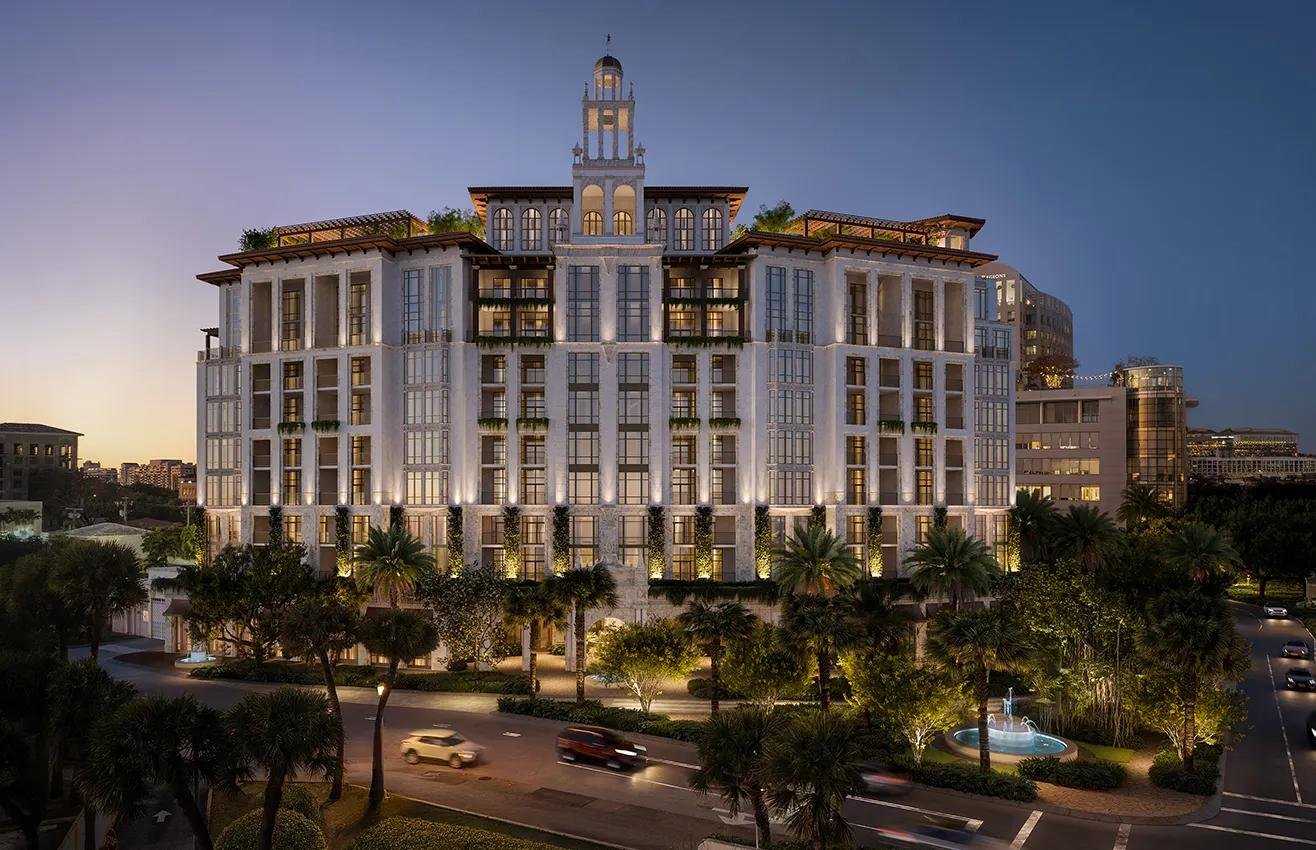
On July 7, the Coral Gables City Commission voted 5-0 to commit an additional $3.9 million in combined city and developer funding to the redesign of Fred B. Hartnett Ponce Circle Park, resolving a financing gap that had been an open question since the project's estimated cost climbed from $8.9 million to $11.2 million over the past year. For most residents, the vote was a routine piece of civic business. For anyone evaluating a purchase at Ponce Park Residences — the 58-residence luxury condominium rising directly beside the park — it's a data point worth understanding.
Key Takeaways
- Coral Gables commissioners unanimously approved $3.9 million in new funding to close the gap on an $11.2 million redesign of Fred B. Hartnett Ponce Circle Park.
- The city is covering the larger share — its total contribution rises to $8.2 million, or roughly 73% of project cost; the developer's contribution rises to $3 million, or about 27%.
- The redesign, still moving through city design review, calls for an open-air performance pavilion, a sculpture fountain, a central event lawn, and shaded arcades.
- The park sits directly across from Ponce Park Residences, the Allen Morris Company's 58-residence condominium at 3000 Ponce de Leon Boulevard, now under construction with delivery expected in early 2028.
- Park construction is targeted to begin next summer; pricing, unit availability, and completion dates for Ponce Park Residences should still be confirmed directly with the developer's offering documents.
What Coral Gables Approved
The commission's July 7 vote addressed two linked items: a resolution amending the park's conditions of approval, and a companion amendment to the city's development management agreement with Ponce Park Residences, LLC, the Allen Morris Company entity building the adjacent condominium. Neither item drew public comment on the night of the vote, a notable contrast to earlier hearings on the park's design, which had generated debate among residents over how much built structure belongs in one of downtown Coral Gables' few remaining open green spaces.
The approved amendment lays out the financing in detail. The park's original funding package, assembled in 2024 and 2025, totaled $7.3 million: a $5.3 million city appropriation paired with a $2 million developer commitment. Against the revised $11.2 million total cost, that left a combined shortfall of $3.9 million once both an earlier $1.6 million gap and the newer $2.3 million cost increase were accounted for. The vote closes that shortfall rather than opening a new one.
Why the Park Budget Increased
The redesign's price tag grew by roughly a quarter over the span of about a year. When the commission originally approved the development agreement with Allen Morris, the park renovation budget was set at $8.9 million. By May 2026, as the conceptual design moved into public review, the developer's representatives told commissioners the design now on the table was estimated at approximately $11.2 million — an increase city officials attributed largely to the scope and material quality of the finalized design rather than to construction-cost inflation alone.
Under the newly approved terms, the city is absorbing most of the increase. Its total contribution rises to $8.2 million through a $2.9 million supplemental appropriation, funded in part by repurposed proceeds tied to a 2020 development agreement connected to The Plaza Coral Gables (the mixed-use project across the street) and in part by mobility and parks impact fees paid by the Ponce Park Residences project itself. The developer's total contribution rises to $3 million, structured through two additional $500,000 commitments — one an advance against impact fees the developer would otherwise owe the city on future projects over the next decade, the other a payment for the naming rights to the park's planned open-air pavilion, subject to city manager approval. The developer remains contractually responsible for any cost overruns beyond the amounts now approved.
What the Redesigned Ponce Circle Park Will Include
The conceptual design, prepared by Coral Gables-based de la Guardia Victoria Architects & Urbanists in coordination with Allen Morris and landscape firm Naturalficial, envisions Ponce Circle Park as a formal civic space rather than a simple green median. The plan centers on an open-air performance pavilion at the park's southern end, intended for concerts and civic gatherings, and a sculpture fountain as a visual anchor at the northern end. Connecting the two is a central event lawn flanked by shaded arcades and pedestrian promenades, with an allée of trees along the eastern and western edges and café-style seating built into the arcade openings.
The design is still working through the city's formal review process. It cleared the Development Review Committee earlier this year, and the Board of Architects is scheduled to take up the plans this month, ahead of a public hearing on the Final Park Design Plan. City officials have indicated the final design must remain substantially consistent with the conceptual plan presented to residents at a June 1 community meeting. Construction on the park is targeted to begin next summer — roughly in step with the final phases of construction at Ponce Park Residences next door.
A well-funded, well-designed park doesn't guarantee a building's success — but a chronically underfunded or stalled one can quietly work against it.
Why Public Space Matters in Luxury Real Estate
Buyers evaluating pre-construction luxury condominiums often focus first on the residences themselves — floor plans, finishes, ceiling heights, amenity decks. The public realm surrounding a building is easy to treat as secondary, but in dense, walkable neighborhoods like downtown Coral Gables, it can shape daily life as much as anything inside the building. A well-maintained park with genuine civic programming — concerts, gathering space, shade, walkability — is often associated with stronger street-level activity, more consistent foot traffic for nearby retail, and a more finished sense of neighborhood identity.
Public investment can also signal, apart from any single developer's marketing, that a municipality is committed to a district's long-term upkeep — particularly relevant here, where the park redesign and the condominium tower next door share a boundary, a timeline, and now a joint funding structure.
What This Means for Buyers Considering Ponce Park Residences
For prospective buyers, the July 7 vote resolves a piece of uncertainty rather than creating a new selling point. Before this vote, the park's financing had an unresolved $3.9 million question mark attached to it, and a stalled or scaled-back park redesign was at least a plausible outcome. That risk is now substantially reduced: the funding is approved, the design is in the city's formal review pipeline, and construction has a stated target date.
None of this changes the fundamentals a buyer should still verify directly with the developer's offering documents — unit pricing, availability, floor plans, HOA structure, and the building's own construction timeline, which is separate from the park's. Ponce Park Residences broke ground in December 2025 and is expected to be completed in early 2028; park construction, by contrast, isn't expected to begin until next summer, meaning early residents may move in before the redesigned park is finished. Buyers touring the building should ask directly about the park's construction timeline and how it may affect the immediate surroundings during the building's first year or two of occupancy.
A resolved funding question also can enhance a buyer's confidence in the surrounding public realm without implying anything about future resale value, which depends on a wide range of market factors unrelated to any single park.
Coral Gables Continues Investing in Its Urban Core
The Ponce Circle Park redesign is one piece of a broader pattern of public investment in downtown Coral Gables, alongside the nearby Plaza Coral Gables mixed-use development and other park and streetscape projects the city has pursued in recent years. Coral Gables pre-construction buyers are increasingly evaluating not just individual buildings but the surrounding public infrastructure — parks, walkability, streetscape quality — as part of what makes a neighborhood function as a luxury living Coral Gables destination rather than simply a collection of towers.
Buyer Takeaway
The financing vote is a procedural milestone, not a marketing event — and that's precisely why it's worth understanding. It removes a specific, identifiable risk (a stalled or underfunded park) that a careful buyer would otherwise have had to factor into a purchase decision at Ponce Park Residences. As with any pre-construction purchase, the responsible next step isn't to assume the park's timeline or scope is guaranteed, but to ask specific, current questions — about the building, about the park, and about how the two projects' timelines intersect — before signing anything.
Considering Ponce Park Residences?
Register with us before you contact the developer's sales team. We'll walk you through current floor plans, pricing, and construction timelines — for both the building and the park next door — and confirm your potential rebate before you take a single step with the sales gallery.
See the Ponce Park Residences rebate (786) 550-6294Reporting drawn from the Coral Gables Gazette's coverage of the May 19 and July 7, 2026 city commission meetings, and from public meeting materials published by the City of Coral Gables. This article is independent buyer-advisory content and is not published by, sponsored by, or affiliated with the City of Coral Gables or The Allen Morris Company.