
Pinecrest luxury homes — keep up to half the commission.
Estates, new construction, large-lot homes and land in the Village of Pinecrest, with independent buyer representation. Eligible buyers receive up to 50% of the buyer-agent commission we receive back at closing.
What could you keep on a Pinecrest purchase?
Pinecrest spans everything from an older house on a good lot to a newly built custom estate. Move the slider to your range.
Illustration only — not a quote and not a guarantee. Compensation varies by listing and by transaction, and not every purchase makes buyer-agent compensation available. Any actual rebate depends on the compensation actually received, your buyer-representation agreement, lender approval of credits, and closing terms. We confirm the figure in writing before you commit.
Looking at a new-construction or builder-owned house? Talk to us before you register or tour — here's why.
Land, canopy and quiet — fifteen miles from Downtown Miami.
Pinecrest is not a neighbourhood of Miami. It is its own municipality of roughly eight square miles in south Miami-Dade, home to around 18,400 residents, and it is almost entirely residential. There is no tower skyline here and no walkable village centre. What there is instead is space: large lots, deep setbacks, mature trees and streets where the houses sit well back from the road. For a certain buyer that is the entire proposition.
Large residential lots
The residential pattern was set by acre-scale development, and the land development code still carries estate districts on top of it — EU-1C at a minimum of 2.5 gross acres, EU-1 built around the one-acre lot. Lot sizes vary, but the scale is the point.
Setbacks and screening
Generous frontage, deep setbacks and mature hedging mean most Pinecrest houses are not visible in full from the street. Privacy here comes from land and planting rather than from a gatehouse.
A protected tree canopy
Pinecrest is nationally recognised as a Tree City USA and received a Tree City Growth Award in 2022 for its urban forestry programme. Tree removal and relocation are permitted activities in the village, which is unusual and worth understanding before you buy.
A live custom-home market
Because the village is built out, new construction happens by replacement. A meaningful share of current upper-end activity is newly built custom and spec houses on established lots — modern product inside a long-established low-density framework.
Close to the Gables and the Grove
Pinecrest sits south of Coral Gables and South Miami, with straightforward access north toward Coconut Grove and Downtown along US 1 — residential calm without being cut off from the rest of Miami-Dade.
Its own village government
Incorporated in 1996, Pinecrest runs its own police department, parks and recreation, building and planning, and public works. Permits, zoning and code questions go to Village Hall on Pinecrest Parkway, not to the county.

In most markets the trees are landscaping. In Pinecrest they are regulated, and they are priced in.
The luxury market is new. The land pattern that makes it possible is not.
It is tempting to read Pinecrest's current custom-home activity as a recent invention. It isn't. Today's estate market is a modern expression of a low-density residential pattern that was laid down two generations ago, and understanding that history explains why the lots are the size they are, why the canopy is so heavy, and why the village guards both so carefully.
Five kinds of opportunity — and most properties sit between two of them.
There is no building directory in Pinecrest, because there are almost no buildings to direct you to. What there is instead is a spectrum of houses at very different points in their life cycle, sitting on lots of very different quality. Categorising the property correctly is the first real analytical step, because it determines what you are actually buying and what you should be inspecting.
Established homes
Older residences, frequently on the mature lots that give Pinecrest its character — often the best land in the village sits under the least current house. Renovation potential is the story, and so is a careful look at roof, systems and permit history.
Renovated estates
Houses a previous owner has materially upgraded to current luxury expectations. The work may be excellent or cosmetic. The critical questions are what was actually replaced, whether it was permitted, and who did it.
New construction & spec homes
Newly built houses, often by local builders working one or two lots at a time. Current layouts and systems, impact protection and indoor-outdoor living designed for how a Miami house is used now — with a premium attached and immature landscaping.
Custom estates
Larger, individual houses where design, materials, ceiling heights, garaging and replacement cost drive the number. Comparable sales are least useful here, and the underlying lot matters most.
Land & redevelopment
Vacant sites, teardown candidates and properties bought principally for the land. You are underwriting the lot, the zoning, the tree position and a build programme rather than a house. Our live search includes vacant land for exactly this reason.
Most homes are hybrids
A 1960s house with a 2019 roof, a renovated kitchen, original plumbing and a superb acre lot belongs to three of the categories above at once. Treat the labels as a way of asking better questions, not as a filing system.
What actually drives value in Pinecrest — and it is not square footage.
In a condominium market, price per square foot does a lot of analytical work: the building is fixed, the exposure is knowable, and the line above yours is a genuine comparable. In Pinecrest none of that holds. Two houses of identical interior size on the same street can be worth materially different amounts, and the reasons are usually outside the walls. No single variable below guarantees value, and no list replaces looking at the property — but these are the things we weigh.
The land itself
Size, shape, frontage and depth — and usable yard as distinct from raw acreage. How much of the lot you can actually build on and live on.
Street and exposure
Street quality, traffic volume, whether the road is a through route or a quiet residential run, and how close the property sits to a busy corridor.
What surrounds you
The condition and scale of neighbouring houses, whether the block is mid-rebuild, and what an adjacent teardown could become in three years.
Canopy and landscaping
Mature trees take decades to replace and are regulated here. Screening drives privacy, and privacy drives price in this market.
Age and build quality
When and how the house was built, and what has been done since. Original 1960s construction and a 2023 rebuild are different assets at the same address.
Renovation quality
Whether past upgrades were structural or cosmetic, whether they were permitted, and whether the finish level matches the price being asked.
Usable living area
Not total square footage but how it is arranged: ceiling height, natural light, primary-suite position and how the plan works day to day.
Indoor–outdoor flow
Covered terrace, summer kitchen, pool position and the link between the main living space and the yard. In this climate that is a primary living space.
Pool, garaging and structures
Pool age and equipment, cabanas, guest houses and detached structures where permitted, garage capacity and motor court.
Storm readiness
Impact windows and doors, roof age and type, shutters and generator — how the house performs when the power is out for a week.
Water, drainage and grade
How the lot sheds water, elevation, flood-zone position, utility service and whether the home is on sewer or septic. These vary by address in Pinecrest.
Redevelopment potential
What the zoning permits, what a replacement house could be, and what a builder would pay for the same site. This sets a floor under good lots.
In Pinecrest you are buying land, location and improvements — in that order.
This is the single biggest difference between buying here and buying a condominium, and it is where most of the money is either made or lost. A house can be rebuilt, extended, re-roofed and re-systemed. The lot is permanent. Two properties with near-identical interior square footage can carry very different economics purely because of the ground they sit on.
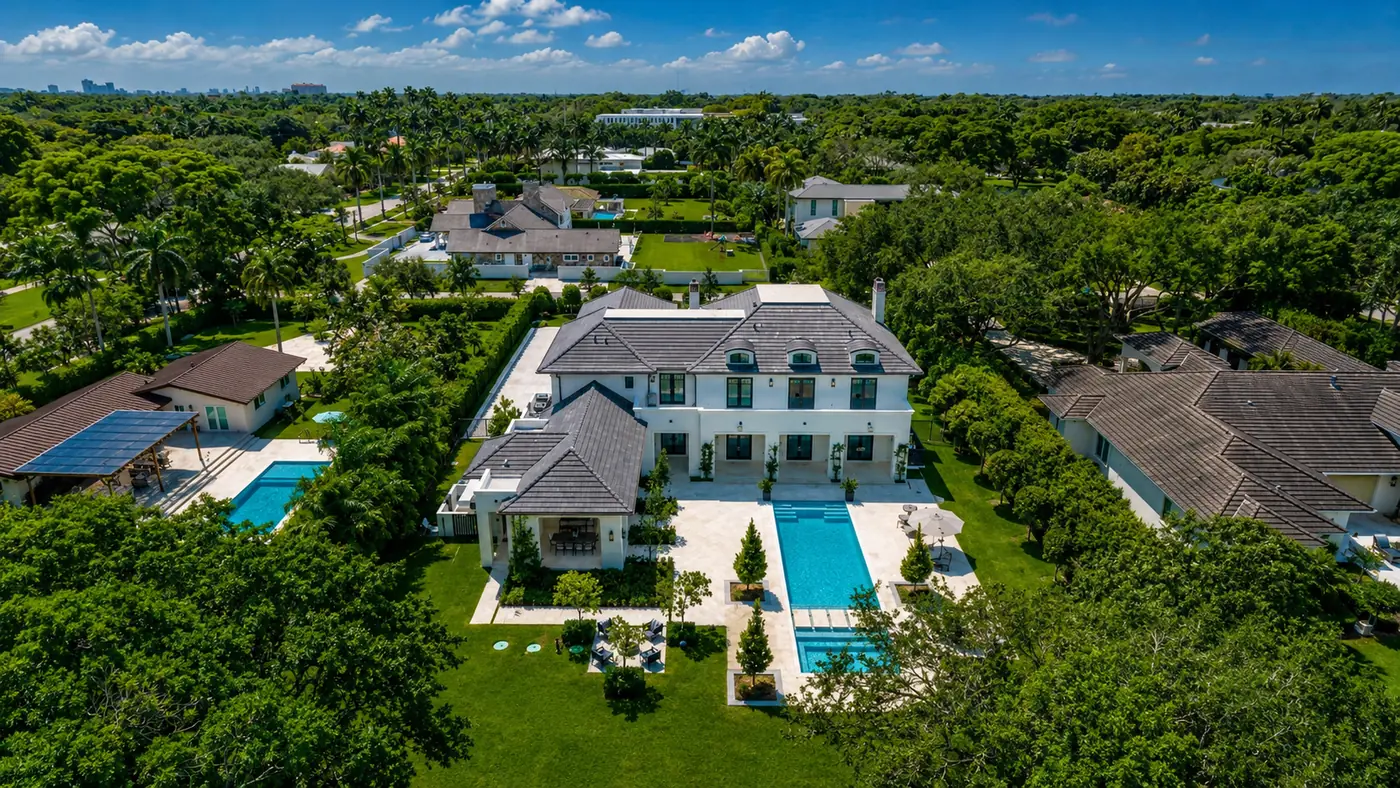
What the aerial tells you that the listing photos do not
From above you can read the things that decide value: how much genuinely usable open ground sits behind the house, where the neighbours' structures actually are, how the pool and terrace are oriented, where the canopy screens and where it does not, and how the parcel is shaped. We look at every Pinecrest property from the air before we see it in person, and at the survey before we form a view on price.
- LandSize, shape, frontage, depth, usable yard, orientation, grade and drainage, tree position, easements and boundaries.
- LocationStreet character and traffic, corner exposure, proximity to corridors and schools, and what the surrounding blocks are becoming.
- ImprovementsThe house, pool, terrace, garaging and detached structures — the only part of the equation you can change later.
Usable yard is not the same as lot size. An acre with a long driveway, a wide setback and a diagonal boundary can leave less usable rear ground than a well-proportioned three-quarter-acre parcel. Ask where the pool, sport court or guest structure could actually go, and what setbacks and coverage limits allow, before you assume a lot can absorb your plans.
Zoning is parcel-specific. Pinecrest's land development code carries a range of residential districts, — from estate districts such as EU-1C, a minimum of 2.5 gross acres with one principal dwelling per 2.5 acres, and EU-1, built around the one-acre lot, through to smaller conventional single-family districts. Estate density in those districts is calculated on gross residential acreage, which includes a share of the adjacent rights-of-way. Confirm the district, the dimensional limits and any conditions for the specific folio with the Village of Pinecrest before you rely on any of it.
The trees are regulated. The Village requires a tree removal permit for the removal or relocation of any tree not specifically exempted, and treats trees over 18 inches in diameter measured four feet above the ground as specimen trees. Certain listed invasive species can be removed without a fee once a Village arborist confirms the species, and a tree certified as hazardous by a qualified arborist or Florida licensed landscape architect may not require a permit. Replacement or mitigation planting can be required. If your plan involves a new footprint, a pool or a driveway, tree position is a design constraint and a budget line — understand it before you are under contract.
Water is a genuine question here. Utility position varies by address: the Village publishes resident guidance both on private well water and on connecting to potable water, and has run a long programme to extend county water service to homes that historically drew from private wells. Septic systems are also present in the village. Confirm the water source, the wastewater arrangement, any special assessment and any connection obligation with the Village and Miami-Dade Water and Sewer.
And look at what is next door. On a street that is actively rebuilding, an adjacent teardown can mean two years of construction traffic — or a new house that lifts the block. Neither settles the decision on its own, but it is information you should have before you write an offer, and it is not in the listing.
Two legitimate routes into the same village.
This is the question almost every Pinecrest buyer eventually has to answer, and there is no universally correct answer. New construction and established estates fail and succeed in different ways. What follows is what each path genuinely offers and what each one requires you to check.
New construction
A newly built custom or spec house, usually replacing an older home on an established lot.
- Current layouts and proportions, built for how a Miami house is used now
- New roof, electrical, plumbing and mechanical systems
- Impact protection and current construction standards throughout
- Contemporary indoor–outdoor living, summer kitchens, covered terraces
- Smart-home and energy systems designed in rather than retrofitted
- Materially less near-term deferred maintenance
- Builder track record and what else they have completed locally
- Permit history, final inspections and certificate of occupancy
- Workmanship and materials, not just the finish you can see
- Warranties — what is covered, for how long, and by whom
- Drainage and site work, which is where new builds most often disappoint
- Immature landscaping and how long screening will take to establish
- How square footage is being defined and measured
- Neighbouring construction still under way on the same street
- The premium you are paying for newness, and whether the lot supports it
Established estates
An existing house, from unrenovated to comprehensively upgraded, usually on a mature lot.
- Mature canopy and established landscaping you cannot buy new
- Settled streets where the rebuilding cycle has largely passed
- In many cases a better or larger lot for the same money
- Architectural character, including original mid-century estate houses
- Renovation upside you control rather than pay someone else for
- A different acquisition basis, with the work priced into the number
- Roof age, type and remaining life — and its insurance consequences
- Electrical service, panel capacity and any aluminium wiring
- Plumbing material, age and any history of leaks or re-piping
- Mechanical systems, ductwork and humidity control
- Windows and doors, and whether impact protection is genuine
- Pool shell, equipment, safety compliance and enclosure
- Sewer or septic, and the condition and location of any system
- Structural condition, including additions and enclosed spaces
- Permit record: closed, open, expired or missing permits on past work
- Insurance availability and cost given the age and construction
- The full deferred-maintenance schedule, priced before you offer
The honest comparison is not new versus old. It is total cost of ownership over your holding period: purchase price, plus the work the house needs, plus insurance and carrying costs, against what the same money buys on the other path. A new build on a modest lot and a renovated estate on a superb acre can land at the same number and be entirely different purchases. We will run both with you.
A real factor in this market — and one you must verify yourself.
Education is part of why many buyers look at Pinecrest at all, so it would be dishonest to leave it out. It would be equally dishonest to make claims we cannot support. Below is what the Village of Pinecrest itself identifies, and what you should do with that information.
Public schools the Village identifies as serving Pinecrest- Pinecrest Elementary SchoolMiami-Dade County Public Schools
- Palmetto Elementary SchoolMiami-Dade County Public Schools
- Howard Drive Elementary SchoolMiami-Dade County Public Schools
- Palmetto Middle SchoolMiami-Dade County Public Schools
- Miami Palmetto Senior High SchoolMiami-Dade County Public Schools
- Gulliver PreparatoryIndependent
- Bet Shira CongregationFaith-based
- Temple Beth AmFaith-based
- St. Louis Covenant SchoolFaith-based
- Pinecrest Presbyterian Day SchoolFaith-based
- Grow With Us AcademyIndependent
Verify before you buy. School attendance boundaries, programmes, magnet and choice options, capacity and individual assignments can and do change. Nothing on this page should be read as a promise that a specific property is assigned to a specific school. Confirm current eligibility directly with Miami-Dade County Public Schools and with the school itself before you purchase, and confirm current programme details with any private school you are considering. We do not publish school rankings or ratings, because they are frequently out of date by the time a buyer acts on them.
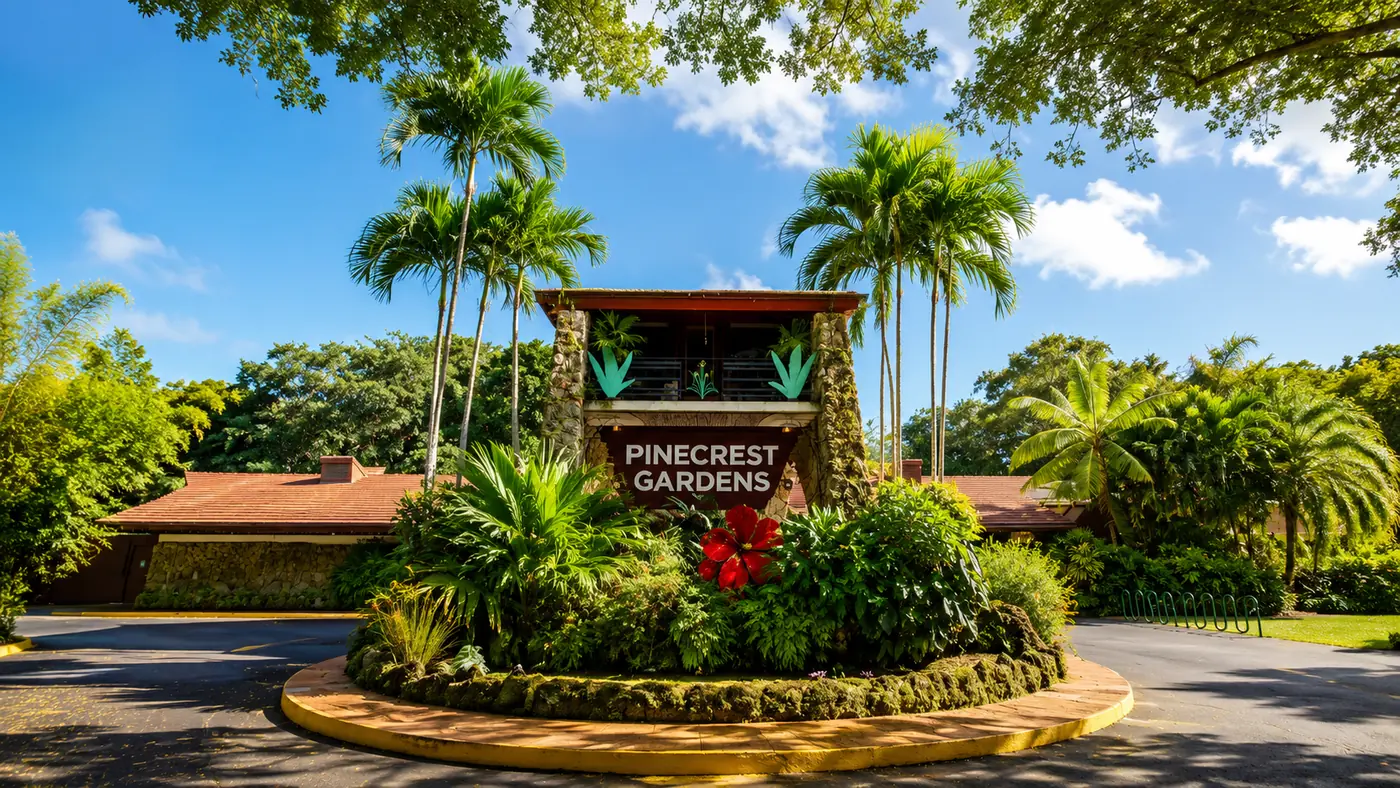
The village kept its most famous twenty acres instead of selling them.
Pinecrest is a place, not just a housing market.
A buyer moving here from a condominium is trading building amenities for civic ones. It is worth knowing what that actually means day to day, because the substitution is real: no gym downstairs, no concierge, no rooftop pool — but a village that programmes its own parks and runs its own services.
Pinecrest Gardens
The village's cultural anchor, on the historic Parrot Jungle site at Red Road and Southwest 111 Street. The Village acquired the property in 2002 and reopened it in 2003 as a municipal park; Pinecrest Gardens describes itself today as a fourteen-acre historic property with botanical gardens, an amphitheatre, a gallery and a year-round cultural and events programme. The site was listed on the National Register of Historic Places in 2011 as the Parrot Jungle Historic District. A genuine local institution, not a line on a brochure.
Parks, canopy and streets
The Village runs its own parks and recreation department across multiple village parks. Above all, though, the public realm here is the streets themselves: heavily planted residential runs under a mature canopy the Village actively protects through its tree preservation programme, its Tree City USA designation and its adopt-a-tree and tree placement initiatives.
Everyday life nearby
Pinecrest has commercial frontage along US 1 rather than a walkable village core, and most residents draw on the surrounding area for dining and shopping — South Miami and Coral Gables to the north, Kendall to the west. The trade-off is deliberate: the residential streets stay residential. If you want to walk to dinner, Coconut Grove or the Gables will suit you better, and we will say so.
Village services
Pinecrest operates its own police department along with parks and recreation, building and planning, public works and code compliance, and publishes resident guidance on hurricane preparedness, flood-zone lookups, stormwater, trees and water connections. Practically, there is a real municipal counterpart for the questions a house on a large lot generates.
The village suits some buyers extremely well and others not at all.
We would rather tell you early that a market is wrong for you than sell you into it. The descriptions below are about property and lifestyle preferences, not about people, and none of them is a statement about investment performance.
Buyers who want land
The core Pinecrest buyer. Someone who wants a real yard, room for a pool and a sport court, distance from the neighbours and a house that is not attached to anything. If that is the requirement, few Miami-Dade markets do it better.
Moving from condo to estate living
Buyers stepping out of a tower for the first time. The adjustment is real — maintenance, grounds, storm preparation and insurance all become yours. We will walk through those running costs with you before you commit.
New-construction buyers
Buyers who want current systems, impact protection and a modern plan without waiting through a build. Pinecrest has an active spec and custom market, and the analysis shifts to builder quality and lot value.
Renovation buyers
Buyers who would rather buy the lot and the location and improve the house on their own terms. Here the permit record, the structure and a realistic scope-and-cost exercise matter more than the finish level.
Land and custom-home buyers
Buyers evaluating a site, a teardown or a build programme. Zoning, setbacks, coverage, trees, drainage, utilities and timeline become the whole conversation; the house currently on the lot is largely incidental.
Buyers comparing markets
Buyers weighing Pinecrest against Coral Gables or Coconut Grove. Our approach and our rebate are identical across all three, so the decision can stay about the property rather than the representation.
Full luxury representation, and better transaction economics. Not a discount service.
We want to be precise about this, because it is easy to misread. We are not a discount brokerage and we do not provide reduced service. You get complete, Florida-licensed, independent buyer representation — search, analysis, negotiation, inspection coordination, financing coordination and closing. What we do differently is what happens to our side of the compensation.
At Pinecrest price points the arithmetic stops being cosmetic. Look at the whole equation, not the sticker: purchase price, plus buyer-agent compensation, minus any rebate, plus inspection findings, closing costs, insurance, property taxes, the renovation the house actually needs, and ongoing carrying costs. Buyer-agent compensation is the one line normally invisible to the buyer — it exists in the transaction whether or not you ever see it.
Eligible buyers receive up to 50% of our buyer-agent commission back at closing. On a $4,500,000 Pinecrest house with an example 2.5% buyer-agent commission, that illustrative rebate is $56,250 — a new roof, a serious portion of an impact-window package, or simply capital retained.
For a full explanation of how the rebate amount is calculated, who may qualify and how it is documented, read our Florida Buyer Rebate Guide.
What that figure actually depends on, in every case:
- Compensation varies by listing and by transaction
- It must be offered, available, and actually received by us
- It is addressed in your buyer-representation arrangement
- Lender approval of closing credits may apply
- Transaction, closing, legal and other limitations may apply
- Every figure is confirmed in writing before you commit
One conversation decides whether the rebate exists at all.
You still receive complete, Florida-licensed buyer representation through the entire purchase. The rebate is what we do with our side of the compensation — not a reduction in the service you get, and not a change in how hard we negotiate for you.
Check my Pinecrest rebateA rebate is not guaranteed. It is possible only where buyer-agent compensation is actually received and a rebate is permitted, and it remains subject to your buyer-representation agreement, lender approval of credits, applicable Florida rules and closing terms.
The order you do things in matters more than anything you negotiate.
This is the most common way buyers lose a rebate they would otherwise have qualified for, and it usually happens before they have made any decision at all.
Contact us before you register with, tour, or inquire with a builder, developer or listing agent.
Where a Pinecrest property is sold by a builder, developer or new-construction sales operation, that seller sets its own broker-registration policy. Those policies generally govern whether a buyer's broker is recognised on the transaction at all — and recognition is what makes a commission, and therefore a rebate, possible. If you submit an online inquiry, walk a spec house alone, or register on a project's website before a broker is named, the seller may decline to recognise us afterwards.
The same applies more loosely on ordinary resale: contacting a listing agent directly, or registering on a portal that routes you to one, can complicate representation later. A listing agent works for the seller. So does a builder's sales representative. Neither represents your side, and neither will tell you what the lot is really worth.
Already inquired somewhere? Call us and tell us exactly what happened — which property, when, and through what channel. Sometimes it can still be preserved, sometimes it cannot, and we will tell you honestly which one it is rather than let you find out at contract.
A house on an acre generates questions a condominium never does.
There is no association to hand you a budget, no reserve study, no board minutes. Everything that would be someone else's responsibility in a tower is yours here, which means the investigation is broader and the inspection budget is larger. None of the below is legal, engineering, insurance or tax advice, and all of it is property-specific — your attorney, inspector, engineer and insurance advisor should review anything material.
Land & title
- Current survey
- Title and exceptions
- Easements and encroachments
- Property boundaries and fence lines
- Zoning district and dimensional limits
- Any restrictions of record
Permits & work history
- Full permit record for the address
- Open, expired or missing permits
- Renovations, additions and enclosures
- Unpermitted work and how it is resolved
- Code compliance history
- New-construction warranties and builder record
Structure & systems
- Roof age, type and condition
- Structural inspection where warranted
- Electrical service and panel
- Plumbing material and condition
- Mechanical systems and ductwork
- Windows, doors and impact protection
- Pool shell, equipment and safety
- Generator and storm readiness
Site, utilities & cost
- Drainage, grade and standing water
- Elevation and flood-zone position
- Water service or private well
- Sewer or septic, and system condition
- Irrigation and any irrigation well
- Trees, canopy and removal constraints
- Insurance availability and cost
- Property taxes and carrying costs
A practical note: on an older Pinecrest house, spend more on inspections rather than less. A general inspection, a roof assessment, a pool inspection and — where warranted — a structural engineer and a survey review typically cost a small fraction of what one missed item costs after closing, and findings are among the most negotiable parts of the transaction.
Not which is best. Which environment fits you.
These three markets come up together constantly, and buyers who tour all three usually find the decision makes itself once the differences are stated plainly. They are genuinely different products, not different price points of the same thing. Our representation and our rebate approach are identical in all three, so the choice can stay about where you want to live.
Pinecrest
Estate-scale, green and almost entirely residential.
- Large-lot, estate-oriented single-family housing
- Privacy from land and planting rather than gates
- Heavy mature tree canopy, actively protected
- Substantial recent custom and spec construction
- Overwhelmingly detached houses; very little multifamily
- Quiet residential streets, no walkable village core
- Its own village government since 1996
Coral Gables
The broadest luxury mix and a real civic centre.
- Wide range of housing types and price points
- Historic Mediterranean architecture and design review
- Waterfront estates along the canals and bay
- Gated enclaves and golf-oriented areas
- A genuine condominium market as well as houses
- A commercial, dining and cultural core you can walk
- Long-established civic identity and city government
Coconut Grove
Lush, historic and closely mixed with the water.
- Eclectic housing: luxury houses, townhomes, condominiums
- Dense historic tree cover on narrow winding streets
- Marinas, sailing and bayfront parks
- A compact village core of dining and retail
- Smaller lots than Pinecrest, closer neighbours
- Strong new-development activity near the centre
- The most walkable of the three
Looking at estate land just north of the village as well? Our Ponce-Davis buyer guide covers EU-1 zoning, septic and redevelopment checks for that area. Also worth a look if you are weighing island living against estate living: our Key Biscayne buyer guide. And if part of your search is still on the condominium side, start with the Miami resale condo buyer rebate hub.
See current Pinecrest homes and land
This page explains how the Pinecrest market works — what drives value, why the lot matters, and what to investigate. What it cannot do is show you what is available today, because MLS inventory changes continuously through the day.
Our Pinecrest search at EAJordan.com is filtered to houses and vacant land, so it shows single-family homes, estates and land — not condominiums. It is a live MLS search, not a directory.
- Live Pinecrest MLS listings
- Single-family homes and estates
- Vacant land and redevelopment sites
- Recent closed sales
- Saved searches
- New-listing alerts
- High-resolution photos
- Payment estimator
- Market information
TheBuyerRebate.com is where you learn the Pinecrest market, understand the lot and see how the Buyer Rebate Program works. EAJordan.com is where you search live houses and land. Together they cover the whole process — education, research, representation, and a potential rebate at closing.
Search Pinecrest homes & land → Research freely. Contact us before you act on a specific property, so your representation — and any rebate — stays intact.
Independent buyer advocacy — not the seller's side.
Enrique Jordan and Alejandro Jordan, Esq. have participated in over $1 billion in real estate transactions and bring more than 30 years of combined experience representing buyers, sellers, investors and developers across South Florida — including the south Miami-Dade single-family markets. Our office is in Coral Gables at 121 Alhambra Plaza, a short drive up Red Road from Pinecrest.
- Florida-licensed real estate professionals
- Independent buyer representation
- Over $1 billion closed
- Negotiation, due-diligence coordination and transaction economics
- Full-service representation through closing
Frequently asked questions
Is Pinecrest a good place to buy a luxury home?
It depends on what you want the property to do for you. Pinecrest is an overwhelmingly single-family village of large residential lots, mature tree canopy and low density, roughly eight square miles south of Downtown Miami, with its own municipal government since 1996. If you want land, privacy, garaging, a real yard and a quiet residential street, it is one of the strongest options in Miami-Dade. If you want a walkable urban core, a doorman or a lock-and-leave building, it is the wrong market. We evaluate the specific property, its lot and its condition rather than the village as a whole.
Why is it called the Village of Pinecrest?
Pinecrest is a municipality in its own right, not a neighbourhood of Miami. Residents voted to incorporate and the Village of Pinecrest was officially established on March 12, 1996, after a movement led by residents Evelyn Langlieb Greer and Gary Matzner. Greer was elected the first mayor and was succeeded by Matzner in 2004. Incorporation gave the community its own council, police department, parks and recreation, building and planning, and public works functions. For a buyer this matters practically: permits, zoning, tree removal and code questions run through Village Hall rather than the county.
What types of luxury homes are available in Pinecrest?
Broadly five kinds of opportunity, and they overlap. Established homes, often on mature lots, with renovation or modernisation potential. Renovated estates where a previous owner has already brought the house up to current expectations. New construction and spec homes, a significant part of the current upper end. Custom estates, where design, materials, lot quality and replacement cost drive the number. And vacant land or redevelopment sites, where the buyer is really evaluating the land, a teardown or a build strategy. Very few Pinecrest properties sit neatly in one category, which is precisely why the analysis is property-specific.
Are there large lots and estate properties in Pinecrest?
Yes, and it is the defining characteristic of the village. Pinecrest's residential character was set in the 1950s and 1960s by ranch-style houses built on acre lots, and the Village's land development code still carries estate zoning districts on top of that pattern: the EU-1C district requires a minimum of 2.5 gross acres with one principal dwelling per 2.5 acres, and EU-1 is built around the one-acre lot. Not every Pinecrest property is an acre, and lot sizes vary considerably across the village, so the zoning district and the actual survey for a specific parcel should always be confirmed with the Village of Pinecrest.
Is new construction common in Pinecrest?
New custom and spec houses are a substantial component of the current upper end of the Pinecrest market. Because the village is essentially built out, most new construction happens by replacement rather than by subdivision: a builder or an owner acquires an older house on a good lot and rebuilds. That is why land and teardown opportunities trade at prices that can look disconnected from the existing structure, and why a buyer looking at an older home should understand roughly what a replacement house on that lot would cost and what the Village would permit.
Should I buy new construction or an established estate in Pinecrest?
Neither path is universally better and we will not tell you otherwise. New construction gives you current layouts, new roof, electrical, plumbing and mechanical systems, impact protection and contemporary indoor-outdoor living, with less near-term deferred maintenance, but you pay a premium for newness and you inherit immature landscaping and a builder record you need to check. An established estate can offer mature canopy, an established street, sometimes a better lot, architectural character and a different acquisition basis, but roof, systems, windows, pool, drainage and permit history all need real inspection. The right answer depends on your timeline, your appetite for work and how much the lot matters to you.
What should I inspect when buying a Pinecrest home?
More than a condominium buyer ever has to. Start with the survey, title, easements and boundaries, then the permit record, including open or expired permits on past renovations and additions. Then the building itself: roof age, structure, electrical, plumbing, mechanical systems, windows and impact protection, pool and equipment, generator and storm readiness. Then the land: drainage, elevation and flood zone, trees, irrigation, and any wells. Confirm the utility position for that specific address, including water service and whether the home is on sewer or septic. On new construction add builder track record, warranties and workmanship. None of this is legal, engineering, insurance or tax advice, and it is property-specific, so use qualified professionals for anything material.
What should I know about Pinecrest schools?
The Village of Pinecrest identifies the public schools serving the village as Pinecrest Elementary, Palmetto Elementary, Howard Drive Elementary, Palmetto Middle and Miami Palmetto Senior High. The Village also lists private and independent options in or near Pinecrest, including Gulliver Preparatory, Bet Shira Congregation, Temple Beth Am, St. Louis Covenant, Pinecrest Presbyterian, Grow With Us Academy and Kendall United Methodist. What we will not do is tell you a particular house is assigned to a particular school. Attendance boundaries, programmes, magnet options and assignments change, so verify current eligibility directly with Miami-Dade County Public Schools and the school itself before you buy.
Do I need a permit to remove a tree in Pinecrest?
Generally yes. The Village of Pinecrest requires a tree removal permit for the removal or relocation of any tree not specifically exempted, and treats trees over 18 inches in diameter measured four feet above the ground as specimen trees. There are exceptions: certain listed invasive species can be removed without a fee once a Village arborist confirms the species, and a tree certified as hazardous by a qualified arborist or a Florida licensed landscape architect may not require a permit or replacement. Replacement or mitigation planting may be required. This matters a great deal if you are buying a wooded lot with a build, pool or driveway plan in mind, so confirm the current requirements with the Village before you commit.
How does Pinecrest compare with Coral Gables?
They are both established, high-quality residential markets with their own municipal identity, but the product is different. Coral Gables offers a broader mix: historic architecture, waterfront estates, gated enclaves, golf-oriented areas, a genuine commercial and cultural core, and a real condominium market. Pinecrest is far more singular. It is dominated by detached single-family houses on large lots, with a heavier concentration of recent custom and spec construction and a quieter, lower-density residential character. Buyers who want walkable civic life and architectural continuity often prefer the Gables; buyers who want land, privacy and space usually prefer Pinecrest.
How does Pinecrest compare with Coconut Grove?
Coconut Grove is lush, historic and eclectic, with luxury houses, townhomes and condominiums mixed closely together, marinas and waterfront parks, and a compact village core of dining and retail you can walk to. Pinecrest is purely residential by comparison, with larger lots, more consistent single-family character and no walkable village centre of its own. The Grove tends to suit buyers who want to be inside a neighbourhood with a social and waterfront life; Pinecrest tends to suit buyers who want the property itself to be the experience.
Can I receive a Buyer Rebate on a Pinecrest home?
Often, yes. We represent you as your Florida-licensed buyer's agent through the whole purchase. Where buyer-agent compensation is available on the property you buy and a rebate is permitted under your buyer-representation agreement, your lender and your closing terms, we credit up to half of the compensation we actually receive back to you at closing. At Pinecrest price points that can be a material number, but it is not automatic and it is not guaranteed. Not every listing makes buyer-agent compensation available, and we confirm the figure in writing before you commit to anything.
Where can I search current Pinecrest homes and land?
Our Pinecrest search at EAJordan.com is filtered to houses and vacant land, so it shows single-family inventory and land rather than condominiums. It is a live MLS search, which means it changes continuously through the day. Use it to see what is actually on the market, then contact us before you act on a specific property so your representation, and any rebate, stays intact.
Check your Pinecrest rebate first.
One call protects it:
(786) 550-6294- Have a specific Pinecrest house or lot in mind? We'll check whether buyer-agent compensation appears to be available before you tour or inquire anywhere.
- Weighing new construction against an established estate? We'll run both on the same purchase price, including the costs that never appear in a listing.
- Looking at land or a teardown? We'll look at the zoning, the trees, the drainage and the utility position with you before you commit to a build strategy.
- Already contacted a builder, portal or listing agent? Tell us exactly what happened — we'll tell you honestly whether a rebate can still be preserved.