Home/News & Intelligence/Florida Amendment 3 Property Tax Changes, 2027–2028
Florida Amendment 3 Passes: What the New Property Tax Rules Mean for Homebuyers in 2027 and 2028
Florida voters approved Amendment 3 on November 3, 2026. It does not abolish property taxes. It roughly triples the homestead exemption from county, city and special-district taxes in 2027, raises it again in 2028, leaves school taxes on their existing rules, and halves the annual assessment cap on second homes, rentals and commercial property. Who benefits, by how much, and when depends on facts a buyer can check before signing a contract.
Approved · About 62% yes, unofficial · Takes effect January 1, 2027
Independent buyer education · Not tax or legal advice · Not affiliated with any campaign, party or government body
Six answers, as of November 4, 2026
Each answer is expanded, with sources, further down the page. Election figures are unofficial until the state certifies them.
- What did voters approve?
- Amendment 3, a constitutional amendment the Legislature placed on the ballot as CS/HJR 1F during its June 2026 special session. It needed 60 percent. Florida Election Watch, the state’s official results site, shows 4,917,482 yes votes (61.99%) to 3,015,840 no (38.01%), with results still labeled unofficial: about 62 percent (also reported by CBS12; Citrus County Chronicle). Amendments 1 and 2 on the same ballot failed.
- Does it eliminate property taxes?
- No. Homestead owners still pay school taxes on assessed value above $25,000, and homes assessed above the new exemption still pay county, city and special-district taxes on the value above it. Non-ad valorem assessments, condominium dues and special assessments are not affected.
- What is the headline change?
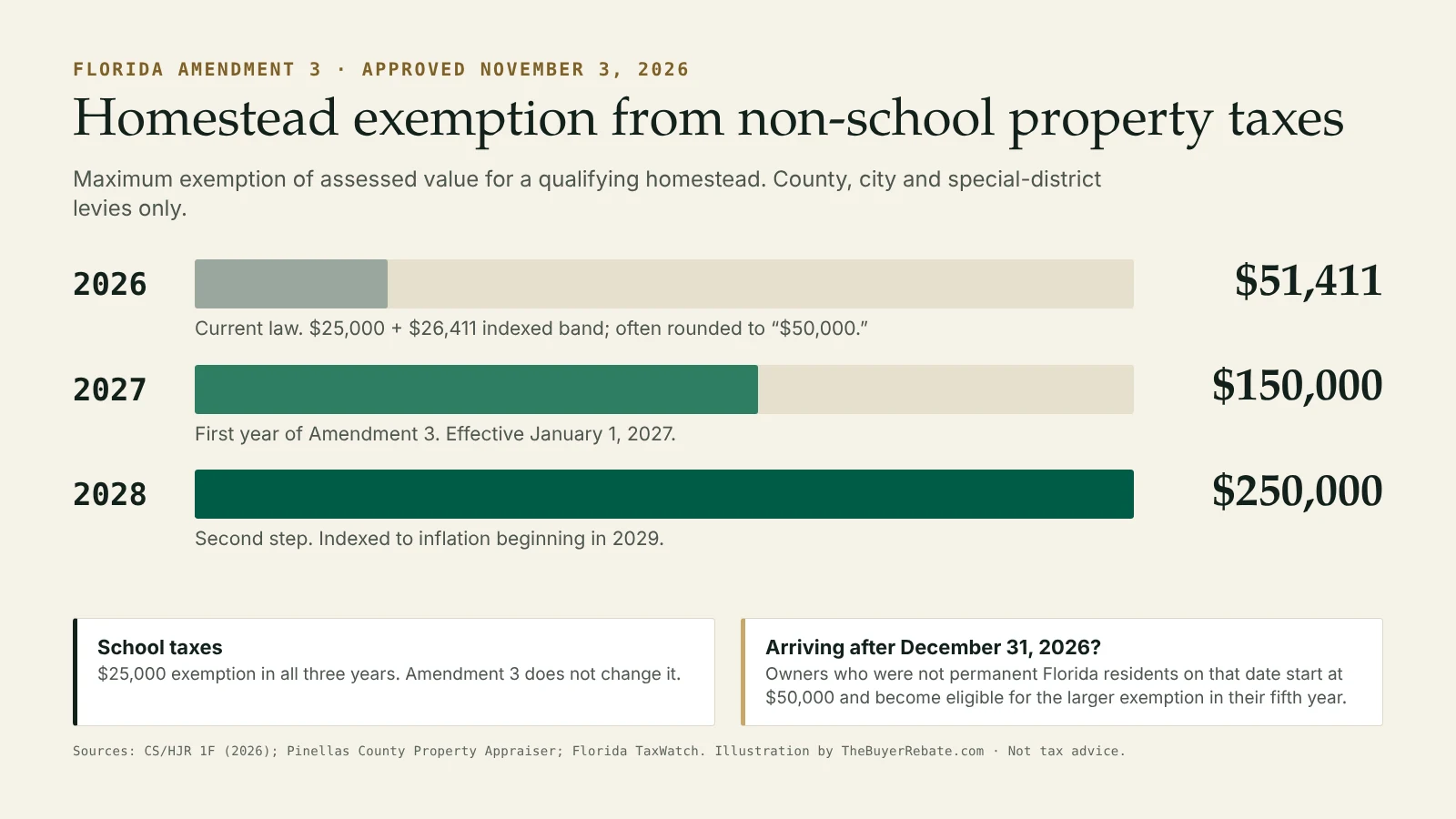
- For a qualifying homestead, the exemption from non-school property taxes rises from $51,411 in 2026 to $150,000 in 2027 and $250,000 in 2028, then adjusts for inflation starting in 2029. The $25,000 exemption from school taxes does not change.
- What about second homes and rentals?
- They do not get a homestead exemption. What changes is the cap on how fast their assessed value can rise for non-school taxes: 5 percent a year instead of 10 percent.
- Is there a catch for people moving here?
- Yes. Owners who were not permanent Florida residents on December 31, 2026 start with a $50,000 non-school exemption and become eligible for the larger amount in their fifth year of holding a Florida homestead exemption.
- When will a bill show it?
- The amendment takes effect January 1, 2027. The first place most owners will see it is the TRIM notice mailed in August 2027, followed by the November 2027 tax bill (Pinellas County Property Appraiser).
What Amendment 3 changes, and what it leaves alone
Amendment 3 rewrites parts of Article VII of the Florida Constitution, the article that governs property taxation. It is worth separating three kinds of statement that tend to get blurred in election coverage: what Florida law already said, what voters have now written into the Constitution, and what still depends on the Legislature, county property appraisers or the courts to put into practice.
| Provision | Through 2026 | Under Amendment 3 | Status |
|---|---|---|---|
| Homestead exemption, non-school taxes | $25,000 plus a second band of $26,411 (2026, inflation-indexed) = $51,411 | $150,000 in 2027; $250,000 in 2028 | Approved |
| Homestead exemption, school taxes | $25,000 | $25,000, unchanged | Unchanged |
| Inflation adjustment | Second $25,000 band indexed | $250,000 indexed beginning 2029 | Approved |
| Owners not permanent residents on Dec. 31, 2026 | Same rules as everyone else | $50,000 non-school exemption (indexed from 2028); larger amount from the fifth year | Approved; details pending |
| Assessment cap, non-homestead property | 10% a year, non-school levies | 5% a year, non-school levies | Approved |
| Save Our Homes cap on homesteads | Lesser of 3% or CPI | Unchanged | Unchanged |
| Portability; senior, veteran, disability and widow(er) exemptions | As provided by law | Unchanged | Unchanged |
| Local option to exempt more | Limited | Legislature must create a uniform procedure for counties and cities to raise the exemption, up to the full assessed value; special districts by referendum | Needs legislation |
| Use of county and city property-tax revenue | No constitutional list | Limited to listed purposes, with other spending allowed unless general law prohibits it | Approved; scope untested |
The revenue-use provision
The amendment directs counties and municipalities to use ad valorem revenue for a defined list: public safety (law enforcement, fire and emergency medical services), education and public schools, infrastructure such as roads, bridges and stormwater, natural-resource projects including flood control, bonds and existing debt service, retirement benefits for local employees, and the operations of county officers, commissions and municipalities, except spending general law prohibits (House staff analysis). Florida TaxWatch’s reading is that the list is broad enough to constrain little in practice; the Pinellas County Property Appraiser notes it does not guarantee any particular level of funding for law enforcement. How tightly it binds will be settled by budgets and, possibly, litigation, not by the ballot.
What is still to be decided
Implementing legislation will shape how the new-resident rule is administered, how a local government elects to exempt more value, and how TRIM notices present rates. The Pinellas County Property Appraiser expects the familiar “rolled-back rate” on TRIM notices to be replaced by a “rolled-up rate,” the highest rate that keeps prior-year revenue flat excluding new construction. Treat every figure on this page as the framework, not the final administrative rule.
How the homestead exemption steps up, and why school taxes sit outside it
How today’s exemption actually works
The figure usually quoted as “$50,000” is two exemptions. The first $25,000 of a homestead’s assessed value is exempt from every levy, school taxes included. A second exemption applies to assessed value between $50,000 and $75,000, for non-school levies only; it is indexed to inflation and stood at $26,411 for 2026, for a total non-school exemption of $51,411 (Pinellas County Property Appraiser; Florida TaxWatch). Because of that gap between $25,000 and $50,000, a home assessed under about $76,000 gets less than the full amount today.
Amendment 3 replaces the non-school side with a single larger figure: up to $150,000 of assessed value in 2027 and up to $250,000 in 2028, indexed to inflation from 2029. The state’s own revenue estimate confirms that structure: its statewide average savings of about $1,035 in 2027 and $2,085 in 2028, at an average non-school rate of 10.5 mills, are exactly what an increase from $51,411 to $150,000 and then $250,000 produces.
Why school taxes are different
A Florida tax bill is a stack of separate levies. The school board’s millage funds public schools and is set within limits the state controls; the county, the city, and special districts such as water management, children’s services or fire rescue each set their own. The proposal as first filed reached school taxes too; the Legislature amended it before passage so that the larger exemption applies to non-school levies only (Insurance Journal).
So the school portion of your bill keeps working as it does now: a $25,000 homestead exemption, and on non-homestead property no assessment cap at all for school purposes, which means school taxes on a second home or rental follow market value. On a typical South Florida bill the school levy is a large share of the total, which is the main reason the amendment reduces bills rather than ending them.
What qualifying homeowners could save: four hypothetical homesteads
These are illustrations, not estimates for any property. They hold assessed value constant so that the only thing changing is the exemption, and they use round hypothetical rates rather than any city’s actual millage.
Assumptions. A homestead owned by someone who was a permanent Florida resident on December 31, 2026. Hypothetical rates: 6.5 mills school and 12.0 mills non-school (one mill is $1 per $1,000 of taxable value). School taxable value = assessed value − $25,000 in every year. Non-school taxable value = assessed value − $51,411 (2026), − $150,000 (2027) or − $250,000 (2028). No other exemptions, no non-ad valorem assessments, figures rounded to the dollar.
| Assessed value | Tax year | School tax | Non-school taxable | Non-school tax | Total ad valorem | Change vs. 2026 |
|---|---|---|---|---|---|---|
| $300,000 | 2026 | $1,788 | $248,589 | $2,983 | $4,771 | — |
| 2027 | $1,788 | $150,000 | $1,800 | $3,588 | −$1,183 (−24.8%) | |
| 2028 | $1,788 | $50,000 | $600 | $2,388 | −$2,383 (−50.0%) | |
| $500,000 | 2026 | $3,088 | $448,589 | $5,383 | $8,471 | — |
| 2027 | $3,088 | $350,000 | $4,200 | $7,288 | −$1,183 (−14.0%) | |
| 2028 | $3,088 | $250,000 | $3,000 | $6,088 | −$2,383 (−28.1%) | |
| $750,000 | 2026 | $4,713 | $698,589 | $8,383 | $13,096 | — |
| 2027 | $4,713 | $600,000 | $7,200 | $11,913 | −$1,183 (−9.0%) | |
| 2028 | $4,713 | $500,000 | $6,000 | $10,713 | −$2,383 (−18.2%) | |
| $1,000,000 | 2026 | $6,338 | $948,589 | $11,383 | $17,721 | — |
| 2027 | $6,338 | $850,000 | $10,200 | $16,538 | −$1,183 (−6.7%) | |
| 2028 | $6,338 | $750,000 | $9,000 | $15,338 | −$2,383 (−13.4%) |
The pattern worth noticing
Once a home’s assessed value is above $250,000, the dollar saving is the same at every price: the exemption grows by $98,589 in 2027 and $198,589 in 2028, and that slice of value is simply multiplied by the non-school rate. At 12 mills that is $1,183 and then $2,383, whether the house is assessed at $300,000 or $3 million. What changes with price is the saving as a share of the bill, which falls from half on the $300,000 home to about 13 percent on the $1 million home.
For a home assessed above the new exemption, the arithmetic is short: (new exemption − $51,411) × your non-school millage ÷ 1,000. A home assessed at or below the new exemption owes no county, city or special-district ad valorem tax for that year, but still owes school taxes and any non-ad valorem assessments.
Why your real bill will differ
- Millage can change. Each taxing authority sets its rate every year. A government that raises its rate can offset part of the saving; one that cuts it adds to it.
- Assessed value can rise. Save Our Homes still lets a homestead’s assessed value increase by up to 3% or CPI, whichever is lower.
- Other exemptions interact. Senior, veteran, disability and widow(er) exemptions, and how they stack with the new amount, follow their own rules.
- Non-ad valorem charges are separate. Solid waste, stormwater, street lighting and similar assessments are flat or per-unit charges unaffected by exemptions.
- A purchase resets assessment. The buyer of a home is assessed at market value as of the next January 1, which is the subject of the next two sections.
What changes for people moving to Florida: the December 31, 2026 line
The amendment ties the larger exemption to residency status on a specific date. Owners who maintained a permanent residence in Florida as of December 31, 2026 qualify for $150,000 in 2027 and $250,000 in 2028 on a qualifying homestead. Owners who were not permanent residents on that date receive a $50,000 non-school exemption (with the usual $25,000 school exemption), adjusted for inflation beginning in 2028. According to the Pinellas County Property Appraiser and Miami-Dade County, they become eligible for the larger amount beginning in the fifth year of holding a Florida homestead exemption.
Summaries do not all describe the waiting period the same way. The ballot summary and the Pinellas County Property Appraiser describe the larger amount beginning with the fifth year of exemption (four years at $50,000); the House staff analysis describes a five-year exemption at $50,000. Implementing legislation may add administrative detail. Before relying on a specific year, confirm it with the county property appraiser.
Three situations worth separating
- Already a Florida resident, already homesteaded. You receive the larger exemption on your current homestead, and on a future Florida homestead if you move within the state.
- A Florida resident by December 31, 2026 who buys later. The Pinellas County Property Appraiser says such owners receive the higher amount when they apply for homestead on the home they buy. Residency and homestead are separate questions: you must still own and occupy the home as your permanent residence on January 1 of the tax year and apply by the county’s deadline, normally March 1.
- Arriving in 2027 or later. Expect the $50,000 non-school exemption for the first years and budget accordingly. The seller’s bill, which may reflect the full exemption and years of capped assessment, tells you very little about yours.
Worked example, using the same hypothetical rates. A buyer relocating from out of state buys a home in 2027 whose assessed value resets to $750,000 and homesteads it. Because homestead status is fixed on January 1, the 2027 bill still reflects the seller’s status and is prorated at closing; the buyer’s first homestead year is 2028. With a $50,000 non-school exemption, the 2028 ad valorem bill is about $13,113: $4,713 school plus $8,400 non-school. A long-time Florida resident with the same assessed value would pay about $10,713 in 2028. The gap is roughly $2,400 a year (slightly less once the $50,000 is indexed) until the larger exemption applies, expected in 2032, the fifth year of exemption; confirm with the property appraiser.
A legal question to watch. Durational residency rules for tax benefits have been challenged before. Florida TaxWatch pointed to a 1982 Florida Supreme Court decision that struck down a similar five-year requirement, and the rewritten ballot summary describes the new-resident provision as applying “to the extent permitted by the U.S. Constitution.” Whether it survives a challenge is unknown. Do not assume either outcome.
Residency is a set of facts, not a form. Permanent residence is judged by where you actually live, supported by evidence such as a Florida driver’s license, voter registration, vehicle registration and a declaration of domicile. If you are weighing the timing of a move, take it to a Florida tax attorney. International buyers should also read the permanent-residence section of our Miami international buyer guide.
How second homes, rental condos and commercial property are treated
If a property is not your permanent residence, Amendment 3 gives it no homestead exemption, at any value. That covers a seasonal condo in Brickell, a rental townhouse in Broward, a home owned by a non-resident, and most properties titled to an LLC or corporation. It also covers commercial property and vacant land.
What these owners do get is a tighter cap. Since 2009 Florida has limited how much the assessed value of non-homestead property can rise each year for non-school levies to 10 percent. Amendment 3 lowers that limit to 5 percent beginning in 2027. School levies remain uncapped and follow market value, as they do today.
How the 5% cap works, in one example
Take a rental condo with an assessed and market value of $400,000 whose market value rises 12 percent in a year, to $448,000. Under the old cap its non-school assessed value could rise to $440,000; under the new one, to $420,000. At a hypothetical 12 non-school mills, that is about $240 less tax that year, and the gap compounds in a rising market. If assessed value already equals market value, the cap does nothing in a flat or falling market. If it sits below market value, assessed value can keep rising up to 5 percent a year even when prices are flat.
The cap protects the current owner, not the property. Florida resets non-homestead assessments to market value after a qualifying change of ownership or control, so an investor who buys a condo inherits none of the seller’s capped value. The 5 percent limit starts working for you from your first year of ownership.

Condo owners: what does not change. Association dues, special assessments levied by the association, insurance and reserve funding are not property taxes and are untouched by Amendment 3. For a condo buyer they can matter more than the tax change; our guide to 2026 Florida condo financing and project-review rules covers the building-level checks lenders now make.
Homesteaded condo owners are treated like any other homestead owner: the same $150,000 and $250,000 non-school exemption, the same $25,000 school exemption and the same residency rules.
Market value, assessed value and taxable value: the distinction that decides your bill
- Market (just) value
- The property appraiser’s estimate of what the property would sell for as of January 1. School taxes on non-homestead property are based on it.
- Assessed value
- Market value after any assessment limitation: Save Our Homes on a homestead, the non-homestead cap (5% from 2027) on everything else. On a long-held home it can sit far below market value.
- Taxable value
- Assessed value minus exemptions. This is the number multiplied by millage. Amendment 3 works here, by enlarging the non-school exemption.
Amendment 3 makes the exemption bigger. It does not change the most important fact for a buyer: a sale resets assessed value. Under Florida law, homestead property is reassessed at market value as of January 1 of the year after a change of ownership, and the seller’s accumulated Save Our Homes benefit ends with the sale. Florida requires purchase contracts to warn buyers not to rely on the seller’s current taxes for exactly this reason.
In established neighborhoods the reset can dwarf the amendment. We documented one case in detail: in Coral Gables, reported analysis of the homesteaded roll puts median market value near $1.49 million and median taxable value near $616,000. Our analysis of Coral Gables home values and property taxes walks through that gap and what happens to it after a sale.
Owners leaving one Florida homestead for another can carry part of that benefit with them through portability, up to $500,000, if they apply on time. Amendment 3 does not change portability.
What it means in Miami-Dade, Broward and Palm Beach
Three features of South Florida shape how the amendment lands here.
High values make the relief a smaller share. Because the saving is a fixed slice of value, it matters most, in percentage terms, where homes are assessed near the exemption. In Coral Gables, Pinecrest, Miami Beach or the town of Palm Beach, where many homes are valued in seven figures, the 2028 saving at typical rates is a few thousand dollars on a bill that can be several times that. In more moderately priced parts of all three counties, it can be a third or more of the bill.
Much of the housing stock is not homesteaded. Brickell, Downtown Miami, Sunny Isles Beach, Fort Lauderdale beach and downtown West Palm Beach have large shares of second homes and investor-owned condos. Those owners get the 5 percent cap, not the exemption, and keep paying school taxes on market value. Critics of the amendment argue that this shifts more of the local tax burden onto them and, indirectly, onto renters.
The counties have published large revenue estimates. Miami-Dade County estimates about $385.8 million less property-tax revenue beginning October 2027 and about $696.7 million a year from October 2028, at current rates, against an annual budget of roughly $14.3 billion (Miami-Dade County). Palm Beach County’s administrator has put the county’s eventual loss at nearly $250 million (CBS12). We did not find a comparable consolidated figure for Broward County and its cities; these are county-government estimates, and cities and other taxing authorities will each run their own budgets.
What a buyer here should actually do
- Watch the 2027 budget hearings in the city and county where you are buying. Millage decisions made in September 2027 decide how much of the exemption reaches your bill.
- Look for new fees. Local governments facing a shortfall can turn to non-ad valorem assessments and user charges, which exemptions do not reduce.
- Price the property, not the tax change. Nobody yet knows how prices respond, and anyone who tells you confidently is guessing.
- Compare the right neighborhoods. Our Brickell, Coral Gables, Fort Lauderdale and West Palm Beach buyer guides cover each local tax jurisdiction.
Local government revenue, and the arguments on each side
The state’s Revenue Impact Estimating Conference, assuming current millage rates, put the reduction in local property-tax revenue at about $4.9 billion in 2027, $8.7 billion in 2028 and roughly $11.8 billion a year by 2031, as summarized by Florida TaxWatch. The amendment provides no state replacement funding. Those estimates are a starting point, not a forecast: rates, values and budgets will all move.
We do not take a position on the amendment. For a buyer, the useful thing is to understand what each side expects to happen next, because those expectations show up in budget hearings and, eventually, in bills.
The case supporters made
- Rising property taxes had become a real cost of staying in a home, and permanent residents deserved relief.
- Local governments can absorb the change by trimming non-core spending rather than cutting essential services.
- Backers included Gov. Ron DeSantis, who said it did not go far enough, the Republican Party of Florida and Florida Realtors.
The case opponents made
- Revenue losses of this size, with no state backfill, risk cuts to police, fire, parks, libraries and transit, especially in rural and fiscally constrained counties.
- The burden shifts toward renters, businesses and non-homestead owners, and toward new fees.
- Opponents and critics included sheriffs’, police and firefighter groups, the Florida Association of Counties, the Florida League of Cities and Florida TaxWatch; Senate President Ben Albritton voted to place it on the ballot but later opposed it.
Positions as reported by WUSF, CBS12, Miami-Dade County and Florida TaxWatch. Florida TaxWatch also observed that Florida’s total property-tax collections have not fallen after past relief measures, except during the Great Recession years, largely because rising taxable values outpaced them.
Practical considerations for buyers, and how to research a property’s taxes before you sign
Before you make an offer
- Decide how you will hold the property. Primary residence, second home and investment are taxed differently, and titling in an entity usually forfeits homestead.
- Establish your residency facts. Were you a permanent Florida resident on December 31, 2026? The answer decides whether you start at $50,000 or the full exemption.
- Re-underwrite the taxes yourself. Start from the expected purchase price, not the seller’s bill.
- Check portability. If you are selling a Florida homestead, ask the property appraiser how much of your benefit can move.
After you close
- File for homestead by March 1 of the first year you own and occupy the home on January 1. It is not automatic.
- File portability with the same application, if it applies.
- Read the August TRIM notice and compare proposed rates with the rolled-up rate; budget hearings follow in September.
- Escrow realistically. If your lender escrows taxes, the first-year estimate is often built from the seller’s bill and can be short.
How to research property taxes before buying, in six steps
- Find the parcel on the county property appraiser’s site (Miami-Dade, Broward, Palm Beach) and note market, assessed and taxable value and the exemptions currently applied.
- Identify every taxing authority on the bill: school board, county, city if incorporated, and special districts, each with its own millage.
- Re-assess at your price. Assume assessed value will reset to roughly market value as of the January 1 after closing.
- Apply only the exemptions you will qualify for: $25,000 for school, and for non-school either $50,000 or the full Amendment 3 amount, depending on residency, or nothing for a non-homestead purchase.
- Add non-ad valorem assessments from the current bill; they carry over regardless of exemptions.
- Check the next budget cycle. Millage for 2027 will not be adopted until September 2027. Model a range rather than a single number.
If you are buying new construction, there may be no meaningful tax history at all; our South Florida pre-construction buyer guide explains how to underwrite taxes and association costs from the offering documents instead.
Buying a Home in Florida?
Property taxes are only one component of the total cost of buying. Eligible buyers working with Jordan Real Estate may receive up to 50% of our buyer-agent commission back at closing through The Buyer Rebate Program, which can help offset closing costs.
Whether a rebate applies, and how much, depends on the compensation available in your transaction, your representation agreement and lender and closing requirements; some lenders limit or restrict credits. A rebate is never guaranteed, and we confirm the figure in writing before you sign. How it works, step by step, is in our Florida Buyer Rebate Guide.
Amendment 3 questions buyers are asking
Did Florida Amendment 3 eliminate property taxes?
What is the Florida homestead exemption in 2027?
What will Florida property taxes look like in 2028?
How much will I save?
Does Amendment 3 apply to second homes or rental properties?
I am moving to Florida in 2027. What exemption will I get?
I moved to Florida before December 31, 2026 but have not bought yet. Do I qualify for the larger exemption?
Will my taxes be the same as the seller’s after I buy?
Does Amendment 3 change Save Our Homes or portability?
When will I see the change on my tax bill?
Can my city or county exempt even more?
Are the election results official?
Planning a Florida purchase in 2027? Run the numbers with us first.
We can help you estimate taxes from your expected purchase price and residency situation, compare the total cost of ownership across neighborhoods and buildings, and explain the rebate available in your transaction. Eligible buyers may receive up to 50% of our buyer-agent commission back at closing. Rebates are never guaranteed and are confirmed in writing before you sign.
(786) 550-6294- Email: info@thebuyerrebate.com
- WhatsApp: +1 (305) 458-3180
- Moving to Florida? Tell us your timeline and where you are buying; we will flag the residency and homestead questions to take to your attorney.
Talk to a Buyer’s Agent
No obligation. We are real estate professionals, not tax advisers; for tax or legal advice, consult a qualified professional.
What this page is based on
Research cutoff: November 4, 2026, the day after the election. Legal provisions are taken from the Legislature’s bill records and staff analysis and cross-checked against county property appraiser and Florida TaxWatch summaries; where those summaries differ, we say so. Vote figures are from Florida Election Watch, the state’s official results site (unofficial results as of November 4, 2026), and news reports. The tax examples are our own arithmetic on stated hypothetical rates.
Source Register
- Florida Legislature · June 2026CS/HJR 1F (2026 Special Session F), bill versions
Supports: the joint resolution placed on the ballot as Amendment 3; enrolled version filed with the Secretary of State June 16, 2026. - Florida House of Representatives · June 2026Staff analysis of HJR 1F
Supports: current exemption structure; $150,000 and $250,000 amounts; 5% cap for non-school levies; local-option procedure; list of permitted revenue uses; January 1, 2027 effective date; 60% approval threshold. - Pinellas County Property Appraiser · 2026Proposed 2026 Florida Property Tax Amendment 3 (CS/HJR 1F) FAQs
Supports: 2026 exemption of $51,411 ($25,000 + $26,411); school exemption unchanged; CPI indexing from 2029; new-resident $50,000 and fifth-year eligibility; residents by December 31, 2026 who buy later; Save Our Homes and portability unchanged; school taxes on non-homestead remain uncapped; TRIM and tax-bill timing; rolled-up rate. - Florida TaxWatch · 2026The Florida Taxpayer’s Guide for the 2026 Constitutional Amendments
Supports: Revenue Impact Estimating Conference figures and average savings; revenue-use analysis; the 1982 Florida Supreme Court precedent; the ballot-summary rewrite and “to the extent permitted by the U.S. Constitution” language; supporters and opponents. TaxWatch recommended a no vote. - Miami-Dade County · 2026Amendment 3 and Miami-Dade County Services
Supports: $385.8 million and $696.7 million revenue estimates; $14.3 billion budget; new-resident and fifth-year description. A county government analysis of the measure’s estimated effect on county services; the page takes no formal position. - WUSF · November 3, 2026Florida voters approve Amendment 3 property tax reduction
Supports: passage; Amendments 1 and 2 failed; statewide revenue estimates; positions of Gov. DeSantis, Senate President Albritton and the Republican Party of Florida. - CBS12 · November 3, 2026Amendment 3 passes with 62% of the vote
Supports: about 62% yes when the race was called; Amendment 1 at 40% and Amendment 2 at 58%. Palm Beach County estimate from CBS12, August 31, 2026. - Citrus County Chronicle · November 3, 2026Florida voters approve Amendment 3 with 62% support
Supports: unofficial statewide count reported election night of 4,881,657 yes (62.03%) to 2,987,869 no. Counts continued to update after publication. - Florida Division of ElectionsFlorida Election Watch: constitutional amendments
Supports: 4,917,482 yes (61.99%) to 3,015,840 no (38.01%), labeled unofficial, as of November 4, 2026. The official place to check the current count and, once certified, the official result. - Insurance Journal · June 3, 2026DeSantis plan to cut Florida property taxes heads to ballot, with schools removed
Supports: school levies removed from the larger exemption during the special session. - Bilzin Sumberg · September 2, 2026Florida’s Amendment 3 residency deadline
Supports: examples of evidence of permanent residence; the distinction between residency date and homestead date. - TheBuyerRebate.com · 2026Coral Gables home values and property taxes; South Florida pre-construction buyer guide; Miami international buyer guide
Our own prior research, cited for reassessment after a sale, portability, the three-values framework and permanent-residence considerations.
How we will update this page
We will revise this page when the state certifies the election results, when the Legislature passes implementing legislation, when the Florida Department of Revenue publishes guidance or forms, if a court rules on any provision, and when 2027 TRIM notices are issued. Each revision will carry a new “updated” date at the top of the page and in this section.
Independence and status. TheBuyerRebate.com / Jordan Group is not affiliated with any campaign, political party, government body or advocacy organization named here, and takes no position on Amendment 3. This page is independent buyer-education content describing the law as of November 4, 2026; election results were unofficial at that date. The tax examples are hypothetical and are not an estimate of any property’s taxes. Nothing here is legal, tax or financial advice; consult a Florida tax attorney, CPA or your county property appraiser about your own situation. Rebate amounts depend on the compensation actually received on each transaction and, where financing is involved, lender approval of credits; a rebate is never guaranteed. Information is deemed reliable but is not guaranteed and is subject to change without notice.