South Florida · Featured market analysis · Independent buyer research Español · Call (786) 550-6294
TheBuyerRebate.com Get started
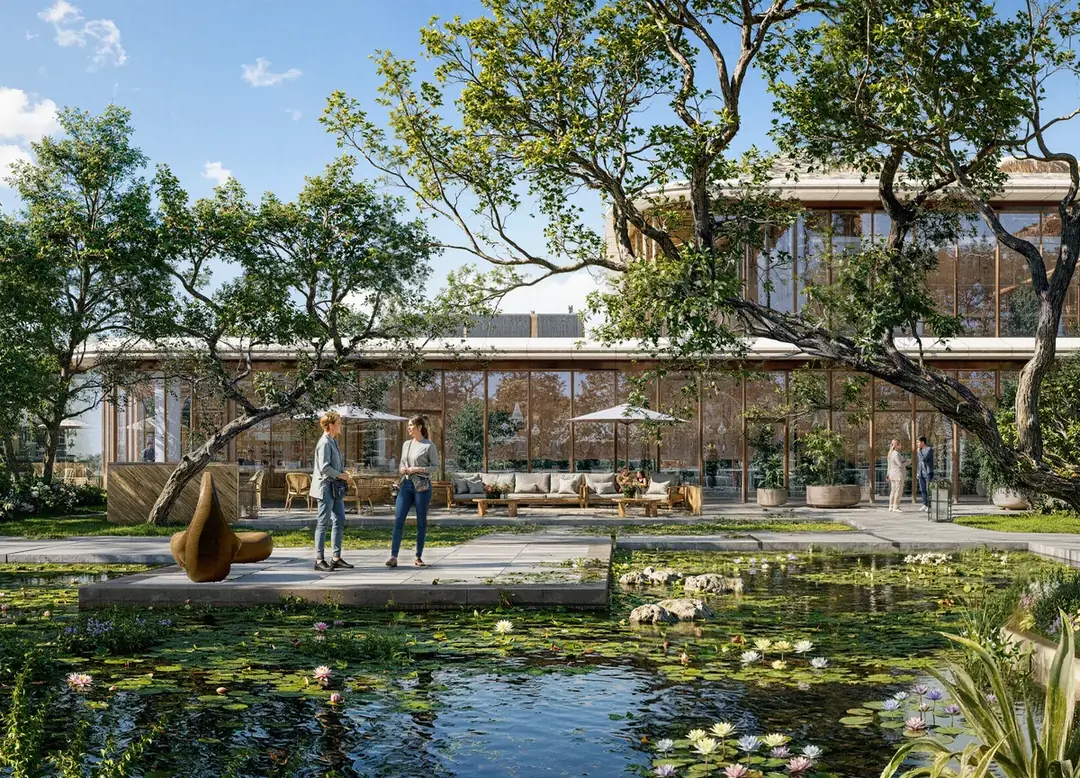
A landscaped garden courtyard with a lily pond and a glass pavilion, shown in an artist's conceptual rendering of a South Florida wellness-oriented residential development
Featured market analysis

The rise of wellness real estate in South Florida.

How healthy buildings, longevity and wellness-centred design are reshaping luxury residential development — and how a buyer can tell a permanent building system from a marketing sentence.

An independent research report. It does not rank, score or recommend any development. Projects appear as documented examples of broader approaches, and every one receives the same editorial treatment.

Independent analysis ~22 min read Updated August 2026

Artist’s conceptual rendering of a landscaped garden and pavilion at Anantara Residences Miami, supplied by the development team and reproduced here to illustrate biophilic design. Renderings depict intent rather than a constructed condition. Its use here is illustrative and is not an endorsement of that or any other development.

Executive summary

Wellness has become a second language for luxury real estate. Most buyers cannot yet read it.

Luxury residences have long been judged on location, architecture, view, service and amenity. Those criteria have not gone away. What has changed is that a growing share of South Florida developments now also make claims about health. Those claims range from independently verified building performance to a treatment room and a juice bar. This report explains the difference.

What is actually happening

Wellness has moved from the amenity deck into the building itself — ventilation, filtration, materials, acoustics, lighting, landscape — and, at the leading edge, into clinical-adjacent services and in-residence equipment.

Why it is hard to evaluate

“Wellness” is not a regulated term. There is no legal definition, no minimum standard, and no requirement that a building deliver what it markets. Certification exists, but it is voluntary and frequently misdescribed.

The distinction that matters most

Some features are architectural — built in and hard to remove. Others are operational — staff, contracts and budgets that can be cut or terminated. Buyers routinely pay for the second while assuming the first.

What this changes for a buyer

Wellness is an additional lens, not a replacement. It belongs alongside construction quality, developer strength, governance, reserves, insurance and resale liquidity — not in front of them.

$876B
Global wellness real estate market, 2025, per the Global Wellness Institute
$151B
The same market in 2017, on the GWI’s current methodology
$254B
United States share in 2025 — the largest single national market
23.6%
GWI-reported average annual growth, 2019 to 2025

Source: Global Wellness Institute data preview released May 12, 2026, ahead of the 2026 Wellness Economy Monitor. Figures are global and cover all wellness-oriented residential construction, not South Florida luxury condominiums specifically. The GWI has revised its own historical figures upward as its methodology developed, so read these as directional evidence of a growth trend rather than precise measurements.

Key findings

01

Certification language is the weakest link

Marketing uses “WELL Certified,” “WELL designation,” “designed to WELL principles” and “pursuing certification” interchangeably. They mean materially different things.

02

Two brands share one word

THE WELL is a private wellness hospitality brand. The WELL Building Standard is a certification programme run by an entirely different organisation. The overlap causes real confusion.

03

Longevity is moving indoors

Hyperbaric chambers, cryotherapy and diagnostics began as shared amenities. In 2026 they started appearing inside individual residences — which changes who maintains them and who pays.

04

Wellness is no longer only ultra-prime

A Brickell tower launched in 2026 with 656 compact residences from roughly $390,000 and a structured wellness programme. The positioning has begun to scale down in price.

05

Operating cost is the untold half

Clinical-adjacent facilities carry staffing, licensing, insurance and equipment-replacement costs. Those land in the association budget, the amenity fee, or both — for as long as you own.

06

Brand agreements are not permanent

A wellness operator’s involvement is usually a contract between developer and operator. Buyers are generally not party to it, and in many structures it can be amended or terminated.

Buyer implications in one paragraph

Ask which wellness features are built into the structure, which are equipment, and which are services. Ask who is contractually obliged to keep them running, for how long, and out of whose budget. Ask whether any certification claim is current, at what level, and whether it covers your residence or only the shared spaces. Then price the answer — the recurring cost of a wellness building is a permanent feature of ownership in a way the amenity photographs are not.

Reading time: approximately 22 minutes. Scope: South Florida residential development, with emphasis on Miami-Dade and Broward. Last reviewed: August 6, 2026.

Research methodology

How this report was built, and what it deliberately will not do.

This is an educational report for buyers, not a ranking, a guide to a single building, or marketing for any development. Holding to that required some rules, and it is fairer to state them than to leave them implied.

The report analyses publicly documented wellness strategies at selected South Florida developments. Projects are included because they illustrate a distinct approach worth explaining — not because they were judged better or worse than those absent. Several significant developments do not appear because a comparable public record was not available at review.

Every project receives the same treatment: what it is, what philosophy it appears to express, what wellness features are documented, and what a buyer would want to verify. Nothing is scored or recommended. Where two projects take opposite approaches, that is a difference in philosophy rather than in quality.

  • Developer materials are identified as such rather than presented as established fact.
  • Certification is stated only at the level that could be independently supported. Where current status could not be confirmed, the report says so instead of guessing in either direction.
  • Health outcomes are not claimed. This report describes what systems and facilities are designed to do, never what they achieve. Nothing here is medical advice.
  • Conflicting figures are disclosed rather than silently resolved, and announced pre-construction dates are labelled as targets.

TheBuyerRebate.com is the buyer-representation platform of Jordan Real Estate. We represent buyers. We are not the developer, sales gallery or marketing agency for any project named here, and we are not affiliated with the International WELL Building Institute, the Global Wellness Institute, or any brand, operator or developer discussed. We maintain pages on a few of these developments and link them where they exist; most projects here have no page and no link, which reflects editorial coverage rather than any view of the project.

Section one

The evolution of luxury living.

Luxury real estate has repeatedly redefined what it sells, and each redefinition absorbed the previous one rather than replacing it. Read the sequence below as accumulating layers, not historical periods. Several overlap, and a single building often expresses four at once.

  1. Layer

    Location

    The original and still the most durable variable. Waterfront, walkability, proximity, protection from what neighbours might build. Nothing that follows has displaced it.

  2. Layer

    Resort amenities

    Pool deck, spa, gym, private dining. Amenity became an arms race, and shared square footage grew accordingly — along with the cost of operating it.

  3. Layer

    Branded residences

    A hospitality brand attaches its name, service standards and design identity to a building. This brought hotel-grade service to condominium ownership, and with it contractual relationships most buyers had never had to read.

  4. Layer

    Smart homes

    Automation, controls, monitoring, app-based access. Important mainly because it normalised the idea that a residence contains systems needing servicing and eventual replacement.

  5. Layer

    Sustainability

    Energy, water, embodied carbon, resilience — and in coastal Florida, flooding, storm hardening and insurability. It established the precedent that matters most for what follows: third-party building certification.

  6. Layer

    Healthy buildings

    The pivot from the planet to the person. Ventilation and filtration, water treatment, low-emission materials, daylight, acoustics, thermal comfort. Largely invisible, mostly permanent, least likely to appear in a photograph.

  7. Layer

    Wellness

    Programming and service on top of the building: movement studios, thermal circuits, treatment rooms, nutrition, coaching. Where the market spends most of its marketing energy — and delivered by people and contracts rather than concrete.

  8. Layer

    Longevity

    The newest and least settled layer. Diagnostics, biomarker testing, recovery technology, sleep optimisation. It borrows vocabulary from medicine, raising questions of licensing, liability, staffing and cost that earlier layers never had to answer.

Why the sequence matters to a buyer

Each successive layer is generally less permanent and more expensive to operate than the one before. Location cannot be removed. A filtration system can be neglected. A programme can be cancelled at the end of a contract term. A longevity clinic can close if it does not pay for itself. Knowing which layer a feature belongs to largely determines whether it will still be there in ten years.

Section two

What wellness real estate actually means.

The Global Wellness Institute describes wellness real estate as built environments deliberately designed, constructed and operated to support the health of the people who use them. The useful word there is operated. A building can be designed for health and run in a way that does not deliver it.

The term covers at least eight distinguishable things, and a development may do any combination of them. Telling them apart is most of the work.

Healthy buildings
The physical fabric and its systems: ventilation rates, filtration, water treatment, low-emission materials, daylight, acoustic separation, thermal comfort. Largely permanent, and the hardest category to fake because it can be measured.
Lifestyle wellness
Facilities supporting healthy behaviour: fitness, movement studios, pools, walking loops, courts, outdoor space. Where luxury amenity and wellness genuinely overlap.
Hospitality-led wellness
A hotel or wellness operator runs the programme, bringing staffing, service standards and a brand — delivered through a management or licence agreement rather than the building.
Medical-grade wellness
Services resembling clinical practice: diagnostics, phlebotomy, intravenous therapy, physician oversight. Raises licensing, scope-of-practice and liability questions ordinary amenities do not.
Longevity
An orientation toward measured healthspan rather than treating illness: biomarker panels, sleep and recovery protocols, structured intervention over time. Newer and less standardised.
Recovery
Facilities aimed at recovery rather than exertion: sauna, steam, cold plunge, thermal circuits, hyperbaric oxygen, red-light. Often the most equipment-intensive part of an offering.
Environmental wellness
The relationship between building and setting: landscape, biophilic design, shade, breeze, water, planting. Cheap to claim, expensive to maintain, easy to verify with your own eyes.
Preventive design
Decisions that make the healthier choice the easier one — a stair you would actually use, a shaded route to the water, daylight in a corridor. Rarely marketed, because it is difficult to photograph.

Luxury amenity or wellness-oriented design?

A spa is an amenity. A ventilation system delivering filtered outdoor air at a verified rate is building design. Both can be valuable, but they are not the same purchase and behave completely differently over a twenty-year hold.

A rough test: if the feature would still be doing its job with nobody scheduled to run it, it is building design. If it stops the moment a contract lapses or a budget is cut, it is a service. Most marketing does not make this distinction. It is squarely in your interest to.

Section three

Healthy buildings, and the standard everyone cites.

The WELL Building Standard is the most frequently referenced health-focused building certification in residential marketing. It is administered by the International WELL Building Institute, which took over administration of single-asset WELL certification from Green Business Certification Inc. in February 2026; documentation review and performance verification continue to be carried out by an independent network of third-party reviewers. Understanding what it does — and does not do — is the most useful technical knowledge a wellness-oriented buyer can hold.

WELL is voluntary. No Florida building is required to pursue it, and a building without it is not thereby unhealthy. What it provides is a structured, externally reviewed way of demonstrating that specific health-related commitments were met rather than merely intended. The current widely used version, WELL v2, organises requirements into ten concepts; the plain-language summaries below are ours, written for buyers rather than project teams.

Air

How much outdoor air arrives, how it is filtered, and what was kept out of the building to begin with.

Water

Quality, treatment and testing of water people drink, bathe in and swim in.

Nourishment

The on-site food environment, and whether the healthier option is a realistic one.

Light

Daylight, glare control and lighting designed around the daily cycle of alertness and sleep.

Movement

Design that makes activity likely rather than merely possible: stairs, circulation, fitness space.

Thermal comfort

Temperature and humidity control, with individual adjustment. In South Florida, humidity is the harder half.

Sound

Separation between residences and from outside. Chronically undervalued until buyers move in.

Materials

Restricted hazardous substances and low-emission finishes, adhesives, sealants and furnishings.

Mind

Restorative space and connection to nature, supporting mental rather than physical performance.

Community

Inclusive design, accessibility, emergency preparedness and a building's social infrastructure.

Source: International WELL Building Institute, WELL v2. Concept names are the Institute’s; the descriptions are this report’s plain-language summaries and are not a substitute for the standard itself.

How a project earns certification

Projects register, document their approach and submit evidence for third-party review. Some requirements are preconditions — mandatory, no exceptions. Others are optimisations, which earn points. Levels under WELL v2 are Bronze, Silver, Gold and Platinum, awarded on points achieved.

Two features separate WELL from a design intention. Performance verification means an assigned agent conducts on-site testing: the building is measured, not described. Recertification means certification lasts three years, after which a project must repeat the process, with ongoing data submitted in the interim. A building certified in 2021 and never recertified is not currently certified.

IWBI also runs related but distinct programmes — the WELL Health-Safety, Performance and Equity Ratings. These are ratings, not WELL Certification, and it is worth checking which a project holds.

Two different organisations, one word

This is the most common point of confusion in the South Florida market. The WELL Building Standard is a certification programme run by the International WELL Building Institute. THE WELL is a private wellness hospitality brand that operates clubs and has partnered on branded residences. They are entirely separate organisations with no relationship to one another.

A residence branded by THE WELL is not for that reason WELL Certified, and a WELL Certified building has no connection to THE WELL. Both usages appear in Miami marketing, sometimes on the same page. Establish which is meant before drawing any conclusion.

An original framework

The Wellness Real Estate Spectrum.

We could not find an existing model that let a buyer place a development without implicitly ranking it, so we built one. The spectrum is arranged on a single descriptive axis: how deeply wellness is embedded in the permanent fabric of the building, versus how much is delivered as an ongoing service. That is a question of approach, not quality. Neither end is better.

← Delivered mostly as facility & service Embedded mostly in building & systems →
Mode 01

Traditional luxury amenities

A spa, gym, pool, treatment room. Excellent facilities, offered without a health claim about the building itself.

Verify Hours, access, who operates them, and what happens to the budget in year five.

Mode 02

Healthy building design

Health located in the fabric: air, water, light, acoustics, materials, thermal comfort. Often invisible, sometimes certified.

Verify Certification status and level, or the actual specifications where there is no certification.

Mode 03

Wellness programming

A structured, staffed programme — classes, coaching, nutrition, membership — layered on top of the facilities.

Verify Who runs it, under what contract, for how long, and what is included versus billed.

Mode 04

Longevity infrastructure

Diagnostics, recovery technology and clinical-adjacent services, whether shared on an amenity level or built into a residence.

Verify Licensing, staffing, liability, equipment replacement, and who pays for all four.

Mode 05

Integrated wellness ecosystems

Building, programme, operator and setting designed together, so wellness is the organising idea of the development.

Verify What survives if the operator leaves, and how much of the ecosystem is contractual rather than structural.

The Wellness Real Estate Spectrum is an original educational framework developed by The Buyer Rebate Intelligence Hub. It describes approach, not merit. Most developments occupy more than one mode at once, and a building strong in Mode 02 and absent from Mode 04 is not thereby worse — it is differently conceived.

How to use it

Place the building, then place yourself. A buyer who wants clean air, quiet rooms and good light and will never book a treatment is buying Mode 02 and should not pay a premium for Modes 03 and 04. One who will genuinely use a longevity programme three times a week is buying Mode 04 and should care more about the operator’s contract than the filtration spec. Mismatch between the two is the most common way buyers overpay here.

Section four

Six philosophies, not six competitors.

Developments arrive at wellness from different starting points, and those starting points produce genuinely different buildings. What follows describes approaches. A project expressing one philosophy is not attempting and failing to express another.

A

Healthy building design

Starts with the fabric: measurably better performance than code on air, water, light, sound and materials. Quiet in marketing terms, because its best work is invisible.

B

Hospitality-led wellness

Starts with the operator. A hotel or resort brand brings service culture, staffing and programming, and the governing document is a management agreement.

C

Wellness-branded residences

Starts with a wellness brand rather than a hotel brand. Its methodology, membership and practitioners are the product, and residences are designed around them.

D

Longevity infrastructure

Starts with the technology. Diagnostics, recovery and biomarker-driven protocols are infrastructure to install — increasingly inside the residence.

E

Medical-grade wellness

Starts with clinical practice: licensed practitioners, physician oversight and diagnostics on site. The heaviest regulatory and insurance load of any approach here.

F

Resort wellness

Starts with the destination: a large spa and thermal offering, and residents sharing facilities with guests or members. The most operationally mature model.

The trade-off no philosophy escapes

Depth of service and permanence of benefit pull against each other. Sophisticated programming depends on people, contracts and budgets, all of which can change. The durable features — a well-built envelope, generous ventilation, real acoustic separation, mature landscape — rarely lead a brochure. A serious wellness building does both, and a buyer should check that both are present rather than assuming the visible half implies the invisible one.

Section five

South Florida case studies.

Seven developments, each illustrating a different approach. These are profiles, not reviews. There is no score, ranking or recommendation, and the order broadly follows position on the spectrum above rather than any judgement of merit. Facts are attributed to their source, and where a figure is disputed between sources, both are given.

2200 Brickell

Brickell, Miami · Delivered
Illustrates Healthy building design in a low-rise, landscape-led format — Modes 01–02 on the spectrum.

A five-storey building on the residential stretch of Brickell Avenue. Reporting in July 2026 confirmed a Temporary Certificate of Occupancy and the start of occupancy. Residence counts appear as both 103 and 105 across sources, including from the developer at different points.

The interesting decision is the massing. Instead of a tower on a podium, 2200 Brickell is long, low and set back behind landscaping, with an amenity level that reads as a one-acre garden rather than a deck — permanent in a way programming is not.
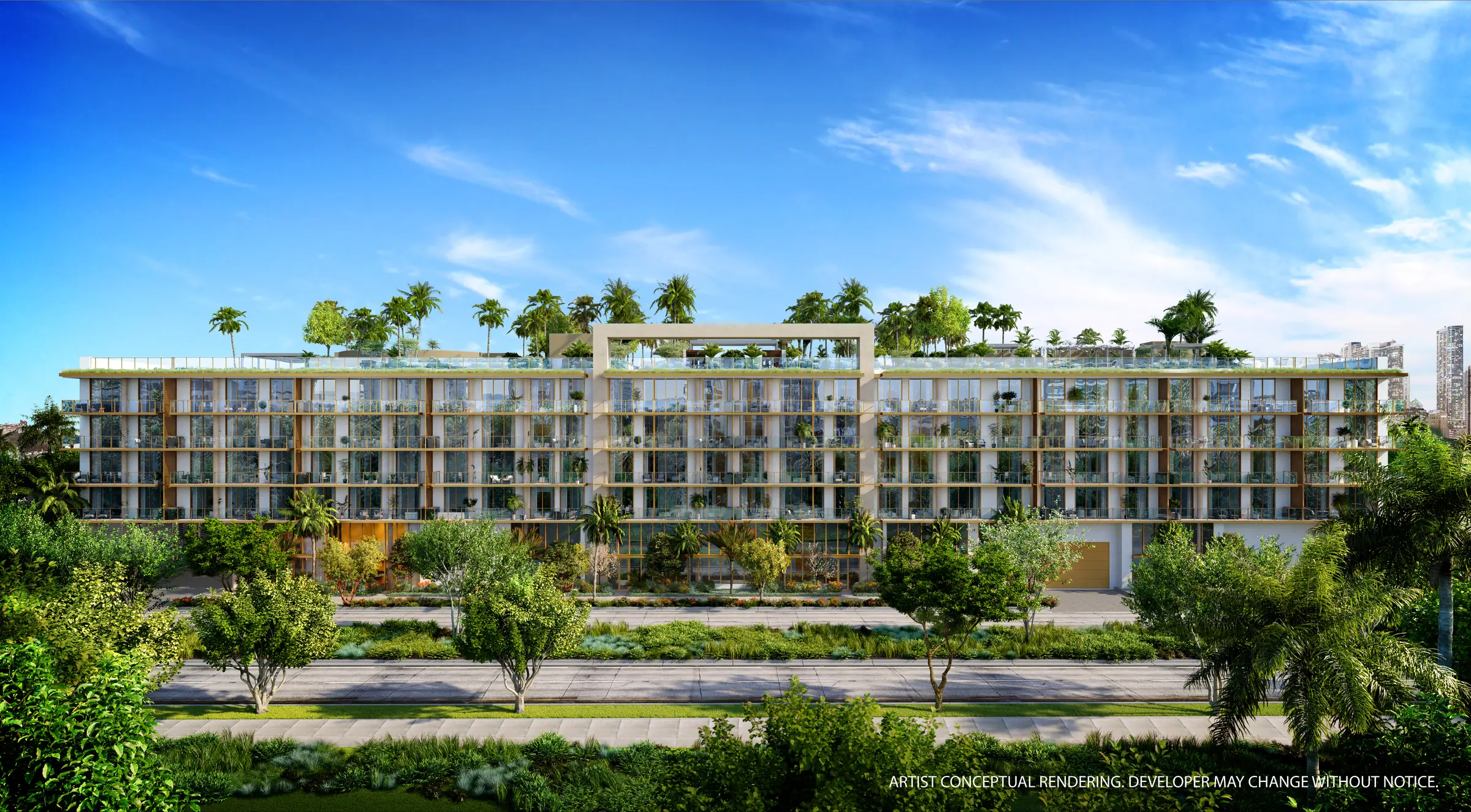
2200 Brickell, a five-storey residential building on Brickell Avenue in Miami, with rooftop palms and landscaped frontage
2200 Brickell on Brickell Avenue. Artist’s conceptual rendering supplied by the development team; the developer may change the design without notice. The low, horizontal massing and the planted roof are the decisions most relevant to this report.

Documented wellness features

Developer materials describe a Vitality Club fitness centre by Homage Fitness, a Wellness Lounge with treatment suite, a heat suite, an Oasis Pool and Spa with cabanas, and a rooftop level with resort-style pool, quarter-mile walking track, pickleball court and outdoor fitness area. The same materials describe a WELL Building Standard designation.

On the certification question

This project illustrates the problem the report keeps returning to, and we raise it as an example of imprecise market language rather than a criticism of the development. Developer materials and several listings refer to a “WELL Building Standard designation.” At least one trade outlet, covering the 2024 groundbreaking, described the building as “crafted as a WELL Certified building.” Those are not the same statement. We have not independently confirmed a current WELL Certification at any level or under any pathway, so we state one in neither direction. Ask for the level, version, pathway and award date, and confirm against IWBI’s own records — the right procedure everywhere, not a special precaution here.

Developers
Aria Development Group, Largo, Place Projects
Design
Revuelta Architecture International; interiors by ODA New York
Scale
Five storeys; 103–105 residences depending on source; approximately 1.7-acre site
Status
Temporary Certificate of Occupancy reported July 2026; occupancy under way
Buyer considerations
Confirm certification status directly; a TCO permits occupancy without confirming every amenity is operating; review the first operating budget

Our maintained page: 2200 Brickell buyer rebate and project detail.
THE WELL Bay Harbor Islands

Bay Harbor Islands · Delivered
Illustrates Wellness-branded residences with an integrated club and workplace — Modes 03 and 05.

An eight-storey building at 1177 Kane Concourse co-developed by Terra and the wellness brand THE WELL. Reporting in April 2026 confirmed a Temporary Certificate of Occupancy, making it the brand’s first delivered branded residential project. It combines 66 residences with roughly 102,000 square feet of office and a wellness club; at TCO, reporting placed residences around 90% sold and offices around 90% leased. Amenity area has been reported at more than 22,000 square feet, anchored by a wellness centre of around 13,000. Rather than adding wellness to a residential building, it puts homes, workplaces and a club into one membership-based environment.

What the timeline teaches

The project also provides an unusually clear record of how pre-construction plans move. Announced in 2023 with an opening originally targeted for December 2024, it was described in early materials as 54 residences and delivered with 66, after a $238 million refinancing reported in November 2025 from Eldridge Real Estate Credit and Hudson Bay Capital Management. Delivery came in April 2026.

None of that is improper; scope, unit mix and schedule commonly change in pre-construction. It is included because it documents what a buyer signing a pre-construction contract accepts: what is described at signing may differ in count, timing and financing from what is delivered. The binding language is in the purchase agreement, not the brochure.

Developers
Terra with THE WELL
Design
Arquitectonica; interiors by Meyer Davis
Scale
Eight storeys; 66 residences; approximately 102,000 sq ft of office
Status
Temporary Certificate of Occupancy reported April 2026
Buyer considerations
What the membership includes and costs; whether club access runs with the residence; how mixed-use expenses are allocated

TheBuyerRebate.com does not maintain a page on this development, and none is linked.

THE WELL Residences, Coconut Grove

Coconut Grove, Miami · Under construction
Illustrates The same wellness brand applied at larger scale in a mature residential neighbourhood — Modes 03 and 05.

Terra’s second project with THE WELL broke ground in February 2026 with a reported $410 million construction loan. It is a materially different proposition from Bay Harbor Islands despite sharing a brand and design team: 194 residences across eight storeys, targeting completion in 2028, with more than 40,000 square feet of rooftop and club amenities anchored by a wellness club reported at around 13,000 square feet. Residence types run from one- to four-bedroom homes to lofts and townhomes with private garden entries, with in-residence wellness features described throughout rather than confined to shared floors.

The comparison is instructive: the wellness club is roughly the same size in both, while the residence count triples. Any buyer evaluating an amenity-led building should do that arithmetic — not how large the facility is, but how large per residence.

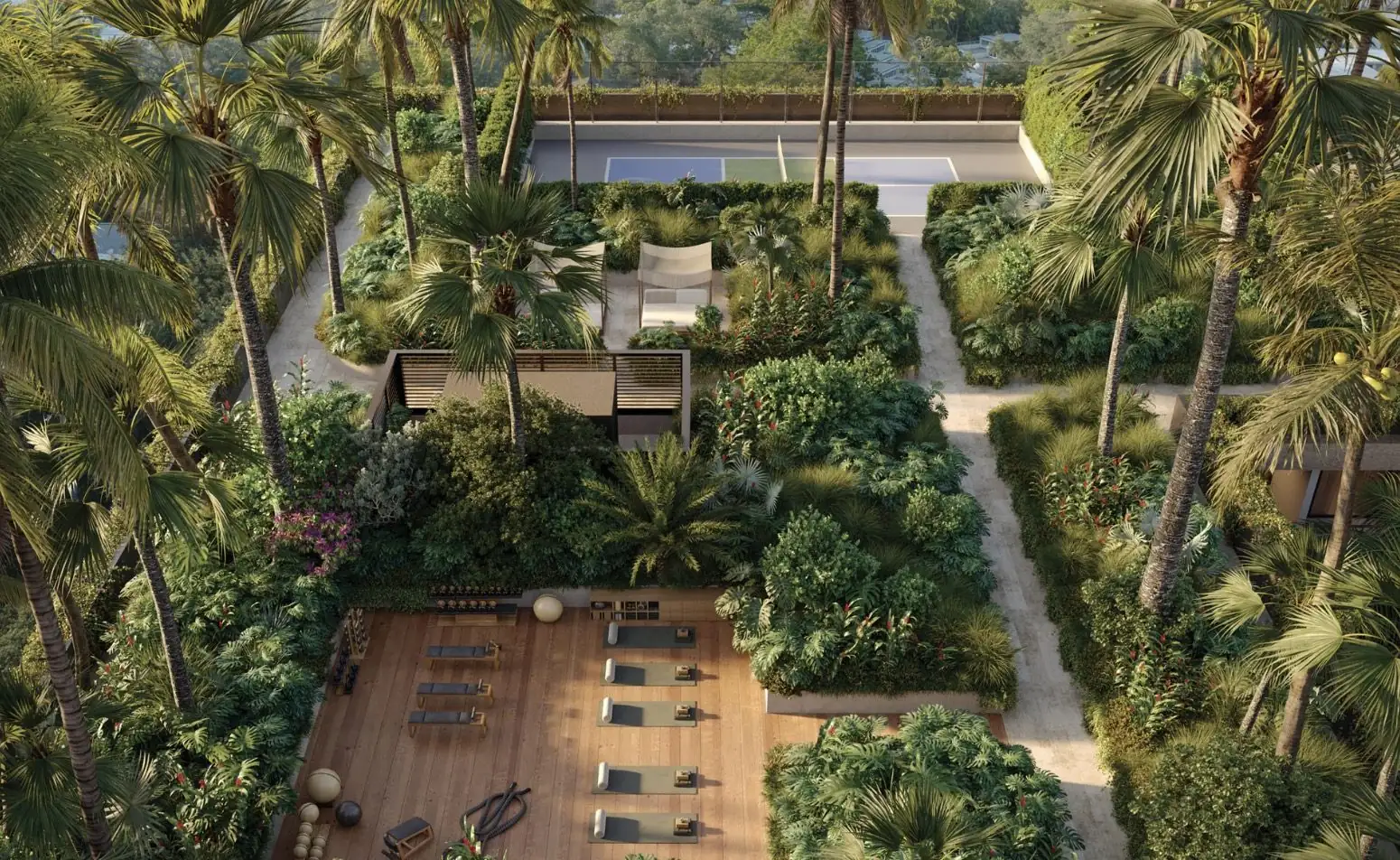
Aerial view of a landscaped wellness garden with an outdoor movement deck, tropical planting and a sport court at THE WELL Residences, Coconut Grove
The landscaped wellness garden and outdoor movement deck at THE WELL Residences, Coconut Grove. Artist’s conceptual rendering supplied by the development team; final design and features are subject to change.
Developers
Terra with THE WELL
Design
Arquitectonica; interiors by Meyer Davis
Scale
Eight storeys; 194 residences; 40,000+ sq ft of amenities
Status
Under construction; completion targeted for 2028 — an announced target, not a commitment
Buyer considerations
Amenity capacity per residence; which in-residence features are standard versus upgrades; deposit schedule and outside completion date

Our maintained page: THE WELL Residences, Coconut Grove buyer rebate and project detail.

Anantara Residences Miami

Edgewater, Miami · Announced
Illustrates Hospitality-led wellness combined with dedicated longevity infrastructure — Modes 03, 04 and 05.

Announced in April 2026 as the Anantara brand’s first residential project in the United States, this is a planned 50-storey tower of approximately 650 feet at 3601 Biscayne Boulevard. Developer materials describe 50 hotel suites on levels 8 to 10, 120 Resort Residences on levels 11 to 23, and 100 Condominium Residences on levels 24 to 46, with penthouses above and a helipad at the crown.

What makes it relevant is the vertical allocation. Developer materials describe a Vitality & Longevity Center of more than 30,000 square feet on its own floor — level 6, overlooking Biscayne Bay — within more than 130,000 square feet of amenities. Giving it a dedicated floor rather than a suite within a fitness level is the clearest expression in this report of wellness as an organising principle rather than an amenity.

Documented wellness programme

Developer materials organise the centre around four pillars. Movement: Technogym strength and functional training, yoga, a Pilates and reformer studio, boxing and Muay Thai. Vitality: consultation rooms, longevity protocols, an intravenous vitamin and mineral lounge, cryotherapy and hyperbaric oxygen therapy, advanced diagnostics and phlebotomy. Nutrition: juice, tonic and medicinal tea bars and a nutritional cafe. Rest and recovery: treatment rooms, a Himalayan salt hammam, communal sauna and steam, red-light zones, and hot, cold and thalasso therapy pools.

The same materials describe the building as designed to Florida Green Building standards and aligned with both WELL Building and Fitwel principles. Alignment with principles is not certification under either programme, and this report does not treat it as such.

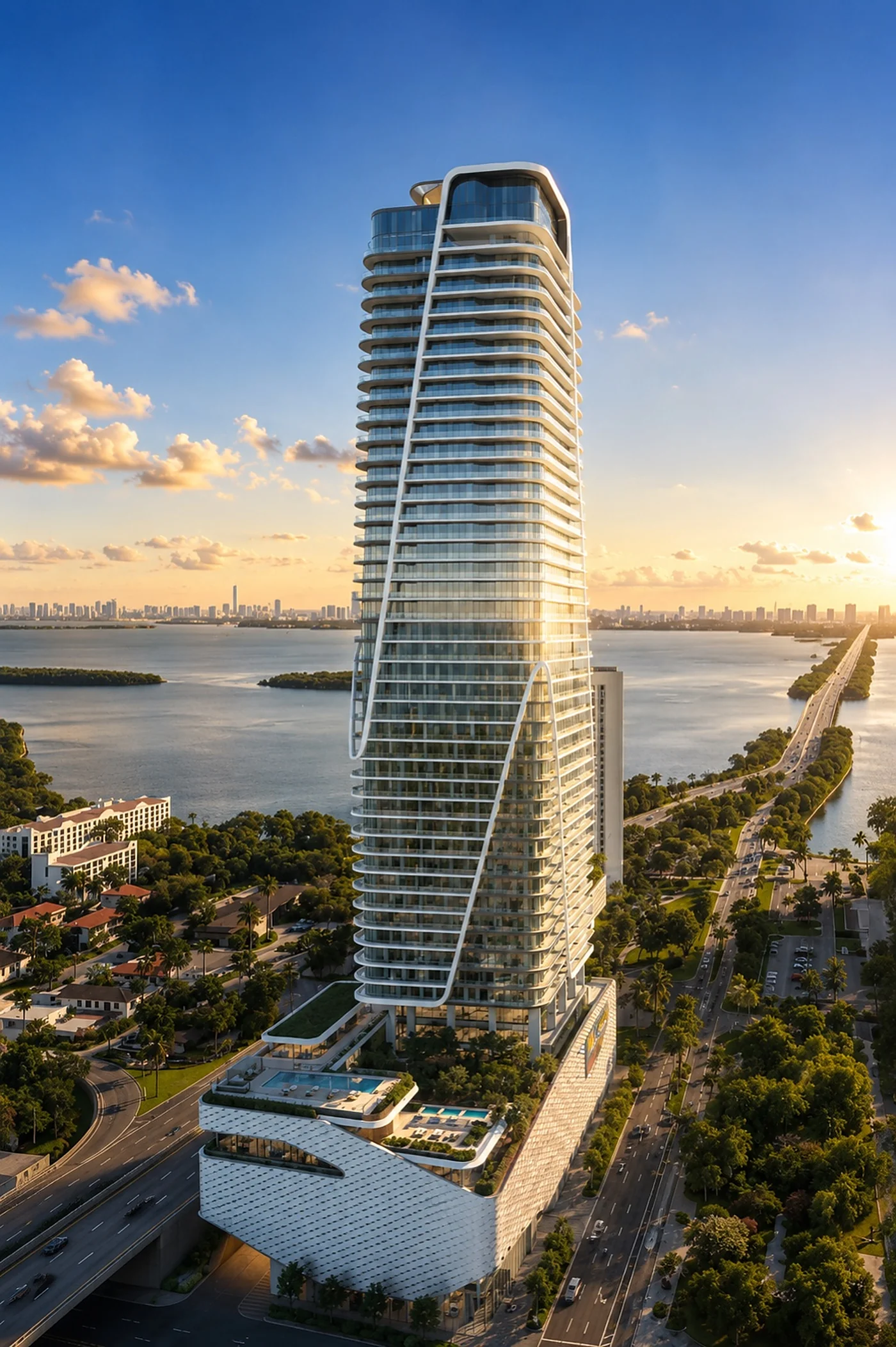
The planned Anantara Residences Miami tower in Edgewater, a tapering curved glass form on a landscaped podium above Biscayne Bay
The planned tower at 3601 Biscayne Boulevard, with the landscaped podium carrying gardens above street level. Artist’s conceptual rendering supplied by the development team; final design and features are subject to change. Construction had not begun as of the July 2026 review of the project.

The structural question a buyer should ask here

A tower containing a hotel, serviced Resort Residences and private Condominium Residences is three products sharing one address. How they share expenses, amenity access, budgets and rental rights is defined in the governing documents — the most consequential thing to read before contracting. The same applies to the brand: a management or licence agreement is between developer and operator, not between the operator and you, and can often be amended or terminated. Sales were anticipated later in 2026 and an opening reported for 2030; those are announced targets.

Developer entity
Tower 36 Owner, LLC; development team 1000 Group
Brand
Anantara Hotels, Resorts & Spas, part of Minor Hotels
Design
Kohn Pedersen Fox with ODP Architects; interiors Studio Patricia Urquiola; landscape P Landscape with EDSA
Scale
50 storeys, approximately 650 ft; 130,000+ sq ft of amenities; Vitality & Longevity Center of 30,000+ sq ft on level 6
Status
Announced April 2026; sales launch anticipated later in 2026; opening reported for 2030
Buyer considerations
Which services are in the maintenance fee and which are billed; how the hotel-and-residential structure allocates cost; what happens if the management agreement ends

Our maintained page: Anantara Residences Miami buyer rebate and project detail. See also our Edgewater neighbourhood guide.

Rivage Bal Harbour

Bal Harbour · Under construction
Illustrates Longevity infrastructure relocated from the amenity floor into the private residence — Mode 04.

An oceanfront tower by Related Group, Two Roads Development and Rockpoint. Reported figures vary: 24 or 25 storeys, residence counts of 54, 56, 61 and 63, delivery reported as both 2027 and 2028, and more than 25,000 square feet of wellness amenity including a fitness pavilion, spa and racquet facilities. We flag the inconsistency rather than resolving it: when basic figures differ across sources, the only reliable version is in the current offering documents.

Why this project matters to the analysis

In July 2026 an upper penthouse at Rivage was revealed at a $75 million asking price, organised around what was described as a dedicated Longevity Suite: an in-residence wellness wing reported to include a hyperbaric chamber and an “Ammortal Chamber,” alongside a sauna, steam room, circadian lighting throughout the residence, advanced air and water purification, and bedrooms designed around sleep.

This report takes no position on what those technologies do, which is a medical question and not a real-estate one. The structural shift is what matters: recovery infrastructure that spent a decade migrating into shared amenity floors has moved through the front door of the residence. That relocates every practical question — maintenance, warranty, insurance, power and water, resale, eventual removal — from the association to the owner. It is a capital asset with a service life and a replacement date.

Developers
Related Group, Two Roads Development, Rockpoint
Design
Skidmore, Owings & Merrill; interiors Rottet Studio; landscape Enea Garden Design
Scale
Reported as 24–25 storeys and 54–63 residences depending on source
Status
Under construction; delivery reported variously as 2027 and 2028
Buyer considerations
Service life, warranty and replacement cost of in-residence equipment; resale impact; confirm all figures against current offering documents

TheBuyerRebate.com does not maintain a page on this development, and none is linked. See our Bal Harbour buyer guide for the wider market.

House of Wellness Brickell

Brickell, Miami · Pre-construction
Illustrates Wellness programming decoupled from ultra-luxury pricing — Mode 03 at scale.

Sales launched in February 2026 for a 34-storey tower at 152 SW 9th Street by North Development. It is planned for 656 residences — studios, one- and two-bedroom homes, sizes reported from roughly 337 to 676 square feet — with pricing reported to start around $390,000 and delivery expected in Q1 2030.

The wellness offering is reported at more than 22,000 square feet: a spa with hammam, sauna, steam room and cold plunge, indoor and outdoor fitness, treatment rooms, co-working, a juice bar and a salon. The distinguishing element is programmatic rather than physical — a structured ongoing programme, described by the developer as an Integrated Wellness Method, delivered through an app with on-site practitioners.

Why it belongs in this report

Every other case study sits in the luxury or ultra-luxury band. This one does not, and that is the point. If wellness positioning were only a device for justifying ultra-prime pricing, it would not appear at this price point and unit count — which suggests the market now treats wellness as a mainstream product feature rather than a trophy differentiator.

It also concentrates the report’s central caution. A programme is the least permanent form wellness can take. Ask what it costs, whether it is in the maintenance fee or billed separately, what obligation exists to continue it, and what the association’s options are if it becomes uneconomic.

Developer
North Development, a joint venture of Oak Capital and Edifica
Design
Studio MC+G Architecture; interiors Urban Robot Associates
Scale
34 storeys; 656 residences; 22,000+ sq ft of wellness and lifestyle amenities
Status
Pre-construction; sales launched February 2026; delivery reported as expected in Q1 2030
Buyer considerations
Cost and contractual durability of the programme; amenity capacity across 656 residences; rental and use restrictions

TheBuyerRebate.com does not maintain a page on this development, and none is linked. See our Brickell buyer guide for the wider market.

Carillon Miami Wellness Resort

North Beach, Miami Beach · Operating
Illustrates Resort and medical-grade wellness, tested by years of actual operation — Modes 04 and 05 in mature form.

Carillon is included for a reason none of the others can offer: it has been running for years. An oceanfront resort and residential property in North Beach, it operates a spa and wellness centre reported at 70,000 square feet and described as the largest on the Eastern Seaboard, with a thermal hydrotherapy circuit and a medical wellness division. Everything the newer projects are planning, Carillon has been doing — which makes it the most useful reference point here, because operating history answers questions renderings cannot.

What an operating precedent demonstrates

  • Wellness facilities are businesses. A large spa with clinical services carries payroll, licensing, insurance, consumables and equipment servicing. It must either generate revenue or be subsidised by owners.
  • Programming changes. Modalities, practitioners and schedules evolve continuously. Anything described as a fixed feature at the point of sale is a snapshot.
  • Mixed use creates shared cost. When residents, guests and members use the same facilities, expense allocation and priority of access are governed by documents, not goodwill.
  • Equipment has a service life. Thermal, hydrotherapy and recovery installations are maintenance-intensive, and reserve studies need to account for them.
Type
Operating oceanfront wellness resort with residences
Wellness facility
Reported at 70,000 sq ft, including a thermal hydrotherapy circuit and a medical wellness division
Residences
One- and two-bedroom apartments reported at roughly 720–1,200 sq ft
Status
Operating
Buyer considerations
Ownership structure and rental terms; expense allocation between residential and resort use; reserve funding for wellness equipment

TheBuyerRebate.com does not maintain a page on this property, and none is linked. See our Miami Beach buyer guide for the wider market.

Reading the seven together

Set side by side, the group does not describe a competition. It describes a market working out, in public and in real time, where health belongs in a building. One put it in the massing and the landscape. Two put it in a brand and a club. One gave it a dedicated floor. One moved it inside the residence. One brought the price down and the unit count up. And one has been running the whole apparatus long enough to know what it costs. A buyer’s task is not to decide which is right, but which matches how they will actually live.

Section six

Certification, and how to check one.

A certification is a claim someone else has checked. That is its entire value, and the mechanics of the check are set out in Section 3. What follows is the practical part: establishing whether the checking actually happened, when, and to what.

The pathway question that most affects a residential buyer

There is a certification pathway aimed at core and shell buildings, under which the base building and common areas are certified while individual interiors are not necessarily covered. In a condominium this is not academic. It is the difference between “the amenity level and the building systems were verified” and “your apartment was verified.” Both are legitimate; they are not equivalent, and marketing rarely separates them.

Five questions that settle it

  1. Certified, precertified, registered, or designed to the principles? Ask for the word, then ask for the document.
  2. What level, under which version? Bronze, Silver, Gold or Platinum, and under which release of the standard.
  3. Which pathway, and what does it cover? Specifically, whether your residence is inside the certified scope.
  4. When was it awarded and when does it expire? Then ask whether recertification appears in the association’s operating budget.
  5. Certification or a rating? A health-safety, performance or equity rating is a different programme from WELL Certification.

Confirm the answer against the certifying body’s published records rather than a brochure, a listing site or a press release from the year of groundbreaking. This report found the same building described three different ways by three different sources, which is not unusual and is not necessarily anyone’s bad faith. It is what happens to a technical term once it enters marketing circulation.

A building without certification is not an unhealthy building

Certification costs money and takes time, and plenty of well-built projects skip it. The absence of a certificate tells you nothing was independently verified — not that the building performs badly. Ask for the specifications directly: outdoor air rates, filtration ratings, water treatment, acoustic ratings between residences, emissions standards for finishes. A developer who has genuinely invested in these can produce them. One who cannot has told you something useful too.

Section seven

A framework for evaluating any wellness-oriented development.

Eight questions. They work on a delivered building and on a hole in the ground, on ultra-prime and on entry-level, and they do not require you to hold a view about any particular therapy. Take them to the sales gallery in this order.

Is the wellness infrastructure permanent?

Separate the offering into structure, equipment and service. A ventilation system is structure; a cryotherapy chamber is equipment with a service life; a health coach is a service. All three can be worth paying for, but only the first is close to permanent.

Ask: which are part of the building, which are association-owned equipment, and which exist only while a contract runs?

Are the amenities operational or architectural?

An architectural feature works whether or not anyone is scheduled; an operational one requires staff, hours, booking and budget. A treatment suite with no practitioner is a room. On delivered buildings, ask what is open today: a temporary certificate of occupancy permits residents to move in and does not mean every amenity is running.

Ask: what is open now, what is not, on what date, and who is contractually responsible for it?

Is any certification independently verified and current?

Use the five questions in the previous section, then confirm against the certifying body’s records.

Ask: may I see the certification document, and does its scope include my residence?

Who maintains it, and under what obligation?

Find the contract. Brand and operator relationships are agreements between the developer or association and the operator; buyers are usually not party to them. Establish the term, renewal mechanism, termination rights, and what the building reverts to if the operator leaves.

Ask: how long does the operator agreement run, who can terminate it, and what happens to branding and programme if they do?

What does it cost to run, every year, forever?

The question most often skipped and most likely to matter. Wellness-heavy buildings carry higher operating costs: staffing, licensing, insurance, utilities for pools and thermal circuits, and periodic equipment replacement. Read the budget and the reserve study, and ask whether wellness equipment is included in reserves — if it is not, its replacement arrives as a special assessment.

Ask: what is the projected monthly assessment per square foot, what share is wellness operations, and are those assets in the reserve study?

What is the capacity per residence?

Divide the wellness square footage by the number of residences, then think about peak hours. A generous facility shared by 66 homes is a different asset from the same facility shared by 656. Then ask whether guests, members, hotel occupants or office tenants also have access.

Ask: how many treatment rooms, how is booking allocated, and who else has access?

Will this still be an asset to the next buyer?

Some features have broad appeal — good air, quiet rooms, daylight, mature landscape. Others are specific to a particular enthusiasm and may narrow the resale pool, especially where specialised equipment sits inside a residence. If a feature carries a premium today, ask what supports that premium in a decade.

Ask: what did comparable residences without these features sell for, and what is the premium buying?

Does the philosophy match how you will really live?

The most expensive mistake in this segment is buying an aspiration. Facilities you use twice a year still appear in your assessment every month. Be candid about which of the five modes fits your habits, and pay less for the ones that do not.

Ask yourself: on an ordinary Wednesday, what would I actually use?
Buyer economics

The recurring cost of wellness, which nobody puts in the brochure.

Wellness is sold as a capital decision and lived as an operating one. The price is paid once; the building is run every month for as long as you own it, and in Florida that sits alongside insurance, reserves and structural obligations that have already reshaped condominium budgets statewide. None of this argues against wellness buildings. It argues for pricing them accurately.

What each mode on the spectrum typically implies for ongoing cost and durability. Directional only; the governing documents and operating budget for a specific project always govern.
ModePrincipal ongoing costWhat can reduce or remove itRelative durability
Traditional amenities Maintenance, utilities, cleaning, periodic refurbishment Budget pressure; deferred maintenance Moderate to high
Healthy building design Filter replacement, system servicing, water treatment, commissioning, any recertification Neglect rather than removal; performance degrades quietly High — if maintained
Wellness programming Staffing, practitioner contracts, software, insurance, programming Contract expiry, operator exit, a board vote on the budget Low to moderate
Longevity infrastructure Specialised staffing, licensing, liability insurance, consumables, equipment servicing and replacement Economics, regulation, staffing, equipment reaching end of life Low without funded reserves
Integrated ecosystems All of the above, plus the operator or brand fee Termination or amendment of the operator agreement Depends almost entirely on contract terms

Three documents worth more than any tour

The operating budget shows what the building intends to spend and on what; wellness items appear under staffing, contracted services and utilities. The reserve study shows which assets are funded for replacement — specialised wellness equipment is the category most likely to be missing, which converts a predictable expense into a future special assessment. The operator or brand agreement shows how long the experience you were sold is contractually obliged to exist. All three are ordinary condominium due diligence, and they matter more here precisely because there is more to run.

Delivery slippage, association litigation, reserve funding, insurance repricing and developer financial position affect whether a purchase turns out well, and none appear in a rendering. Recent examples from our coverage include a lender’s foreclosure action against a branded pre-construction developer, what a condominium’s litigation reveals about its finances, and how shifts in supply change buyer leverage. Read them as illustrations of the questions worth asking, not as commentary on any building in this report.

Section eight

The wellness real estate glossary.

Sixteen terms a buyer will meet in a South Florida sales gallery.

Healthy building
A building designed and operated to support occupant health through its physical systems. Not a regulated term, so it means whatever the person using it intends unless backed by a specification or certification.
Biophilic design
Design that connects occupants to nature: planting, daylight, natural materials, water, views. Planting depth, irrigation and long-term maintenance separate it from decorative greenery.
Circadian lighting
Lighting designed around the daily cycle of alertness and rest, typically varying intensity and colour temperature. Implementations vary widely; ask what is installed and whether residents can control it.
Hyperbaric therapy
Breathing oxygen in a pressurised chamber. It appears as an amenity or as in-residence equipment, with installation, servicing, supervision and insurance requirements.
Cold plunge
A cold-water immersion pool, usually paired with sauna or steam in a contrast circuit. Simpler than most recovery equipment, though chilling and water treatment carry real running costs.
Recovery suite
A grouped set of recovery facilities. The term is descriptive rather than defined; ask for the equipment list, not the label.
Air filtration
Removal of particulates and, in some systems, gases from the air supply. Effectiveness depends on filter grade, outdoor air volume, how well the system is sealed, and whether filters are changed.
Water purification
Treatment beyond municipal supply, at the building or the residence. Ask what is treated for, and who pays for media replacement.
Thermotherapy
Therapeutic use of heat — sauna, steam, hammam, laconium, infrared — often combined with cold immersion. Among the most maintenance-intensive amenities a building can carry.
Longevity medicine
Extending healthspan through measurement and early intervention rather than treating illness after onset. In a residence it raises licensing and liability questions.
Hospitality-led wellness
A wellness offering delivered by a hotel or resort operator under contract. The agreement, not the building, makes the service exist.
Healthy materials
Finishes, adhesives, sealants and furnishings selected for low emissions and restricted hazardous content. Invisible after handover, which is why third-party verification matters here.
WELL Building Standard
A voluntary health-focused certification: ten concepts, mandatory preconditions, point-earning optimisations, on-site verification, four levels, three-year term.
IWBI
The International WELL Building Institute, which administers the WELL Building Standard and, since February 2026, the administration of single-asset WELL certification previously handled by Green Business Certification Inc. Reviews remain with an independent network of third-party reviewers. Unrelated to any private wellness brand using a similar word.
Preventive wellness
Reducing the likelihood of future illness rather than responding to current illness. In buildings, design that makes healthier behaviour easier.
Medical-grade wellness
A marketing term rather than a regulatory category, generally indicating services delivered by licensed practitioners, sometimes with physician oversight. It does not by itself indicate any level of clinical governance; ask who is licensed for what, and by whom they are supervised.
Buyer representation

Where a rebate fits into all of this.

Nothing in this report changes because of a rebate, and a rebate is no substitute for the diligence described above. But if you are going to buy in this segment, the compensation structure is worth understanding, because it is one of the few variables in a new-development purchase genuinely within your control.

Developers commonly pay a buyer-agent commission on new-development purchases, and the price is the same whether or not you bring your own representative. Where Jordan Real Estate is engaged as your buyer representative and receives that compensation on an eligible transaction, eligible buyers receive up to 50% of our buyer-agent commission back at closing, subject to transaction terms, lender and closing requirements, broker and project cooperation where applicable, and buyer eligibility.

Timing matters more than the arithmetic. Registration and procuring-cause questions are usually decided at first contact, so speak to a representative before you visit a sales gallery or submit an inquiry form.

Estimated buyer rebate Illustration only
$3,000,000
$400,000$20,000,000
Example buyer-agent commission$90,000
Your estimated rebate — up to$45,000

Illustration only — not a quote, an offer or a guarantee. Commission rates are set by developers and vary by project, and not every project or transaction makes buyer-agent compensation available. Your actual rebate, if any, depends on the compensation actually received, your written buyer-representation agreement, lender approval of credits where financing is involved, and closing terms. We confirm the applicable figure in writing before you commit.

For the full mechanics — the legal basis in Florida, eligibility, lender treatment and what can reduce or remove a rebate — see the Florida Buyer Rebate Guide.

Section nine

Fifteen questions buyers ask about wellness real estate.

What is wellness real estate?
Homes and buildings deliberately designed, built and operated to support the health of the people who use them. The term covers healthy building systems such as ventilation, filtration, water treatment, lighting and acoustics; lifestyle facilities such as fitness and movement space; hospitality-led programming run by an operator; recovery facilities such as saunas and thermal circuits; and, at the leading edge, longevity and clinical-adjacent services. The useful question is not whether a building is wellness-oriented but which of these it actually offers.
Is wellness real estate a regulated or legally defined term?
No. There is no legal definition in Florida or the United States generally, no minimum standard a development must meet before using the term, and no requirement that a building deliver anything its marketing describes. That is why voluntary third-party certification exists, and why a buyer should ask what specific systems, facilities and services are provided.
What is the WELL Building Standard?
A voluntary, health-focused building certification programme administered by the International WELL Building Institute, which absorbed administration of single-asset WELL certification from Green Business Certification Inc. in February 2026; reviews continue to be conducted by an independent network of third-party reviewers. It organises requirements into ten concepts: air, water, nourishment, light, movement, thermal comfort, sound, materials, mind and community. Some are mandatory preconditions, others optional optimisations that earn points, with certification awarded at Bronze, Silver, Gold or Platinum level. It requires on-site performance verification, not just documentation.
Is THE WELL the same thing as the WELL Building Standard?
No. They are entirely separate organisations with no relationship to each other. THE WELL is a private wellness hospitality brand that operates clubs and has partnered with developers on branded residences. The WELL Building Standard is a certification programme run by the International WELL Building Institute. A residence branded by THE WELL is not for that reason WELL Certified, and a WELL Certified building has no connection to THE WELL. Establish which is meant before drawing any conclusion.
How can I verify whether a building is actually WELL Certified?
Ask the developer for the certification level, the version of the standard, the pathway, the award date and the expiry date, then confirm those details against the International WELL Building Institute’s own published records rather than marketing material, a listing site or a press release. Market language uses certified, designation, precertified and registered loosely, and these describe materially different things.
What is the difference between WELL precertification and WELL certification?
Precertification means a design-stage review has been passed, and under the current version of the standard it carries no level. Full certification means documentation review and on-site performance verification are complete and a level has been awarded. Verification is where a building is measured rather than described, so a precertified project has not yet demonstrated built performance.
Does WELL certification cover my individual residence?
Not necessarily. There is a pathway aimed at core and shell buildings, under which the base building and common areas are certified while individual interiors are not necessarily covered. In a condominium that is the difference between the building systems and amenity areas being verified and your own apartment being verified. Ask whether the certified scope includes the residence you are buying.
How long does WELL certification last?
Three years. To keep it, a project must apply for recertification and go through performance verification again, and must submit ongoing data in the interim for features that require it. A building certified several years ago and never recertified is not currently certified. Ask when the current certification expires and whether recertification appears in the association’s operating budget.
Do wellness buildings cost more to own?
Generally yes, because there is more to operate: staffing, licensing, insurance, consumables, utilities for pools and thermal circuits, system servicing and filter replacement, and periodic replacement of specialised equipment. Those costs appear in the association assessment, in a separate amenity or membership fee, or both. Review the operating budget and reserve study, and ask whether wellness equipment is funded in reserves — if it is not, replacement tends to arrive as a special assessment.
What is the difference between an architectural wellness feature and an operational one?
An architectural feature is built into the structure and keeps working with nobody scheduled to run it: ventilation and filtration, acoustic separation, daylight, materials, mature landscape. An operational feature depends on staff, contracts, hours and budget, and stops when any of those stop: coaching, treatment services, classes, concierge programmes. Buyers frequently pay for the second while assuming the durability of the first.
Can a developer or association change or remove wellness amenities after I buy?
That is specific to the governing documents and the purchase agreement, and is one of the more important things to have reviewed before contracting. Developers commonly reserve rights to change amenities and specifications, and associations can change how facilities are operated, staffed and funded once the building is turned over. A space no longer staffed or maintained delivers little. Have qualified Florida counsel review what is committed and what is reserved.
Is a wellness-branded residence guaranteed to keep its brand?
No. Brand and operator relationships are normally established by a management or licence agreement between the developer or association and the operator, and buyers are usually not party to it. These agreements have terms, renewal mechanisms and termination rights, and in many structures can be amended or terminated. Confirm how long the agreement runs, who can end it, and what happens to branding, services and staffing if it ends.
Do wellness features improve resale value?
There is not yet enough evidence to answer reliably, and this report does not forecast it. Some features have broad appeal that seems likely to hold value, such as good air quality, quiet rooms, daylight and mature landscape. Others are specific to a particular enthusiasm and may narrow the pool of future buyers, especially where specialised equipment is installed inside a residence.
Should I buy a residence with longevity equipment installed inside it?
That is a personal decision, and this report takes no position on any specific technology, which is a medical question rather than a real estate one. What matters practically is that equipment inside a residence is maintained by the owner, not the association. It has a service life, servicing and warranty requirements, insurance and possibly power or water implications, and a replacement cost with a date attached.
Does a buyer rebate apply to wellness-oriented developments?
It can, on the same basis as any other purchase. Developers commonly pay a buyer-agent commission on new-development purchases, and the price is the same whether or not you bring your own representative. Where Jordan Real Estate is engaged as your buyer representative and receives that compensation on an eligible transaction, eligible buyers receive up to 50% of our buyer-agent commission back at closing, subject to transaction terms, lender and closing requirements, broker and project cooperation where applicable, and buyer eligibility. Contact us before you visit a sales gallery, because registration questions are usually decided at first contact.
Section ten

Wellness is a lens, not a verdict.

The most defensible conclusion this research supports is also the least dramatic. Wellness has become a genuine additional lens through which luxury buyers evaluate residential real estate in South Florida. It has not replaced any of the older lenses, and it should not.

What has changed is the range of what the word can mean. In 2016, a wellness building was a building with a good spa. In 2026 it might be a building with verified ventilation performance, a membership club with residences attached, a tower that gave a longevity centre its own floor, a penthouse with a hyperbaric chamber off the primary suite, or a 656-unit tower with an app. These are not degrees of the same thing. They are different products sharing a word.

For a buyer that has one practical consequence. The question is no longer whether a development is wellness-oriented, because increasingly they all claim to be. The question is which kind, how much of it is permanent, who is obliged to keep it running, what that costs every month, and whether any of it matches the way you actually live. Those are answerable questions — answered in operating budgets, reserve studies, certification records, management agreements and governing documents, not in renderings.

So evaluate wellness alongside what has always determined whether a purchase works out: location, construction quality, developer strength, governance, reserve funding, insurance exposure, financing, resale liquidity, and your own long-term plans. A wellness building that scores well on those fundamentals is a good purchase that also happens to have clean air. One that does not is a marketing campaign with a treatment room in it.

A living resource

What we’re watching next.

Wellness real estate is moving faster than almost any other segment of South Florida development, and a report written today will describe a different market in eighteen months. This page is maintained rather than published once. Below is what would cause us to revise it, so you can judge how current your version is.

01

New developments launching

Each new project tests whether the approaches described here are converging or diversifying. Entrants are added when a comparable public record exists.

02

Projects moving from plan to delivery

Delivery is when intent meets reality: what opened, what slipped, what changed in scope, and how the first operating budget compares to what was described at sale.

03

Certification statuses changing

Registrations become precertifications, precertifications become certifications or lapse, and certifications expire on a three-year clock. We update whenever a status can be independently confirmed, in either direction.

04

Operational details becoming public

Budgets, reserve studies, amenity fees and management agreements surface only after delivery. They are the best evidence of what wellness costs to own, and the hardest to obtain in advance.

05

Buyer behaviour and resale evidence

The segment is too new to say how wellness features affect resale. As these buildings begin trading second-hand that evidence starts to exist, and we would rather report it than forecast it.

06

The standards themselves

Certification frameworks are revised, rating programmes added, and research methodologies change — as the Global Wellness Institute’s own restatement of historical figures shows. Technical sections are re-checked against primary sources at each review.

How to read a maintained page

Every project profile in this report is time-stamped, and every status statement is written as of the review date shown at the top. If you are reading this well after that date, treat the pre-construction entries in particular as a starting point for your own verification rather than a current-state description — and confirm anything that matters against the offering documents and the certifying body directly.

Who produced this report

Independent buyer representation, in English and Spanish.

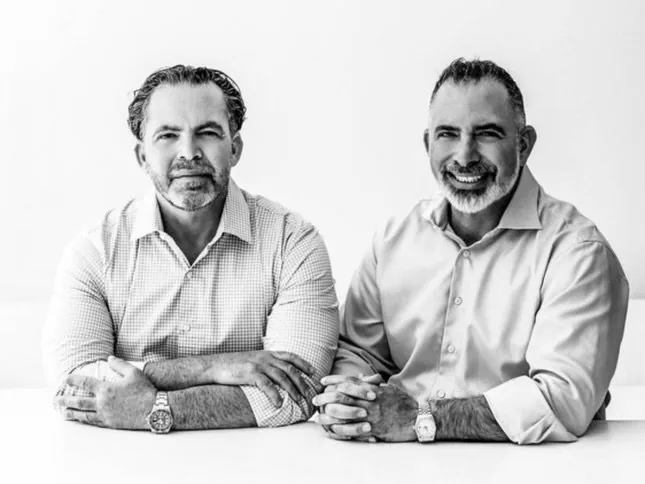
Enrique Jordan and Alejandro Jordan, the buyer-representation team at Jordan Real Estate

Enrique Jordan and Alejandro Jordan have participated in over $1 billion in real estate transactions and bring more than 30 years of combined experience representing buyers, sellers, investors and developers across South Florida. Our office is in Coral Gables at 121 Alhambra Plaza.

We represent buyers. On the transactions we take on through this programme that means comparable analysis, offer strategy, negotiation, coordination of inspections and specialists, association and reserve review, new-development registration and contract review, and management of the transaction through to closing — and returning up to 50% of our buyer-agent commission to eligible buyers at closing.

Alejandro’s background in real estate law and title informs how we read a contract and how we approach closing. It does not make the brokerage a law firm, and it does not mean legal representation or legal advice is included in the brokerage relationship. Contract-specific and legal questions should be directed to qualified Florida counsel. More about Enrique and Alejandro.

Next step

Evaluating a wellness-oriented development?

Tell us which buildings you are looking at. We will pull what is publicly documented, help you frame the certification, operating-cost and governing-document questions from this report, and confirm in writing what buyer-agent compensation appears to be available before you register anywhere.

(786) 550-6294
  • Considering a new development? Contact us before you visit the sales gallery or submit an inquiry — registration questions are usually decided at first contact.
  • Looking at a delivered building? Ask us for the operating budget and reserve study before you make an offer, not after.
  • Already been in touch with a sales team? Tell us what happened and when, and we will tell you honestly whether representation and any rebate can still be preserved.

No obligation, and no cost for the conversation. We will also tell you when a rebate is not available on a particular transaction.

Submitting this form does not create a rebate entitlement or a brokerage relationship. Any rebate is set out in a written buyer-representation agreement and depends on the compensation actually received and the requirements of your transaction.

Sources & methodology

What this report is built on.

Sources are grouped by the weight we gave them: standards documentation and primary research for technical statements, developer materials for project descriptions, trade reporting for status, dates and transactions. All accessed August 6, 2026.

  • International WELL Building Institute — WELL Building Standard, version 2. Used for the ten concepts, preconditions and optimisations, certification levels, performance verification, precertification, the core-and-shell pathway, the three-year term and recertification, and the distinction from IWBI’s separate rating programmes. Also GBCI’s announcement of 17 February 2026 that administration of single-asset WELL certification transitions to IWBI, with reviews continuing through the same network of third-party reviewers. Summarised in our own words; the standard itself governs.
  • Global Wellness Institute — wellness real estate market data. Market size and growth figures are from the GWI data preview released May 12, 2026, ahead of the 2026 Wellness Economy Monitor. Figures are global and cover all wellness-oriented residential construction.
  • Developer and project materials for Anantara Residences Miami, 2200 Brickell, THE WELL Bay Harbor Islands, THE WELL Residences Coconut Grove, Rivage Bal Harbour, House of Wellness Brickell and Carillon Miami Wellness Resort. Used for amenity descriptions, design teams and programme structure, and presented throughout as developer descriptions rather than verified facts.
  • Trade and business reporting for delivery status, financing, transaction and launch information — including the July 2026 temporary certificate of occupancy at 2200 Brickell, the April 2026 temporary certificate of occupancy and November 2025 refinancing at THE WELL Bay Harbor Islands, the February 2026 groundbreaking and construction financing at THE WELL Coconut Grove, the February 2026 sales launch of House of Wellness Brickell, and the July 2026 revelation of the Rivage Bal Harbour upper penthouse.
  • TheBuyerRebate.com project pages for Anantara Residences Miami, 2200 Brickell and THE WELL Residences Coconut Grove, maintained against developer materials.

Where sources conflict

Residence counts at 2200 Brickell appear as both 103 and 105. Rivage Bal Harbour is reported at 24 and 25 storeys, at four residence counts, and with two delivery years. THE WELL Bay Harbor Islands was announced with 54 residences and delivered with 66. Amenity square footages differ between developer materials and third-party listings. We report the conflicts rather than picking a number: the reliable figure is in the current offering documents for the specific residence being purchased, and no published summary — including this one — substitutes for that.

What we deliberately do not say

We make no claim about the health effects of any building, feature, therapy or technology described here; those are medical questions outside our competence and our licence. We state no current WELL Certification for any project in this report, because we could not independently verify one. And we offer no forecast of how wellness features will affect resale values, because the segment is too new for the evidence to exist.

Important disclosures

Please read this alongside the rest of the page.

Educational purpose. This report is general market analysis and buyer education. It is not legal, tax, accounting, medical, engineering, insurance, lending or investment advice, and it does not create a brokerage, advisory or fiduciary relationship. It is not a complete statement of any standard, certification programme or research report referred to, all of which change over time.

No health claims. Nothing in this report asserts that any building, design feature, amenity, therapy or technology produces any particular health outcome. Descriptions of what facilities are designed to do are not claims about what they achieve. Health decisions should be discussed with qualified medical professionals.

No ranking, no endorsement, no affiliation. This report does not rank, score or recommend any development. Inclusion is editorial and is not an endorsement; omission is not a criticism. Neither Jordan Real Estate nor TheBuyerRebate.com is the developer, sales agent or marketing agency for any project named here, and we are not affiliated with the International WELL Building Institute, the Global Wellness Institute, THE WELL, Anantara Hotels Resorts & Spas, Minor Hotels, Terra, Related Group, Two Roads Development, Rockpoint, Aria Development Group, Largo, Place Projects, North Development, Carillon Miami Wellness Resort, or any of their affiliates.

Project information is unverified and changes. Project descriptions are drawn from developer materials and public reporting available as of August 6, 2026 and are subject to change without notice. Pre-construction projects may change in design, scope, unit count, amenity programme, timing and pricing. Announced dates are targets, not commitments. Renderings are conceptual and depict intent rather than a constructed condition. Certification, brand, operator and amenity arrangements may be amended or terminated under their own terms.

A rebate is not guaranteed. Eligibility is transaction-specific and possible only where our brokerage actually receives buyer-agent compensation and a rebate is permitted under your written buyer-representation agreement. Not every project or transaction makes buyer-agent compensation available, and compensation is negotiated rather than fixed. Lender requirements, closing structure, developer registration and cooperation, timely involvement of your representative and applicable Florida rules may all affect whether a rebate is available and the form it takes. If the transaction does not close, no rebate arises. The calculator is an arithmetic illustration based on stated assumptions and is not a quote, an offer or a guarantee.

Consult the right professional. Buyers should have condominium documents, budgets, reserve studies and purchase agreements reviewed by qualified Florida counsel, confirm the treatment of any credit with their lender and closing agent, and confirm certification status with the certifying body. We coordinate specialists; we do not substitute for them.