Miami Preconstruction Broker Registration Rules: What Buyers Should Know Before Contacting a Developer
Florida has no statewide rule, among the authorities we reviewed, saying a buyer permanently loses the ability to use a real estate broker by calling, emailing or visiting a developer first. Developers and their exclusive sales brokerages can, however, set their own registration and participation requirements for recognizing and paying an outside broker. Those policies vary by project. Prior direct contact, or not following a project’s procedure, can affect whether an outside brokerage is eligible for compensation — and with it, a rebate funded by that compensation.
Each claim below is attributed to the statute, rule, court decision, industry standard or published project policy it comes from.
Prior contact does not stop you from hiring a broker. Whether that broker is paid is a separate question.
Representation is your decision: Florida law lets you choose whether to work with a broker and under which brokerage relationship. Whether a developer or its sales brokerage owes compensation to an outside brokerage depends on the applicable agreements and governing law. A buyer agreement you sign binds you and your brokerage; it does not, by itself, oblige a developer to pay that brokerage.
So “can I add an agent after visiting the sales gallery?” has a two-part answer: yes, you can be represented; whether that brokerage is compensated, and whether a commission-funded rebate exists, depends on the applicable written terms and your own agreements — which can often be clarified before you make contact, where the project’s terms are available in writing.
The distinction the whole page rests on
A buyer’s ability to obtain representation is not the same thing as a developer’s recognition of an outside broker for compensation. Losing the second does not erase the first, and having the first does not guarantee the second.
Six separate links between a buyer and a commission-funded rebate.
Each link is governed by a different document. A break upstream can mean there is nothing to share at the end.
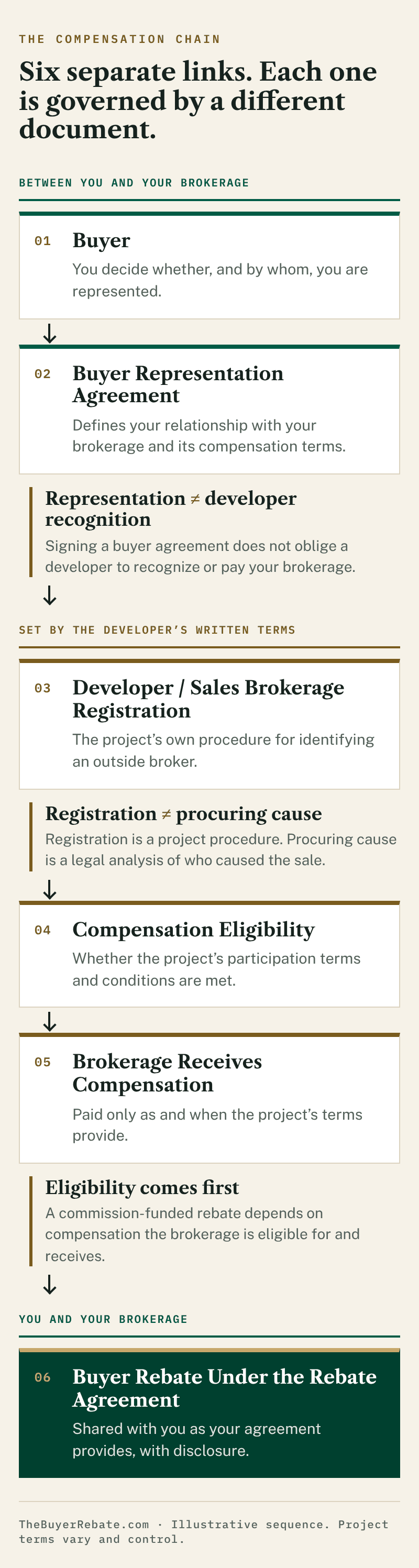
-
Your choice
Buyer
Florida recognizes single agency, transaction brokerage and no brokerage relationship; transaction brokerage is presumed unless another relationship is established in writing.
-
Your buyer agreement
Buyer representation agreement
Defines your brokerage’s services and compensation terms with you.
Does not establish developer recognition. -
The project’s procedure
Developer or sales-brokerage registration
The project’s own procedure for identifying an outside brokerage and a prospective purchaser. Method, timing, accompaniment and duration vary.
Does not establish procuring cause — and submitting a name is not always an accepted registration. -
The applicable participation agreement
Compensation eligibility
Conditions may include accepted registration, treatment of prior contact, a qualifying purchase contract and, where required by the applicable agreement, closing.
Eligibility and payment can be separate events. -
The project’s payment terms
Brokerage receives compensation
Paid as and when the applicable terms provide. Published examples tie payment to closing; historical Miami reporting also documents partial payment at contract. No universal schedule exists.
-
Your rebate agreement
Buyer rebate under the rebate agreement
Florida permits a licensee to share brokerage compensation with a party to the transaction, with full disclosure to all interested parties. Whether and how much is shared is set by your written agreement; implementation depends on your lender and closing terms.
A commission-funded rebate generally depends on compensation the brokerage was eligible for and received.
Four different concepts buyers should not confuse.
These terms are often used interchangeably in sales conversations. Each controls a different question.
Buyer representation
ControlsWho works for you, under what brokerage relationship, and what you have agreed to pay that brokerage.
Broker registration
ControlsWhether a developer or its exclusive sales brokerage recognizes an outside broker on your purchase for compensation purposes.
Procuring cause
ControlsWhich broker, in a commission dispute, caused the completed transaction — unless a contract supersedes it.
Buyer rebate
ControlsWhether, how much and when your brokerage shares compensation it actually receives with you.
| Issue | Florida-wide framework | Set by the project or your agreements |
|---|---|---|
| Sharing commission with the buyer | Permitted with full disclosure to all interested parties under FREC Rule 61J2-10.028(2). | Amount, base and conditions are set by your rebate agreement. |
| First visit | No statewide first-visit compensation rule identified. | Accompaniment requirements, absent-broker declarations, grace periods. |
| Registration method | No uniform procedure in the law reviewed. | Portal, email, in person only, or approval required. |
| Protection period | No universal period. | Published 90-day provisions exist, with materially different triggers. |
| Prior contact | Not automatically procuring cause. | Terms may exclude buyers who already expressed interest or were referred by another source. |
| Payment timing | No universal schedule. | At closing, after closing, or at stated milestones. |
| Rebate and financing | Disclosure to interested parties, including your lender. | Your loan program and lender decide treatment, not the project. |
Does Florida law require your buyer agent to attend the first sales-gallery visit?
No statewide rule identified in the Florida authorities we reviewed establishes a universal requirement that a buyer’s outside broker attend the buyer’s first developer visit. We reviewed Chapter 475, Part I of the Florida Statutes, Chapter 61J2 of the Florida Administrative Code, DBPR materials and Florida appellate decisions on broker compensation. The first-visit procedures we found are developer or brokerage policies.
That finding does not settle the practical question:
- Project policies can still impose conditions. A project may make registration, or accompaniment, a condition of paying an outside broker. The published examples differ materially (see published policies).
- Contract terms can outweigh doctrine. Florida courts apply procuring-cause principles “barring a superseding contractual provision.”
- No statewide rule is not guaranteed compensation. It says nothing about whether a particular project will pay a broker added later.
The practical conclusion is sequence, not alarm: where a project’s rules are written down, they can be requested and confirmed before you call, email, submit an inquiry or walk in.
First contact is not automatically procuring cause.
In Rotemi Realty, Inc. v. Act Realty Co., 911 So. 2d 1181 (Fla. 2005), the Florida Supreme Court described the broker’s role in terms the Third District Court of Appeal summarized in Real Capital Partners, LLC v. Alhambra Center International, Ltd. (Fla. 3d DCA May 22, 2024) as two tasks: initiating negotiations through an affirmative act that brings buyer and seller together, and remaining involved in the continuing negotiations — a duty that does not apply where buyer and seller intentionally exclude the broker. The Third District called procuring cause an equitable concept that applies “barring a superseding contractual provision,” and affirmed rejection of a commission claim where the broker had abandoned its efforts concerning the eventual buyer. Neither case involved a condo sales gallery.
For disputes between REALTOR® brokers, NAR’s 2026 Arbitration Guidelines describe procuring cause as “the uninterrupted series of causal events which results in the successful transaction.” Panels weigh continuity, abandonment, estrangement and whether the buyer already knew the property; no single factor decides.
| Dispute | What governs it |
|---|---|
| Broker against developer or seller, for a commission | The contract terms and, where not superseded, Florida procuring-cause doctrine. |
| Broker against another REALTOR® broker | Association arbitration obligations and NAR’s arbitration guidelines. |
| The project’s initial registration decision | The project’s written participation policy and acceptance procedure. |
| Buyer against brokerage, over a rebate | The buyer’s written representation and rebate agreement. |
A broker can be the procuring cause in the common-law sense and still not satisfy a project’s registration conditions; a properly registered broker can still face a procuring-cause dispute with another broker. Treat them as two separate tests.
Three compensation agreements, read alongside the purchase contract.
Buyer representation agreement
Between you and your brokerage: services, relationship and compensation.
Project registration / participation terms
Between the project (or its exclusive sales brokerage) and the outside brokerage: registration method, timing, protection period, prior-contact treatment and payment conditions.
Ask the project, in writing: what is your current outside-broker procedure for this purchaser, and has the registration been accepted?Buyer rebate agreement
Between you and your brokerage, sometimes inside the buyer agreement: whether and how compensation is shared, on what base, when, and how it is disclosed.
The purchase contract
The purchase contract governs the purchase and may also contain broker acknowledgments, compensation provisions, credits or rebate-related terms. Review it alongside the buyer representation agreement, project participation terms and rebate agreement.
What Florida’s rebate rule establishes
- Sharing is permitted“The sharing of brokerage compensation by a licensee with a party to the real estate transaction with full disclosure to all interested parties is not considered a violation of Chapter 475, Part I, Florida Statutes.”
- Disclosure is the conditionFlorida Realtors identifies the buyer’s lender as an interested party. The buyer need not be licensed.
What it does not decide
- Entitlement or amountIt permits sharing; it does not entitle any buyer to a rebate or set a percentage.
- Earning, receipt and implementationWhether compensation was earned and received, your agreement’s terms, and your lender’s treatment.
- Subsection (1)That subsection addresses a licensee’s receipt of kickbacks tied to placing business. The rule does not make every disclosed kickback lawful.
The legal pages of at least two Miami projects we reviewed (Mandarin Oriental Residences Miami and 1428 Brickell) state that broker representations and arrangements are not binding on the developer — a further reason to read each project’s own written terms.
What published registration documents actually say.
These are published policies, website terms, a contract specimen and an inquiry form located during our research. Each is labeled by source and scope; inclusion does not establish that it is a current operative participation agreement. None of them is evidence of how a different project handles registration.
| Source and scope | First visit and method | Protection and prior contact | Exceptions and payment |
|---|---|---|---|
| Builder policy · Palm Beach Gardens, Port St. LucieAkel Homes, published realtor policy | Broker accompaniment recommended; in-person registration only; online purchaser registration not accepted. | Published 90-day provision; its contract-versus-closing wording is internally ambiguous. | Buyer may name an absent broker on the walk-in form; broker has two days to formalize in person. Payment at or shortly after closing. |
| Project website · Miami WorldcenterPARAMOUNT Miami Worldcenter | Client registration and program completion required; accompaniment and online acceptance not specified in the terms reviewed. | Binding purchase contract required within 90 days of registration, on acceptable terms. | Published referral payment after actual closing. Current program availability not independently confirmed. |
| Brokerage contract specimen · undatedMiami Real Estate Group cooperating-broker agreement | No accompaniment rule; buyer identified in the agreement or a dated written addendum signed by the brokerage. | Prior expression of interest, prior discussions, or referral from another source can disqualify the fee; notice within three business days. | Fee conditional on closing and on the seller paying the brokerage. Not verified as any luxury condo project’s agreement. |
| Project inquiry formPagani Residences | Public form asks “Are you a broker?” and “Do you have a broker?” | No protection period or prior-contact forfeiture provision located. | Evidence that brokerage status is collected — not proof that completing the form registers or protects an outside broker. |
For the other branded Miami projects buyers most often ask about, our research did not obtain current written outside-broker registration agreements, so we do not assign a registration rule to any of them. That is an evidence-status statement, not a claim that such policies do not exist. An inquiry form that collects your brokerage status, or a project’s registration of its offering for marketing in another state, is not by itself an outside-broker registration.
Common first contacts, labelled by what the evidence supports.
None of these actions automatically assigns you to a developer. Each can matter on a project whose written terms say it does.
| Buyer action | What the evidence shows | Safe conclusion |
|---|---|---|
| Walked into a sales gallery alone | At least one published builder policy allows a buyer to name an absent broker, with a two-day cure. | Not universally irreversible. Ask whether this project offers a cure. |
| Submitted a website inquiry | Project forms can ask whether you have a broker. | Can record representation status; forfeiture was not established. |
| Called or emailed the sales team | One cooperating-broker agreement we reviewed excludes buyers who had prior discussions or expressed interest, without naming a channel. | Can matter under some terms. Channel-specific Miami luxury rules remain unverified. |
| Requested pricing, booked a tour or downloaded a brochure | No operative provision or forfeiture evidence obtained for the priority Miami projects. | A question to verify, not an automatic loss. |
| Attended a developer event | No registration consequence verified for the priority projects. | Event sign-in is not an outside-broker registration decision. |
| Inquired through a listing portal or social media | At least one project inquiry form tracks lead source. | Source tracking is not proof of compensation disqualification. |
| Was registered by a different broker | One cooperating-broker agreement we reviewed addresses buyers referred by another source. | A possible compensation conflict; project terms and both buyer agreements control. |
| Attended a virtual presentation | NAR rules cover live virtual home tours by MLS participants. | Developer treatment for registration remains unverified. |
What to do next, in order.
Prior contact is a fact to document, not a verdict to accept. This sequence does not guarantee an outcome; it gathers what you need to decide while you still have options.
- You
Write down every contact
Dates, channel, staff names, and whether you named a broker.
- You
Check what you signed
A guest card, registration form, reservation or any acknowledgment that you were unrepresented. Keep copies.
Before signing further statements about your representation or registration status, review them with your prospective broker or attorney. - Your prospective broker
Request the project’s written registration terms
What counts as first contact, what prior contact disqualifies, and who can authorize an exception.
If the project will not put its terms in writing, that is itself information. - Your prospective broker
Look for a written cure or exception
At least one published policy lets a buyer identify a broker after an unaccompanied visit, within a deadline that can be very short.
- Your prospective broker
Check for another broker’s registration or an existing buyer agreement
Either raises separate contractual questions.
- You and your broker
Get the outcome confirmed in writing
Whether the registration is accepted, on what conditions, and for how long.
Do not rely on an oral assurance alone. Obtain written confirmation from the person authorized to accept outside-broker registration. - You decide
Decide on representation with the facts in hand
You can be represented either way. If compensation is unavailable, the rebate question changes; the value of representation on contract, deposits and closing does not.
Not yet contacted a project? Establish these first.
- Your brokerage, and a buyer agreement whose compensation and rebate terms you understand.
- The project’s written registration procedure: first-contact definition, accompaniment, how acceptance is confirmed.
- How long registration lasts — to a signed contract, or to closing — and who the purchaser of record will be.
- When compensation is paid, and how your lender will treat the rebate.
The sales team, written buyer agreements, lender treatment and remote buyers.
Who the onsite sales team represents
The onsite team markets the developer’s inventory. Florida presumes transaction brokerage unless a single-agent or no-brokerage relationship is established in writing, and a transaction broker owes limited, non-fiduciary duties — so neither “they owe you nothing” nor “they represent you” is a safe assumption. Licensing arrangements also differ (see § 475.011(2)). A project may sell through a licensed exclusive sales brokerage; ask which one and what relationship, if any, it has with you.
Written buyer agreements after the NAR settlement
Since August 17, 2024, NAR practice rules require an MLS participant working with a buyer to enter a written agreement before a covered home tour, in person or live virtual. Compensation must be stated in a specific and objectively ascertainable way; compensation from any source cannot exceed the amount or rate agreed with the buyer; and the agreement must disclose that commissions are fully negotiable and not set by law. These are NAR/MLS policies, not Florida statutes. NAR’s consumer guidance confirms buyers can still receive seller-paid buyer-broker compensation. The sources reviewed do not settle whether a rendering presentation or an unfinished-project gallery appointment is a covered “home tour”. Signing a buyer agreement does not guarantee developer recognition.
A post-closing check is not a way around lender rules
Under Fannie Mae’s Selling Guide B3-4.1-02 (May 7, 2025), a broker rebate not credited toward the transaction is a sales concession regardless of whether it is paid before, at or after closing. Undisclosed contributions can make a loan ineligible. These rules govern loans sold to Fannie Mae; jumbo, portfolio, foreign-national, FHA and VA loans have their own. For a cash purchase, loan-program limits do not apply in the same way; the disclosure condition in Rule 61J2-10.028(2) still does.
International and remote buyers
No developer document we reviewed creates a different registration rule based on nationality or remote purchasing. Confirm in writing whether a relative’s or advisor’s inquiry is attributed to you, how registration works for an LLC or trust purchase, and whether it can be accepted before you travel. See also our International Buyer’s Guide to Miami Real Estate.
Nine questions, answered with the qualifications left in.
Can I use a Realtor after visiting a new-construction sales gallery?
Does my buyer agent have to attend my first visit?
Can a developer refuse to pay my agent if I contacted them first?
Is first contact the same as procuring cause?
What is broker registration in Miami pre-construction?
How long does a broker registration last?
Can contacting the developer affect my buyer commission rebate?
Are buyer commission rebates legal in Florida?
Can I receive my rebate after closing to avoid lender limits?
How we approach registration before you make contact.
Before you contact a project, we ask for its written outside-broker procedure, register you where it permits, and ask for written confirmation of acceptance. Where contact is already recorded, we tell you what the terms say and whether a cure exists. If our brokerage will not receive the compensation that would fund a commission-based rebate, the rebate may be unavailable, depending on your written rebate agreement — and we will tell you that before you commit.
Eligible buyers receive up to 50% of our buyer-agent commission back at closing — where Jordan Real Estate is engaged as your buyer representative and receives buyer-agent compensation on an eligible transaction, subject to transaction terms, lender and closing requirements, and project cooperation where applicable.
Illustration only — not a quote, an offer or a guarantee. Compensation is negotiated, varies by transaction and is not available on every transaction; on a developer purchase it depends on the project recognizing our brokerage under the applicable terms. Any rebate depends on the compensation actually received, your written rebate agreement, lender approval where financing is involved, and closing terms.
For the full mechanics, see the Florida Buyer Rebate Guide.
Independent buyer representation, in English and Spanish.
Enrique Jordan and Alejandro Jordan have participated in over $1 billion in real estate transactions and bring more than 30 years of combined experience representing buyers, sellers, investors and developers across South Florida, from our office at 121 Alhambra Plaza, Coral Gables. On pre-construction purchases we confirm registration terms before first contact, compare projects on documented risk, review deposit schedules and contract terms, and coordinate lender and closing requirements.
Alejandro’s background in real estate law and title informs how we read a contract. It does not make the brokerage a law firm or include legal advice in the brokerage relationship; contract-specific questions belong with qualified Florida counsel. More about Enrique and Alejandro.
Considering a Miami pre-construction project?
Tell us which project you are considering and what contact, if any, you have had with it. We will tell you what we can confirm about its registration terms, what to avoid doing in the meantime, and whether a rebate is realistic on that purchase.
(786) 550-6294- Not contacted any project yet? This is the easiest moment. We can request the project’s written terms before you call, email or visit.
- Already visited or inquired? Send us the dates and channels. A cure period, if one exists, can be short.
- Registered by another broker? Tell us. That changes what can be done, and we will say so plainly.
No obligation, and no cost for the conversation. We will also tell you when a rebate is not available on a particular transaction.
What this analysis is built on.
This page relies first on Florida statutes, the Florida Administrative Code, DBPR materials and Florida appellate decisions; then on Florida Realtors and NAR guidance; then on official developer and project documents. Project documents are cited only for what they say about their own project. Where a source does not resolve a question, the page says so.
- Florida Administrative Code Rule 61J2-10.028. Used for the text of subsections (1) and (2), including compensation sharing with a transaction party with full disclosure. flrules.org — Rule 61J2-10.028 · reproduction: law.cornell.edu
- Florida Statutes, Chapter 475, Part I. Used for brokerage relationships, the presumption of transaction brokerage, and the scope of brokerage activity. leg.state.fl.us — Chapter 475
- Florida Statutes § 475.011. Used for the owner-sale exemption and its transactional-compensation limitation. leg.state.fl.us — § 475.011
- Florida Statutes § 475.278. Used for transaction-broker duties. flsenate.gov — § 475.278
- Florida DBPR — Real estate statutes and rules. Used to identify Chapter 475, Part I and Chapter 61J2 as the governing authorities reviewed. myfloridalicense.com
- Rotemi Realty, Inc. v. Act Realty Co., 911 So. 2d 1181 (Fla. 2005). Used for the procuring-cause framework. caselaw.findlaw.com
- Real Capital Partners, LLC v. Alhambra Center International, Ltd., No. 3D23-0833 (Fla. 3d DCA May 22, 2024). Used for superseding contract provisions, affirmative initiation, continuing involvement, intentional exclusion and abandonment. caselaw.findlaw.com
- NAR — Arbitration Guidelines (2026), Appendix II to Part Ten. Used for the REALTOR® arbitration definition and factors. nar.realtor · NAR: “Hold On, That’s My Client!”
- NAR — Written Buyer Agreements 101; Consumer Guide to Written Buyer Agreements. Used for the August 17, 2024 written-agreement requirement, compensation terms, the open-house exception and seller-paid compensation. nar.realtor — 101 · nar.realtor — consumer guide
- Florida Realtors — Compensation and commission (June 12, 2025). Used for the interpretation of rebates to transaction parties and the lender as an interested party. floridarealtors.org
- Fannie Mae Selling Guide B3-4.1-02 and SEL-2025-03 (May 7, 2025). Used for interested-party contributions, financing and sales concessions, and timing-independent treatment of rebates. selling-guide.fanniemae.com · SEL-2025-03
- Akel Homes — Realtor policies. Used for in-person registration, the absent-broker two-day cure, the 90-day provision and payment terms. Builder policy; Akel communities only. akelhomes.com/realtors
- PARAMOUNT Miami Worldcenter — official website terms. Used for registration, the 90-day contract condition and closing-based referral payment. Current program availability not confirmed. paramountmiami.com
- Miami Real Estate Group — cooperating-broker registration agreement (undated specimen). Used for prior-interest exclusions, written registration and conditional fees. Not verified as any luxury condo project’s agreement. loopnet.com (PDF)
- Pagani Residences — official inquiry form. Used only for the brokerage-status questions it asks. paganiresidences.com
- Mandarin Oriental Residences Miami and 1428 Brickell — official legal pages. Used only for their statements that broker representations and arrangements are not binding on the developer. mo-residencesmiami.com/legal · 1428brickell.com/legal
- The Real Deal (October 20, 2015). Secondary reporting, used only as historical evidence that at least one Miami developer paid part of broker commissions at contract. therealdeal.com
What we deliberately did not resolve
Current registration terms for named Miami luxury projects. We did not obtain current written outside-broker agreements for the branded Miami towers buyers ask about most, and we do not assign rules to them.
Whether a gallery appointment is a “home tour”. The NAR materials reviewed do not settle whether rendering presentations or unfinished-project appointments trigger the written-agreement requirement.
Attribution of family or advisor inquiries. No reviewed document addresses whether a relative’s or advisor’s inquiry is attributed to the eventual purchaser.
Exhaustiveness. “No statewide rule identified” is a research finding from the authorities listed, not a legal opinion covering every potentially relevant authority.
About the image
The diagram on this page is an original explanatory graphic produced by TheBuyerRebate.com. It does not depict any project, document or person. Its full content is also set out in text immediately below it.
Primary sources as cited · Current as of October 6, 2026
Please read this alongside the rest of the page.
General education only. This page is not legal, tax, lending or investment advice and does not create a brokerage, advisory or fiduciary relationship. Statutes, rules, court decisions, industry guidelines and developer policies are summarized, not reproduced in full, and they change. Project registration terms are set project by project; nothing here states any project’s current policy beyond the published document cited for it. Contract, commission-dispute and registration-conflict questions belong with qualified Florida counsel, and financing treatment with your lender. Neither Jordan Real Estate nor TheBuyerRebate.com is affiliated with any developer, sales brokerage, project, Fannie Mae, the National Association of REALTORS®, Florida Realtors, the Florida Real Estate Commission or the Florida DBPR.
A rebate is not guaranteed. Compensation is negotiated and is not available on every transaction; on a developer purchase, the project’s registration and participation terms may affect whether it is available. Lender requirements and closing structure may affect the form a rebate takes. Any rebate obligation, including what happens if the transaction does not close, is governed by your written rebate agreement. The calculator is an arithmetic illustration, not a quote, an offer or a guarantee.