
How to Buy Pre-Construction in South Florida — 2026/2027
A pre-construction purchase asks you to commit money years before there is anything to inspect. What protects you is not the rendering or the sales presentation — it is the contract, the offering documents, the public record, and having someone reading them on your side of the table.
This guide is written for buyers, not for developers. It covers the whole journey: choosing representation before first contact, verifying who is actually building, how deposits and escrow work under Florida law, what the purchase agreement can expose you to, how financing can change before delivery, and what happens at closing.
Editorial illustration of South Florida pre-construction activity. Not a depiction of any specific project, and not a developer rendering.
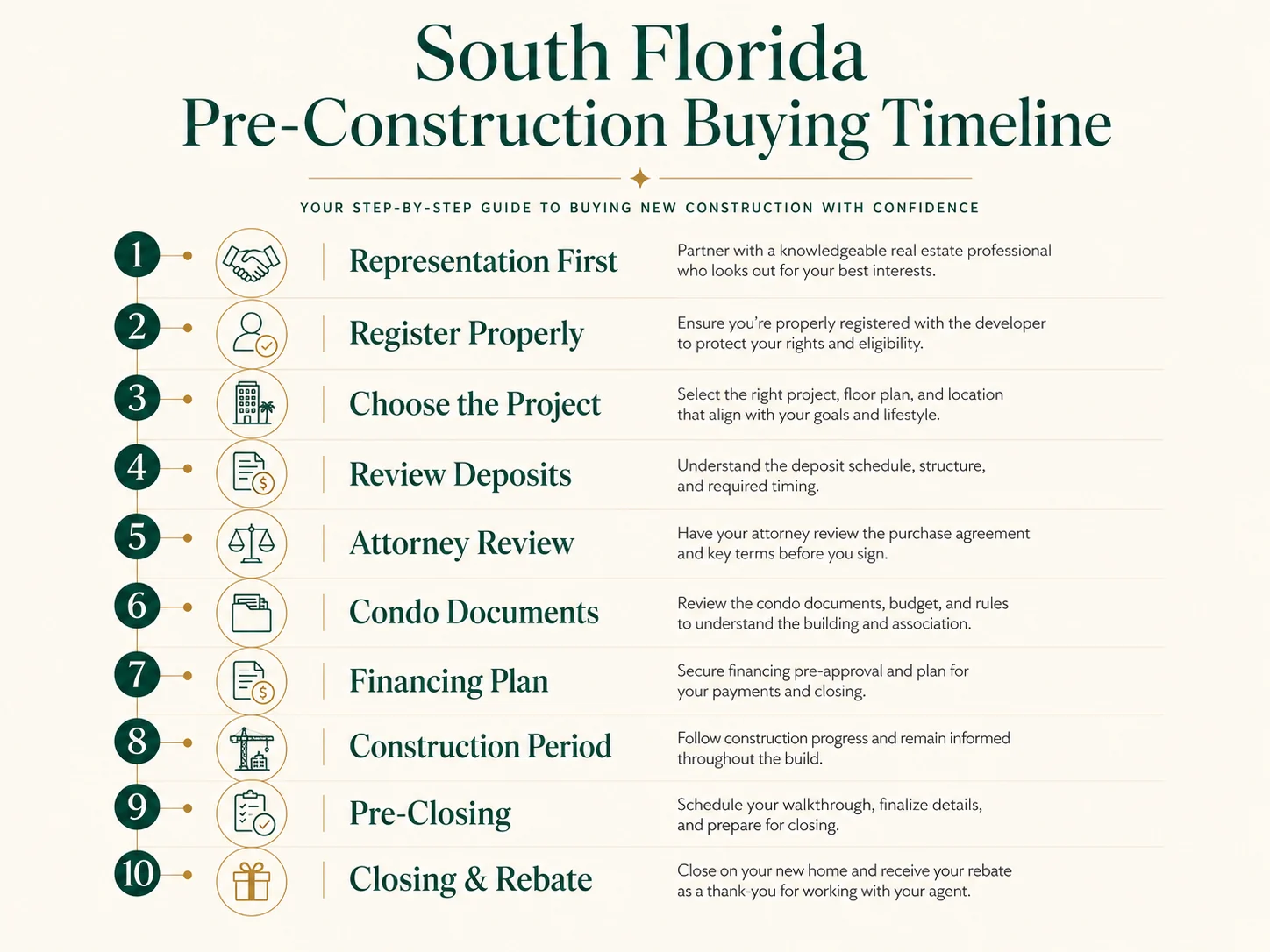
Ten things that decide how a pre-construction purchase goes.
Each of these is expanded into a full chapter below. Taken on their own, they are still the ten decisions that separate a buyer who is protected from a buyer who is improvising.
Arrange representation before you contact anyone
Developer sales staff work for the developer. If you want someone advocating for you, engage them before your first call, form submission, or visit — not after.
Have the project’s broker-registration rules confirmed in writing
These are set by each developer and vary. They are project policy, not Florida law. The point of asking early is that the answer is knowable before you act, not after.
Verify the developer and the project in the public record
Who owns the land, what is permitted, who the contractor is, what is recorded against the site, and what litigation exists. A brochure is marketing; the record is evidence.
Understand exactly how your deposit is treated
Florida law requires the first 10% of pre-completion payments to be escrowed. Amounts above that are treated differently and, in defined circumstances, may be used for construction. The contract tells you which regime applies to you.
Have the contract and offering documents reviewed by Florida counsel
Completion dates, extension rights, unit-size tolerances, substitutions, assignment and leasing restrictions all live in documents most buyers sign without reading.
Read the proposed budget as a projection, not a ceiling
The declaration, bylaws, master-association arrangements and branded-service agreements determine what you will owe for as long as you own.
Assume your financing picture will change before delivery
Permanent financing is normally arranged near closing, which may be years away. Rates, your own qualification, and the project’s eligibility can all move in the meantime.
Underwrite the whole cost of ownership
Assessments, capital contributions, branded-service charges, insurance, parking, furnishing and taxes. The purchase price is the beginning of the number, not the number.
Monitor construction against evidence, not announcements
Permits, inspections, actual structural progress and certificates of occupancy carry more weight than a groundbreaking ceremony or a press release.
Treat any rebate as conditional and transaction-specific
A rebate depends on compensation actually received, your written agreement, lender treatment where financing is involved, and closing terms. It is a benefit of representation, not a substitute for it.
One conversation before first contact, because the rules are knowable in advance.
Developers set their own rules about how an outside broker is recognised on a transaction. Those rules differ from project to project, and they can change. What does not change is that they are easier to satisfy before you have made contact than afterwards.
Contact your buyer team first
Before you call the project, submit an online enquiry, book an appointment or walk in. We can advise on strategy from the start rather than reconstructing what already happened.
Let us confirm the project’s rules
Registration, escort and broker-recognition requirements are set by each developer and vary by project. We obtain the current written terms for the specific project you are considering.
Protect the opportunity
The aim is to preserve your ability to be independently represented, and any qualifying buyer rebate, before anything is decided by default.
What this is — and what it is not
Florida law does not create a universal rule that a buyer who visits a sales gallery alone automatically loses representation or rebate eligibility. Registration requirements, escort rules, internet-lead handling, how long a registration lasts and how a broker is recognised are generally developer and project policies, not rights or restrictions under Florida’s Condominium Act.
That is precisely why the answer has to be obtained in writing for the specific project rather than assumed. Some projects are strict about first contact. Others are not. Anyone who tells you every developer works the same way is describing a sales script, not the market.
Developers’ own published legal notices reinforce a related point: brokers and salespeople generally cannot make representations or arrangements that bind the developer. Whatever you are told verbally, the operative terms are the written ones.
The buyer journey, in eighteen chapters.
The order follows the transaction rather than the marketing. You can read it end to end, or jump to the stage you are actually at.
Representation Before the Sales Gallery
The single most consequential decision in a pre-construction purchase is made before you have chosen a unit, and often before you have chosen a project: whether anyone in the transaction is working for you.
A developer’s sales gallery is a sales operation. The people in it are knowledgeable, often extremely so, and they are compensated by and accountable to the developer. That is not a criticism — it is simply the structure. They are not neutral advisors, and they are not obliged to tell you which line of units has the compromised view, which floor plan has consistently resold poorly, or which clause in the purchase agreement deserves a second reading.
An independent buyer representative occupies the other seat. On the transactions we take on, that means comparing projects on documented risk rather than finish level, reading the offering documents against what a lender will later test, coordinating with your attorney and lender rather than substituting for them, and managing the timing of the decisions so that you are not deciding anything in the final week.
Why first contact can matter
Developers commonly maintain a broker-registration process: a written procedure that determines whether an outside brokerage is recognised on a transaction, and therefore whether that brokerage is compensated. Depending on the project’s rules, an online enquiry form, a phone call, an appointment, an unaccompanied visit or an event registration may all be recorded as a first contact.
It is worth being precise about what this is. These are project policies. Florida’s Condominium Act does not set a statewide registration rule, does not require a developer to pay a buyer-agent commission, and does not provide that a buyer who walks in alone has forfeited anything. Registration windows, renewal terms, escort requirements and internet-lead handling vary by developer and can be changed by the developer.
The practical conclusion is not alarm. It is sequence. Because the rules are project-specific and written down, they can be obtained and confirmed before you act — and that is a far easier conversation than one that begins after a registration has already been recorded.
What to establish, in writing
Before you contact a project, your representative should be able to tell you what that project’s current written policy says about how an outside broker is registered, what constitutes first contact, whether accompaniment on the first visit is required, how long a registration remains effective and whether it can be renewed. Where a project will not put its terms in writing, that is itself information.
A worked example helps. Our buyer guide to Six Fisher Island applies this chapter to a single ultra-luxury project on Fisher Island: what the developer’s own disclosure does and does not commit to, which claims rest on press reporting rather than project documents, and what a buyer should establish before first contact.
Compensation should never be assumed. Post-2024 changes to MLS practice removed offers of broker compensation from the MLS and made written buyer-broker agreements central to how representation is documented. Those changes apply to MLS participants; they neither prohibit a developer from negotiating compensation outside the MLS nor guarantee that a developer will offer any. What compensation exists on a given project is a question of that project’s written policy and your written agreement.
The claim we deliberately do not make
You will find pages across the industry asserting that Florida law requires you to bring an agent on your first visit, or that visiting alone permanently destroys your rebate. Neither is a correct statement of Florida law. Converting a developer’s policy into a legal rule makes for a more urgent sales pitch and a less accurate guide.
What is accurate: first contact can affect broker recognition when the applicable project’s written rules say it does, and you will not know which projects those are unless someone asks in advance.
For the mechanics of how a rebate is calculated, when it is available and what can reduce or remove it, see the Florida Buyer Rebate Guide. For how this works specifically across Miami new development, see Miami pre-construction buyer representation.
Understand What You Are Buying
“Pre-construction condominium” covers products that behave very differently once you own them. The differences are recorded in the governing documents, not in the brochure.
Before comparing prices, establish which category the project actually falls into, because the category determines your ongoing obligations, your rental rights and your eventual resale market.
Conventional condominium
A residential condominium with an owners’ association, a declaration, shared common elements and assessments. The simplest structure, and the baseline against which the others should be read.
Branded residence
A condominium associated with a hospitality or luxury brand. The brand relationship exists under a licence or operating agreement with defined terms, obligations and termination provisions — which is where it should be verified.
Mixed-use project
Residential combined with hotel, retail, office or club components. Introduces shared facilities, master associations, cost-allocation formulas and use priorities that need to be mapped individually.
Condo-hotel and rental-oriented product
Where a unit participates in a rental or hotel programme, the terms govern occupancy limits, revenue treatment, mandatory participation and management. These structures can also affect lender project review.
Furnished and unfurnished delivery
Furnishing packages vary in whether they are included, optional, separately priced or a condition of a rental programme. Confirm what is contractually included rather than what is shown in the model.
Intended use
Primary residence, second home or investment. This drives homestead eligibility, financing treatment, insurance and whether the building’s leasing rules are compatible with your plan at all.
Branding is a contract, not a permanent condition
A brand name on a building is the product of an agreement between the developer or association and the brand. Those agreements have terms, standards, fees and, in most cases, circumstances in which they can end. A brand affiliation should not be assumed to be perpetual, and a brand name is not by itself a guarantee of a particular service level, of hotel-standard operations, or of rental income.
If service levels, amenity access, club membership or rental participation matter to your decision, they belong to the documents: the declaration, the master declaration, any shared-facilities or operating agreement, and the branded-service arrangement. Ask for them, and have them read.
South Florida’s current pipeline spans all of these categories across distinct submarkets — Brickell and Downtown Miami towers, Edgewater waterfront sites, Coconut Grove low-rise product, oceanfront Sunny Isles Beach and Bal Harbour, and Fort Lauderdale and West Palm Beach to the north. The full set of projects we cover is on the pre-construction hub.
Research the Developer and Project
A sales brochure is not due diligence. Almost everything that matters about a developer and a site is recorded somewhere public, and the exercise is knowing which record answers which question.
The purpose of this work is not to find a reason to walk away. It is to replace impressions with evidence, so that the risk you accept is a risk you chose. Some of it your representative can do; some belongs to a real-estate attorney or a title company; a little of it you can do yourself in an afternoon. For a project-level example of separating supplied marketing claims from document-verification items, see our independent Gaia Residences Hollywood buyer guide.
Identify the actual selling entity
The developer’s marketing name and the entity signing your contract are frequently different. Establish the legal entity, who owns the land today, and how the two relate.
Ask: which entity is the seller under this contract, and does it own the site?Retrieve the recorded instruments
Deed, mortgages and recorded financing, easements, the declaration and any amendments once recorded, plus liens and other encumbrances against the site.
Ask: what is recorded against this property, and what does it obligate the site to?Check permits, zoning and approvals
What has actually been permitted, at what scope, and by which authority. Miami-Dade provides free online searching for permits, plans, unsafe-structure cases, code cases, certificates of occupancy and use, and zoning records.
Ask: is the project permitted for what is being sold, and what remains outstanding?Identify the contractor
Who is building it, their licensing status and any disciplinary history, and whether they have completed comparable work.
Ask: who is the general contractor, and what have they delivered before?Search court records and litigation
Suits involving the developer, affiliated entities or prior projects; construction-defect claims; foreclosure actions; and disputes with buyers at earlier developments.
Ask: what is the developer’s track record when a project goes badly?Look at DBPR filings
Residential condominium developers must submit condominium documents for review and approval before offering units. What was filed, and when, is part of the record.
Ask: what has been filed with the Division, and does it match what I have been shown?Verify the brand or operator relationship
Where a brand is central to the offering, the licence or operating agreement defines the term, the standards, the fees and the exit rights.
Ask: on what terms is the brand attached, and how can that end?Establish construction status honestly
Redesigns, phase changes, unit-count changes, cancellations and schedule revisions at this or prior projects. Then compare with what is physically happening on site.
Ask: has the project changed since it was launched, and how often?Where the records live
There is no single database. Miami-Dade County publishes a public-records service covering permits, plans, certificates of occupancy and use, code cases and zoning; the county property appraiser handles parcel and assessment data; and the Clerk of Court handles recorded instruments and litigation. Broward maintains its own official records and a separate permit search. Palm Beach County operates its own systems again.
Municipalities complicate this usefully. Many projects are permitted and inspected by a city rather than the county — Miami, Miami Beach, Coral Gables, Sunny Isles Beach, Aventura and Fort Lauderdale all run their own building and zoning processes. For any specific project, the applicable city portal is the one that matters, and identifying it is part of the work.
Construction financing deserves a caveat. It may be recorded, it may be private, it may have been amended, and it is not always inferable from a simple search. Where it matters to your decision, a title or real-estate attorney should review the recorded instruments and, if necessary, ask the developer directly for evidence.
What due diligence cannot tell you
Public records establish what has been filed, recorded and permitted. They do not establish whether a project will be delivered on schedule, whether a market will hold, or whether a developer’s private financing is sound. Diligence narrows uncertainty; it does not eliminate it, and a guide that suggests otherwise is selling confidence rather than information.
Deposits, Escrow and Cancellation Rights
This is where Florida law gives pre-construction buyers their most concrete protections — and where the protections are most often overstated. Both halves matter.
In a pre-construction purchase you are wiring substantial sums to an entity that has not yet delivered anything, sometimes years in advance. Florida’s Condominium Act addresses this directly, and the framework is worth understanding precisely rather than approximately.
The first 10% is escrowed
For a condominium that is not substantially complete, the developer must place payments up to 10% of the sale price in escrow. A purchaser can request an escrow receipt. This is the core statutory protection, and it is real.
It is also bounded. “Escrowed” addresses who holds the money and on what terms. It does not eliminate developer credit risk, completion risk, or the possibility of a dispute that has to be resolved before anyone sees a refund.
Amounts above 10% are treated differently
Deposits beyond the initial 10% are ordinarily held in a special escrow account and may not be used before closing — but there is a defined statutory exception permitting use toward construction costs where the required contract disclosure and conditions are satisfied. Whether you are exposed to that mechanism depends on your contract language and the escrow instructions.
This is the single most commonly misstated point in pre-construction marketing. It is not correct that all deposits stay untouched in escrow until closing, and it is not correct that a developer can never access deposits before closing. Which is true for your transaction is a question your attorney answers by reading your documents.
Reservation payments are a separate regime
A statutory reservation agreement carries stronger refund mechanics than a purchase contract. Reservation payments must be paid to the escrow agent and, on written request of either the prospective purchaser or the developer, must be immediately and unconditionally refunded in full. They may not be released to the developer except as a down payment simultaneous with or after execution of a purchase contract.
The caution: this applies to a statutory reservation agreement. Not every payment a project labels a “reservation” necessarily has that legal character. Read what you are actually signing.
Non-compliance has consequences
Failure to comply with the statutory escrow requirements renders the contract voidable by the buyer, and where voided, sums deposited or advanced are refundable with the statutorily specified interest. This is a remedy that depends on facts and timing and requires legal analysis — it is not an automatic refund button.
Example Pre-Construction Deposit Structure
Illustrative example onlyIllustrative example only. Deposit amounts, timing and construction milestones vary by project and are governed by the applicable purchase agreement.
Deposit structures vary materially by project. The purchase agreement controls.
The structure above is an illustration of how staged deposits are commonly arranged. It is not a market standard, not a typical schedule, and not a benchmark against which to judge a project as generous or aggressive. We reviewed the publicly available material for several major South Florida projects while preparing this guide and could not verify a single current, first-party deposit schedule from a developer source. Third-party project pages disagreed with each other and with the developers’ own materials.
That finding is worth stating plainly: if a website quotes you a specific project’s deposit schedule, treat it as unverified until the developer supplies a dated schedule and the executed contract confirms it.
The cancellation right, stated carefully
Florida provides a statutory voidability period in connection with a developer sale of a residential condominium unit. The agreement must contain the prescribed conspicuous notice. The contract remains voidable until the documents required by statute have been furnished; once they are furnished, written cancellation may be delivered within 15 days. A developer ordinarily may not close during that period unless the statutory conditions for an earlier closing are met.
Note what the timing actually depends on. It is not simply “15 days from signing.” It runs from execution and receipt of all required documents, which means the date on which the clock starts is a factual question about what was delivered and when. Amendments to the offering materials can also matter. Cancellation generally must be in writing and delivered as the contract and statute require.
If you are anywhere near this window, the practical advice is unambiguous: get a Florida real-estate attorney onto the specific dates immediately, rather than reasoning from a general description like this one.
Purchase Contract Review
Pre-construction purchase agreements are drafted by the developer’s counsel to protect the developer. That is expected. What it means is that the document allocates most of the schedule, design and financing risk to you unless something says otherwise.
Florida’s Condominium Act does not impose a universal completion date, a buyer financing contingency, view protection, a fixed square footage, a non-substitution promise, an assignment right or a rental right. Whatever you have on those points, you have because it is written in your contract.
This section is issue-spotting, not legal advice. Its purpose is to let you recognise what deserves attention so that you engage qualified Florida condominium or real-estate counsel on the right questions.
For a current project-level illustration of how far marketing and documents can diverge on exactly these points, see our Frida Kahlo Wynwood due-diligence guide, which separates marketed rental flexibility, deeded-office features, furnishing representations and developer view studies from what a buyer still has to verify in the contract and the condominium documents.
Completion and outside dates
Is there a stated completion date, and separately an outside date beyond which you have a remedy? What is the remedy, and is it meaningful?
Extensions and force majeure
How broadly is force majeure defined, how much discretionary extension does the developer hold, and is there any cap on cumulative delay?
Unit-size tolerances
By how much can the delivered unit differ from the stated area before you have a right to object, and is the price adjusted?
Floor plans, finishes, substitutions
What may the developer change unilaterally — layout, materials, appliances, fixtures — and on what standard of equivalence?
Amenity and common-element changes
Amenities are a large part of what is sold. What is contractually committed, and what is described as subject to change?
View disclaimers
Views are almost never protected. Expect an express disclaimer, and price the unit on the assumption that adjacent sites may be developed.
Parking and storage
Deeded, assigned, limited common element or licensed? Included or separately purchased? Transferable on resale?
Assignment and resale
Whether the contract may be assigned before closing, on what conditions, at what fee, and whether the developer restricts resale or marketing before delivery.
Leasing and short-term rental
Minimum lease terms, frequency limits, approval requirements and any short-term-rental prohibition. Confirm against the declaration and local rules, not the sales pitch.
Financing contingency — or its absence
Many pre-construction contracts contain none. If yours does not, you are committing to close regardless of what happens to rates, your income or the project’s lender eligibility.
Default and liquidated damages
What constitutes buyer default, what the developer’s remedies are, whether deposits are forfeited, and whether any cure period exists.
Developer termination rights
Circumstances in which the developer may terminate — failure to reach a sales threshold, inability to obtain financing — and what you receive if it does.
Closing requirements and notices
How and when closing notice is given, how much lead time you receive, where notices must be sent, and what happens if you cannot perform on the stated date.
Dispute resolution
Arbitration, venue, jury-trial waivers, fee-shifting and limitations on remedies all shape what recourse actually costs you.
Engage Florida counsel, and engage them early
Contract review is legal work. TheBuyerRebate.com is a brokerage, not a law firm, and nothing on this page is legal advice. Alejandro Jordan’s background in real-estate law and title informs how we read a contract and how we approach a closing; it does not make the brokerage a law firm, and it does not mean legal representation is included in the brokerage relationship.
Contract-specific and legal questions should be directed to qualified Florida counsel — ideally before you sign, and certainly before any cancellation window has run.
Condominium Documents and Budget
The purchase agreement governs the transaction. The condominium documents govern the next twenty years.
For qualifying residential offerings, a developer must prepare and file a prospectus or offering circular before entering an enforceable contract and provide it to each buyer, together with required financial information. Developers must also submit condominium documents to the Division for review and approval before offering residential units. You are entitled to these materials; the question is whether anyone reads them.
The declaration is the centre of gravity
It is the recorded instrument that creates the condominium and defines what you own. Review it and its exhibits and amendments for unit boundaries, limited common elements, easements, phasing, developer reserved rights, voting, assessments, insurance obligations, leasing, use restrictions, parking and storage, and termination provisions. Use the executed and recorded version — not a summary, and not a brochure paraphrase.
Articles of incorporation and bylaws govern the association and its board. Rules and regulations govern daily use and are usually the easiest of the three to change later.
Where mixed-use projects get complicated
Master associations, shared amenities, commercial and hotel components, leased amenities, branded-service arrangements and club memberships each create obligations. Map every mandatory payment, ownership right, operating agreement, termination and renewal right, and use priority. Who controls the amenity deck, and can that change? Is club membership mandatory, and what does it cost?
This matters beyond lifestyle. Lender project review may examine commercial and hotel characteristics of a building, and separate master-association assessments above a defined monthly threshold can bring the wider master development plan into a lender’s review.
Developer control and turnover
Developers typically control the association during the sell-out period, appointing the board and setting the budget. Understand when control transitions to owners, what triggers it, and what the association inherits at that point — including its financial position and any deferred obligations.
A proposed budget is a projection, not a cap
The budget in the offering materials estimates the first period of operation, often conservatively, and sometimes with developer subsidy or guarantee arrangements that end. Assessments can rise after turnover, after the first full year of actual operating experience, after an insurance renewal, or when reserves are funded properly. Nothing in the offering documents caps your future assessments.
Reserves deserve specific attention. Florida’s milestone-inspection and structural-integrity-reserve-study framework primarily burdens existing owner-controlled associations rather than a building still under construction — but it shapes the obligations your future association will carry, and it influences lender review. For the detail, see our guide to Florida condo financing rules and project review.
Ask for the documents before you are emotionally committed
The offering documents usually arrive with a signature packet, at the point of maximum momentum, and the statutory review window is short. Requesting them early — and having your attorney read them before the pen comes out — converts a rushed decision into an informed one.
Financing and Project Eligibility
You are signing now and borrowing later. Between those two moments, rates, your own finances, agency guidelines and the building itself can all change.
Most buyers obtain permanent financing near closing, not when signing a contract years earlier. That gap is the defining financial characteristic of a pre-construction purchase, and it produces several distinct risks that are worth separating.
Rate and lock risk
A rate lock lasts a limited stated period — commonly measured in weeks rather than years — and is contingent on closing and on no material change to your application. A multi-year pre-construction timeline cannot be treated as a long-term rate lock. Whatever the rate environment is at signing, you are underwriting the rate environment at delivery.
Your own qualification can move
Income, assets, credit, employment and existing debt are re-verified at the time of the loan, not at the time of the contract. A career change, a business downturn, a new obligation or a change in household circumstances between contract and closing can change what you qualify for. So can changes to underwriting guidelines that have nothing to do with you.
Appraisal risk
The unit is appraised near closing against then-current market conditions. If the appraised value comes in below a contract price agreed years earlier, the shortfall is generally yours to cover in cash, unless your contract provides otherwise — and most do not.
The building has to qualify too
This is the risk buyers most often overlook. A financially strong borrower can still be unable to obtain conventional financing because the project does not satisfy agency requirements. Fannie Mae identifies ineligible project conditions including unresolved critical repairs and special assessments and certain business-income arrangements. Freddie Mac evaluates critical repairs, litigation, delinquent assessments, reserves, commercial space, leased amenities and concentration.
Both agencies’ standards can affect lender appetite and, later, resale liquidity for the buyers who follow you. Agency eligibility is also not the same as loan approval: individual lenders apply their own overlays on top.
What changed recently, and what changes next
On August 3, 2026 Fannie Mae retired Limited Review and Freddie Mac retired Streamlined Review, so more transactions now require fuller project review. Fannie Mae’s Full Review reserve allocation rises from 10% to 15% for loan applications dated January 4, 2027 or later. Freddie Mac maintains its own project-review requirements, which should be verified against its current guidance at the time of underwriting. We cover this in depth, with the primary sources, in the 2026 Florida condo financing guide.
Foreign-national and developer programmes
Foreign-national lending exists but operates on different terms — typically larger down payments, different documentation and a narrower set of lenders. Some developers offer preferred-lender relationships or, occasionally, developer financing. These are project-specific and lender-specific arrangements; their existence and terms have to be confirmed for the project in question rather than assumed.
Language discipline matters here
Nothing on this page says a project “will qualify” or “will not qualify” for financing, and you should be sceptical of anyone who does. Project characteristics may affect financing, may affect lender eligibility and may affect resale liquidity. A new condominium does not automatically qualify for Fannie Mae or Freddie Mac financing, and no one can promise you at contract signing what a lender will conclude at delivery.
If your contract has no financing contingency — and many do not — this risk sits with you regardless. That is a reason to understand it now rather than later.
True Cost of Ownership
The purchase price is the most visible number and rarely the most important one. What determines whether a purchase works is the total annual cost of holding it.
Cost structures vary enormously between projects, and particularly between conventional condominiums and branded or amenity-heavy buildings. What follows is a framework for building your own estimate from project documents — not a set of figures to apply generically, because generic figures in this category are worse than none.
Developer closing costs
Pre-construction contracts commonly shift costs to the buyer that a resale contract would not — developer fees, contributions and administrative charges. Read the allocation clause.
Documentary stamp and recording
Deeds transferring Florida real property are subject to documentary stamp tax. The statewide deed rate is 70 cents per $100 of consideration; Miami-Dade applies 60 cents per $100 plus a 45-cent surtax, with a stated single-family-only surtax exception. Who pays is negotiated and set by contract.
Title and lender costs
Title search and insurance, settlement fees, survey where applicable, and lender origination, appraisal and related charges if financing.
Capital contribution
Many projects charge a one-time capital contribution or initiation fee to the association at closing, often expressed as a multiple of monthly assessments.
Condominium assessments
The core monthly charge, set by the association’s budget. Confirm what is included — some buildings bundle utilities, cable and insurance; others do not.
Master association
In master-planned or mixed-use developments, a separate master assessment on top of the condominium assessment, with its own budget and governance.
Branded service charges
Where a brand or operator provides services, there may be a separate service charge, resort fee or programme cost. Establish whether participation is mandatory.
Club and amenity fees
Beach clubs, spas, marinas and private clubs may carry mandatory or optional membership with initiation and recurring dues.
Insurance
The association insures the structure; you insure your unit and contents and carry liability. Florida coastal insurance has been volatile, and the association’s premium flows into your assessment.
Property taxes
Assessed by the county appraiser after purchase — see below, because this is the line buyers most often estimate incorrectly.
Parking, storage, utilities
Separately charged in many buildings, and sometimes separately purchased. Confirm whether spaces are deeded, assigned or licensed.
Furnishing and upgrades
Design packages, upgrades selected during construction, and window treatments. On a large unit these can be a meaningful percentage of the purchase price.
Property taxes: why the current bill tells you nothing
This is the most reliably mis-modelled cost in a Florida purchase, and in pre-construction it is worse because there may be no prior residential bill at all.
A seller’s current tax bill is not a forecast of yours. Florida’s homestead exemption can reduce taxable value by up to $50,000 for eligible permanent Florida residences and brings Save Our Homes assessment limitation with it — but eligibility and timing are individual to the owner. The limitation applies after qualification and does not simply transfer with a sale. A long-held property may carry an assessed value far below market, and that advantage does not come with the keys.
Model it properly instead: use the county property appraiser’s tools and current millage, assume reassessment following the purchase, and treat homestead as applicable only if you actually qualify. The county property appraiser — not a sales gallery — determines assessed and taxable value.
Show your method, not false precision
The honest way to underwrite a pre-construction purchase is to build a range from the documents you have: the proposed budget for assessments, the fee schedule for parking and services, a current millage estimate for taxes, an insurance quote for your unit, and an explicit assumption for post-turnover assessment growth. A single confident annual number, produced without those inputs, is a guess wearing a suit.
Evaluate the Investment Case
If the purchase is partly or wholly an investment, it should survive analysis that assumes nothing about the direction of the market.
Start with intended use, because it determines which risks are relevant. A primary residence tolerates illiquidity that an investment purchase does not. An income-oriented purchase depends on rental rights that may not exist in the form you expect.
Rental rights are contractual, not aspirational
What matters is what the declaration and the rules permit: minimum lease terms, how many times per year a unit may be leased, approval processes, and whether short-term rental is permitted at all. Local ordinances apply on top. A projection of nightly income is worthless if the building requires six-month minimum leases.
Where a rental or hotel programme exists, examine the terms rather than the headline: revenue split, mandatory participation, blackout or owner-use limits, management fees, and who bears operating costs. Guaranteed-income language that does not appear in binding documents is marketing.
Model the carry, not just the exit
Assessments, taxes, insurance, financing costs and management add up to a holding cost that runs whether or not the unit is occupied. Test whether you can carry it through a soft rental year.
Think about who you will be competing with
At delivery, a large building can produce a concentration of closings in a short window. Developer inventory may still be selling, and early investors may list simultaneously. Your resale competition at delivery is often other units in the same building — sometimes identical ones — and unsold developer inventory can set the pricing reference.
The financing environment at delivery affects who can buy from you. Currency movement matters for foreign buyers on both sides of the eventual trade. And there is opportunity cost: capital committed in staged deposits over several years is capital doing nothing else.
What this guide will not tell you
That Miami always appreciates. That pre-construction is reliably cheaper than resale. That a delivery-date resale is a dependable strategy. These are market claims that depend on conditions no one can commit to years in advance, and developer return projections are not facts unless they are contractually supported — which they almost never are.
What can be said: pre-construction concentrates several risks — time, financing, delivery and market — into one commitment. Sometimes that is compensated. Whether it is compensated on the specific project in front of you is the analysis.
Construction Period and Milestones
Between contract and closing there are years of announcements. Only some of them are evidence.
The normal progression of a South Florida tower runs roughly: sales launch, reservation phase, contracts, permitting, site preparation, groundbreaking, foundation, vertical construction, topping off, enclosure and façade, interiors, inspections, temporary or final certificate of occupancy, and closing notices.
That sequence is useful for orientation. It is misleading if it suggests every milestone carries equal weight.
The distinction that matters
Sales launch, the reservation phase and groundbreaking can be commercial milestones. A groundbreaking is an event a developer can schedule. It does not by itself prove the project is fully financed, and it does not necessarily mean meaningful vertical construction has begun or will begin promptly.
Milestones with genuine evidentiary value are the ones a third party has to produce: issued permits, recorded construction financing where it is public, engagement of a contractor, passed inspections, actual structural progress you can observe, and a temporary or final certificate of occupancy. A CO is a governmental occupancy milestone — not a developer target date, and not a statement that the building is defect-free.
Announcements and ceremonies
Sales launches, groundbreaking events, press releases about sales volume, updated renderings and revised marketing timelines. All controllable by the developer.
Records and physical progress
Issued permits, inspection history, recorded financing, visible structural work floor by floor, enclosure progress, and certificates of occupancy or use.
Monitoring is straightforward once you know where to look. The permitting authority — county or, more often, the city — publishes permit and inspection activity. Recorded instruments appear in the county official records. And the site itself is visible: floors added over a quarter is a more reliable indicator than any newsletter.
Repeated revisions to a completion date, extended gaps in inspection activity, or a redesign that changes unit counts are all worth understanding rather than dismissing. None of them is proof of failure. All of them are questions.
We track construction and delivery developments across the South Florida pipeline in News & Intelligence, including where projects have encountered financing or delivery difficulty — for example our coverage of a branded pre-construction foreclosure action and a major construction permit issuance.
Pre-Closing and Walkthrough
Closing on a pre-construction unit typically happens quickly once notice is given. The preparation should happen well before that.
The developer issues a closing notice, and the contract sets how much lead time you receive — sometimes as little as a few weeks. Everything below needs to be ready when that notice arrives, not started because of it.
The pre-closing sequence
Financing finalisation. Application, updated documentation, appraisal, project review and clear-to-close. If the project requires a fuller lender review, this takes longer than a resale purchase.
Title work. Search, review of exceptions and encumbrances, resolution of objections within the contract’s procedure, and the owner’s policy.
Insurance. Your unit policy bound and evidence delivered to the lender.
Funds. Confirmed settlement figures and wire arrangements made early, with wire instructions verified verbally through a known number. Wire fraud in real-estate closings is a real and ongoing risk.
Entity documentation. If taking title in an entity, the formation, authority and signing documents must be in order in advance.
Remote closing. Where you cannot attend, arrangements for remote or mail-away execution — and for international buyers, apostille or consular requirements — take time to set up.
The walkthrough
Inspect the delivered unit against what was contracted: dimensions and layout, finishes and materials, appliances and fixtures, mechanical systems, windows and doors, and visible defects. Document everything in writing with photographs and dates.
Be clear about the legal position. A “blue-tape walkthrough” is not universally required by Florida law, and a punch list is not automatically a right to withhold closing. Walkthrough and punch-list rights are generally governed by your contract and the facts. What the contract says about inspection, punch-list treatment, the condition of the certificate of occupancy and your remedies determines what leverage you have.
Warranty and defect rights for new construction come from a combination of contract terms, statutory warranty principles, the building code and the facts of the defect — not from marketing promises. A certificate of occupancy means the authority permitted occupancy. It does not mean there are no defects.
Do the walkthrough with someone who has done it before
The delivery walkthrough is the last practical moment to identify a problem while you still have the developer’s attention. Coordinating that inspection, documenting it properly, and knowing which issues belong to the punch list versus your attorney is part of what representation is for.
Closing and Buyer Rebate
Everything above is the work. This is the part where, on an eligible transaction, some of the cost of that work comes back to you.
At closing you sign the settlement documents, funds are disbursed, the deed is recorded and possession transfers. Where Jordan Real Estate has been engaged as your buyer representative and receives buyer-agent compensation on an eligible transaction, eligible buyers receive up to 50% of our buyer-agent commission back at closing — subject to transaction terms, lender and closing requirements, broker and project cooperation where applicable, and buyer eligibility.
The word doing the work in that sentence is eligible. A rebate is possible only when buyer-agent compensation is actually received and a rebate is permitted. It depends on your written buyer-representation agreement, on the project’s compensation structure, on lender approval of credits where financing is involved, and on how the closing is structured. On some transactions no buyer-agent compensation is available at all, and we tell buyers that rather than discovering it late.
A worked illustration, clearly labelled as hypothetical: on a $2,000,000 purchase, with an assumed buyer-side compensation of 5%, the gross buyer-side commission would be $100,000, and an illustrative 50% rebate would be up to $50,000. The 5% assumption is not a market standard and is used here only because it makes the arithmetic legible. Compensation is negotiated and varies by transaction.
Illustration only — not a quote, an offer or a guarantee. Compensation is negotiated and varies by transaction, and not every transaction makes buyer-agent compensation available. Your actual rebate, if any, depends on the compensation actually received, your written buyer-representation agreement, lender approval of credits where financing is involved, and closing terms. We confirm the applicable figure in writing before you commit.
How a rebate appears at closing. A broker rebate is a share of the buyer’s own brokerage’s compensation returned to the buyer. It is not a discount from the seller and not a reduction in the purchase price, and it is distinct from a seller concession. How it is presented at closing depends on the closing agent’s practice, the lender’s requirements where financing is involved, and applicable disclosure rules. Where a loan is involved, a credit generally has to fit the lender’s and loan programme’s treatment — a rebate is not automatically lender-approved, and it is not automatically payable in cash.
Tax treatment. Guidance from the IRS in a fact-specific private ruling has supported the view that certain payments to homebuyers may be treated as an adjustment to purchase price rather than income. That ruling is specific to its facts and is not a blanket tax opinion, and nothing here is tax advice. Your accountant should address your situation.
For the full mechanics — the legal basis in Florida, eligibility, lender treatment of credits and what can reduce or remove a rebate — see the Florida Buyer Rebate Guide.
After Closing
The first year of ownership in a newly delivered building has its own rhythm, and a few items are time-sensitive.
Punch list and warranty. Track outstanding items to completion in writing. New construction reveals issues over the first months of occupancy, and warranty periods run from defined dates. Keep the correspondence.
Association transition. Early in a building’s life the developer typically still controls the association. Turnover to owner control follows defined triggers. If you intend to be involved, this is the period in which the association’s financial habits are established.
Tax reassessment. Expect the assessed value to be revisited following the purchase. The first full tax bill on a newly completed unit frequently differs from any estimate given during the sales process.
Homestead. If the unit is your permanent Florida residence and you qualify, the exemption must be applied for — it does not attach automatically — and filing deadlines apply.
Insurance. Review your unit policy against the association’s master policy once the association’s coverage is actually in place, so that the boundary between the two is clear.
Rental setup and management. If leasing, confirm the association’s approval process and lease-term rules before committing to a tenant, and engage management on terms consistent with the building’s rules.
Records. Keep the executed contract, all addenda, the offering documents, closing statement, deed, warranty documentation, punch-list correspondence and receipts for upgrades. These matter at resale and for cost-basis purposes.
Entity and estate planning. Where title is held in an entity or trust, or where the owner is not a U.S. person, ownership structure and estate planning should be reviewed with qualified tax and legal advisors. That is a referral, not something this page can resolve.
International Buyer Considerations
Non-U.S. buyers can and regularly do purchase South Florida real estate. The complications are in structure, funding, reporting and eventual sale — not in permission.
There is no prohibition on foreign ownership of Florida residential real estate of the kind discussed here. What differs is the surrounding machinery, and the issues divide usefully into those that arise at purchase and those that arise on disposition.
At purchase
Source of funds and wires. International transfers attract compliance scrutiny. Expect documentation requirements from the closing agent and the receiving bank, and allow more time than a domestic buyer would.
Financing. Foreign-national mortgage programmes exist through a subset of lenders on distinct terms. Availability should be confirmed early, because it constrains which projects are realistic.
Ownership structure. Individual, joint, trust or entity ownership each carry different tax, liability and estate consequences. This decision should be made with international tax counsel before contract, because changing it later can be costly.
Execution. Remote signing, notarisation, apostille and consular requirements vary by country and take time to arrange.
Screening. OFAC and anti-money-laundering screening is standard for the parties and the funds.
On eventual disposition
FIRPTA. When a foreign person later sells U.S. real property, the transferee may be required to withhold from the proceeds. Exceptions and reduced-withholding procedures exist, and the outcome is fact-specific.
Estate and gift tax. Federal estate and gift tax treatment differs for nonresident non-citizens, including a much lower threshold for U.S.-situated assets — the IRS discusses a filing threshold for U.S.-situated assets above $60,000. Treaties and exceptions matter. This is a genuine planning issue, not a formality.
Reporting rules are in flux
Federal reporting obligations touching residential real estate and entity ownership have changed repeatedly and remain subject to litigation. As of FinCEN’s published guidance during 2026, the Residential Real Estate Rule had been vacated by a federal court order and reports were not required while that order remained operative; separately, FinCEN’s beneficial-ownership framework was revised so that domestic U.S. entities are exempt while certain foreign entities registered to do business in the United States may remain reporting companies.
Both of those positions are time-sensitive and must be re-verified as at the date of your transaction. Do not rely on this paragraph, or any published guide, as a current statement of federal reporting obligations.
This section is deliberately high-level
International tax, estate and reporting questions are individual and consequential, and nothing here is tax or legal advice. What we can do is coordinate the transaction, keep the timeline realistic for cross-border funding and execution, and make sure the specialists are engaged early enough to matter. For the longer treatment of these issues, see our full international buyer's guide.
Red Flags
A warning sign is not a verdict. The distinction below — between something documented and something felt — is the difference between diligence and rumour.
None of the items below means a project is bad. Each means a question is unanswered. The right response is to ask it, in writing, and to weigh the answer.
Documented warning signs
Things you can point to in a record, a document or a dated communication.
Unclear escrow treatment
The contract does not clearly identify the escrow agent, the account treatment, or which deposits fall under which statutory regime — or the developer will not provide an escrow receipt on request.
Broad or poorly explained deposit use
Contract language authorising use of deposits for construction costs that is vague about conditions, or that the sales team cannot explain consistently with the document.
Aggressive extension rights
Force majeure defined so broadly, or discretionary extension so extensive, that no meaningful outside completion date effectively exists.
Income promises absent from binding documents
Rental returns, guaranteed income or occupancy figures presented verbally or in marketing but not appearing in any contract or programme agreement.
Renderings that contradict the documents
Amenities, layouts, finishes or unit dimensions in marketing materials that the declaration, prospectus or contract does not commit to.
Litigation or foreclosure activity
Actions involving the developer, affiliated entities, the site or prior projects. Note whether matters are pending rather than decided.
Repeated timeline revisions
A completion date that has moved several times, particularly alongside gaps in permitting or inspection activity.
Major redesign or unit-count change
Substantial changes to the building after sales began, which may affect what you contracted for and the project’s economics.
Unclear brand or operator arrangement
A brand central to the pricing, but no visibility into the licence or operating agreement, its term, or its termination provisions.
Unclear rental, parking or master obligations
Leasing rules, parking and storage rights, or master-association obligations that cannot be established from the documents provided.
Operating costs that look implausible
A proposed budget markedly below comparable buildings of similar size, amenity level and coastal exposure — or one relying on a developer subsidy that ends.
Pressure to sign immediately
Urgency framed so that there is no time for attorney review or document reading. The statutory cancellation framework exists precisely because this happens.
Subjective impressions — useful, but not evidence
A sales team that seems evasive, a design you find unconvincing, a neighbourhood you are unsure about, or a general sense that a project is “overpriced” are all legitimate inputs to your decision. They are not documented risk, and they should not be presented as such.
We do not label projects “risky” without evidence, and we would encourage the same discipline of any source you rely on. The useful question is always: what document or record supports this, and what does it actually say?
Buyer Checklist
A working checklist for the four phases of a pre-construction purchase. It is designed to stand alone — print it, or work through it with your representative.
Before contacting a developer
- Engage buyer representation and put the relationship in writing before first contact.
- Identify target projects and the submarkets that actually fit your use.
- Establish your budget including deposits, carry and closing costs — not just purchase price.
- Confirm intended use: primary residence, second home or investment. This changes which projects work.
- Have registration rules confirmed in writing for each specific project before you enquire, tour or register.
Before signing
- Verify the selling entity and confirm site ownership in the public record.
- Search permits, litigation, liens and recorded financing for the site and the developer.
- Obtain the offering documents — prospectus or offering circular, declaration, articles, bylaws, rules and proposed budget.
- Obtain the full deposit schedule in writing, with escrow agent, account treatment and refund provisions identified.
- Instruct Florida counsel to review the contract and offering documents before signature.
- Review the proposed budget and model assessments beyond the first year.
- Review leasing, short-term rental, pet, parking and storage rules against your intended use.
- Assess financing exposure, including whether any financing contingency exists at all.
- Calculate total annual ownership cost from the documents, not from an estimate.
- Note the cancellation window and diarise it against the date documents were actually received.
During construction
- Monitor permits and inspections through the applicable city or county portal.
- Track physical progress against the stated schedule rather than against announcements.
- Watch for project changes: redesigns, unit-count changes, amenity changes, schedule revisions.
- Monitor public records for new financing, liens or litigation affecting the site.
- Diarise each deposit milestone so no payment is missed or made prematurely.
- Keep documents organised: contract, addenda, amendments, escrow receipts, all correspondence.
- Reassess your financing position periodically as delivery approaches.
Before closing
- Confirm financing and allow time for project review, not just borrower underwriting.
- Complete title work and raise objections within the contract’s procedure.
- Bind insurance and deliver evidence to the lender.
- Complete the walkthrough and document every item in writing with photographs.
- Review the settlement statement in advance, line by line.
- Verify wire instructions verbally through a known number before sending funds.
- Confirm rebate treatment in writing with your representative, the closing agent and, where financing is involved, the lender.
Frequently Asked Questions
The questions buyers actually ask, answered against the same sources as the rest of this guide. Visible answers and the structured data on this page match exactly.
Do I need an agent to buy pre-construction in Florida?
Should I contact a sales gallery before choosing an agent?
Can visiting a sales gallery affect broker registration?
Do I permanently lose my rebate if I contact the developer first?
How much money do I need for pre-construction deposits?
Are all deposits held in escrow?
Can a developer use part of my deposit?
How long do I have to cancel a new-construction condo contract?
Do I need a Florida attorney to review the contract?
Is financing guaranteed when the building is completed?
Can a new condominium be non-warrantable?
What does “topping off” mean?
Does groundbreaking mean full construction has started?
How should I estimate property taxes?
Can foreign buyers purchase South Florida pre-construction?
How does the buyer rebate work?
What happens if completion is delayed?
What documents should I review before signing?
Sources & Methodology
This guide was built from primary sources: the Florida Statutes, Florida DBPR guidance, federal agency material, and county and municipal public-record systems. Third-party project pages and industry commentary were used for orientation only and are not the basis of any legal, financial or tax statement here.
How to read the categories
The guide distinguishes throughout between four different kinds of authority, because conflating them is how pre-construction misinformation is manufactured:
Statewide law — Florida statutes and regulations that apply regardless of project. Federal lender guidance — Fannie Mae and Freddie Mac requirements that affect financing but are not law and do not bind every lender. Tax guidance — IRS and Florida Department of Revenue material, general in nature. Developer policy and project documents — the contract, offering documents and registration rules, which are specific to your transaction and control the outcome.
- Florida Statutes, Chapter 718 (Condominiums). The umbrella source for the developer-sale, disclosure, deposit and association provisions relied on here. leg.state.fl.us — Chapter 718
- Fla. Stat. § 718.202. Used for the escrow of payments up to 10% of sale price before completion, the different treatment of amounts above 10%, the statutory construction-cost use mechanism and its conditions, the reservation-deposit refund framework, and the voidability consequence of non-compliance. leg.state.fl.us — § 718.202
- Fla. Stat. § 718.503. Used for developer disclosure prior to sale, the required conspicuous notice, and the voidability and 15-day cancellation framework running from execution and receipt of required documents. leg.state.fl.us — § 718.503
- Fla. Stat. §§ 718.502 and 718.504. Used for the requirement to file documents before offering units and for the prospectus or offering circular obligation applicable to qualifying residential offerings. leg.state.fl.us — Chapter 718
- Florida DBPR — Division of Florida Condominiums, Timeshares and Mobile Homes. Used for the requirement that developers submit condominium documents for review and approval before offering residential units, and for milestone-inspection and structural-integrity-reserve-study guidance. DBPR condominium FAQs · DBPR inspection guidance
- Fannie Mae Selling Guide and Project Standards. Used for ineligible project conditions including unresolved critical repairs and special assessments, new-project review requirements, and the treatment of master-development plans where a separate master assessment exceeds the stated monthly threshold. Ineligible projects · Project Standards FAQs
- Freddie Mac condominium guidance. Used for the evaluation of critical repairs, litigation, delinquent assessments, reserves, commercial space including hotel space, leased amenities and concentration. Condominium Unit Mortgage FAQ · Condo Project Advisor FAQ
- CFPB — rate locks. Used for the limited, stated duration of a rate lock and its contingency on closing and on no material change to the application. consumerfinance.gov — rate lock
- Florida Department of Revenue. Used for documentary stamp tax on deeds, including the Miami-Dade rate and surtax framework, and for homestead exemption and Save Our Homes treatment. Documentary stamp tax · Property tax exemptions
- IRS. Used for FIRPTA withholding on disposition by a foreign person, for federal estate-tax treatment of nonresident non-citizens including the discussed threshold for U.S.-situated assets, and for the fact-specific private ruling addressing treatment of certain homebuyer payments as a purchase-price adjustment. FIRPTA exceptions · Estate tax — nonresidents
- FinCEN. Used for the status of the Residential Real Estate Rule and the revised beneficial-ownership reporting framework. Both are time-sensitive and must be re-verified at the date of any transaction. Residential Real Estate FAQs · BOI FAQs
- County public records. Used for the due-diligence workflow: permits, plans, certificates of occupancy and use, code cases, zoning, parcel and assessment data, recorded instruments and litigation. Miami-Dade records · Miami-Dade property search · Broward official records
What we deliberately did not resolve
Project-specific deposit schedules. We could not locate current, first-party, dated deposit schedules for the major South Florida projects we examined. Publicly available third-party pages disagreed with one another. Rather than publish an unverified schedule, this guide presents an illustrative structure and tells you to obtain the real one from the developer in writing.
Broker-registration windows. Developers’ published legal notices were available, but current first-contact triggers, registration durations, renewal terms and compensation policies generally are not public. They are collected per project, which is why this guide asks rather than asserts.
Rebate mechanics in detail. The presentation of a broker rebate at closing depends on brokerage compliance policy, closing-agent practice, lender and loan-programme treatment and applicable disclosure rules. We describe the framework and confirm the specifics in writing on each transaction.
Currency of this guide
Statutes, agency guidance and federal reporting rules change, and several of the areas covered here have changed more than once in the past two years. Project terms change too. This guide reflects the sources as at its publication date; your transaction is governed by the current law and by your own current written documents, and where the two diverge, the documents and the current law control.
Independent buyer representation, in English and Spanish.

Enrique Jordan and Alejandro Jordan have participated in over $1 billion in real estate transactions and bring more than 30 years of combined experience representing buyers, sellers, investors and developers across South Florida. Our office is in Coral Gables at 121 Alhambra Plaza.
We represent buyers. On the pre-construction transactions we take on that means confirming a project’s registration rules before you make contact, verifying the developer and site in the public record, reading the contract and offering documents against what a lender will later test, coordinating your attorney, lender and title company, monitoring construction milestones through delivery — and returning up to 50% of our buyer-agent commission to eligible buyers at closing.
Alejandro’s background in real estate law and title informs how we read a contract and how we approach closing. It does not make the brokerage a law firm, and it does not mean legal representation or legal advice is included in the brokerage relationship. Contract-specific and legal questions should be directed to qualified Florida counsel. More about Enrique and Alejandro.
Considering a South Florida pre-construction purchase?
Tell us which project you are looking at and how far along you are. We will confirm that project’s current broker-registration rules, tell you which documents to request first, and give you an honest read on what the transaction actually exposes you to — before you are deciding under pressure.
(786) 550-6294- Haven’t contacted the developer yet? This is the ideal moment. We can confirm the project’s registration requirements in writing before you enquire, tour or register.
- Already visited or registered? Tell us what happened and when. We will find out what that project’s current rules actually permit rather than guessing.
- Already under contract? Send us the dates. Cancellation and deposit timing are the variables that matter most once the clock has started.
No obligation, and no cost for the conversation. We will also tell you when a rebate is not available on a particular transaction, and when a project is not worth the diligence.